Or twenty if you decide to make a cup of tea first:


Or twenty if you decide to make a cup of tea first:
Well our trip is at an end, we leave India for Cyprus this evening and before long the last five months will seem like a distant memory. No doubt it will be a while before we fully assimilate all we’ve seen and experienced. A sensible person would delay publishing their “Top Ten” until that assimilation process was complete but we’re not ready to be sensible just yet so here it is:
Hope you’ve enjoyed sharing our adventure, thanks for coming along.
Leishia and Ian xxx
To the north-east of Mumbai lies Aurangabad. Most people who visit Aurangabad do so to use it as a base for the UNESCO caves at Ajanta (105km) and Ellora (30km). There are also caves on the outskirts of Aurangabad but they are much less frequented. We decided to visit all three sites and also Aurangabad’s own Taj Mahal the Bibi Ka Maqbara.
As luck would have it we were in Aurangabad for the Holi festival – the festival of colours. The festival marks the victory of good over evil and the arrival of Spring. It mostly consists of groups of friends getting together and throwing coloured powder around then following that up with liberal doses of water:
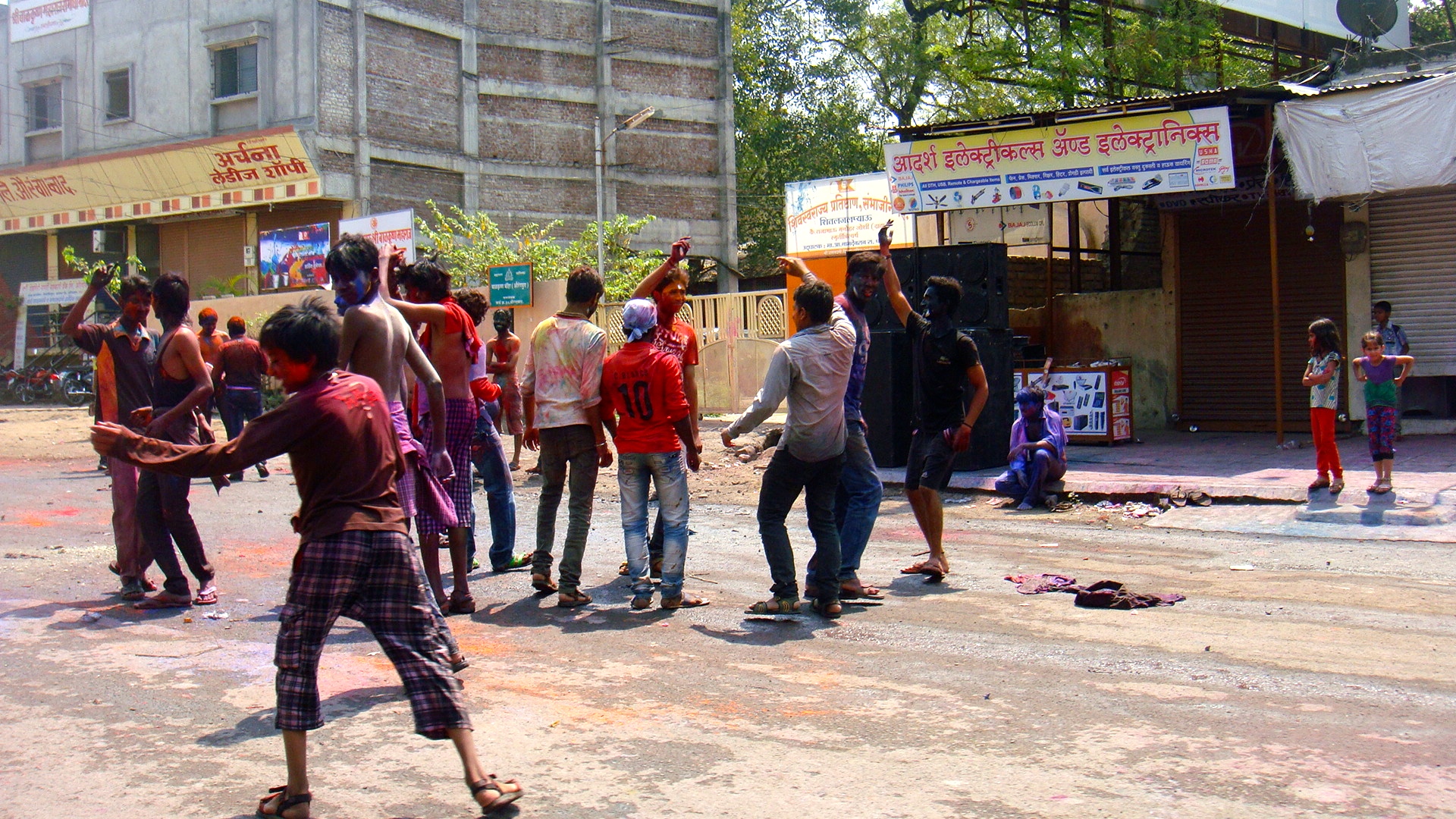
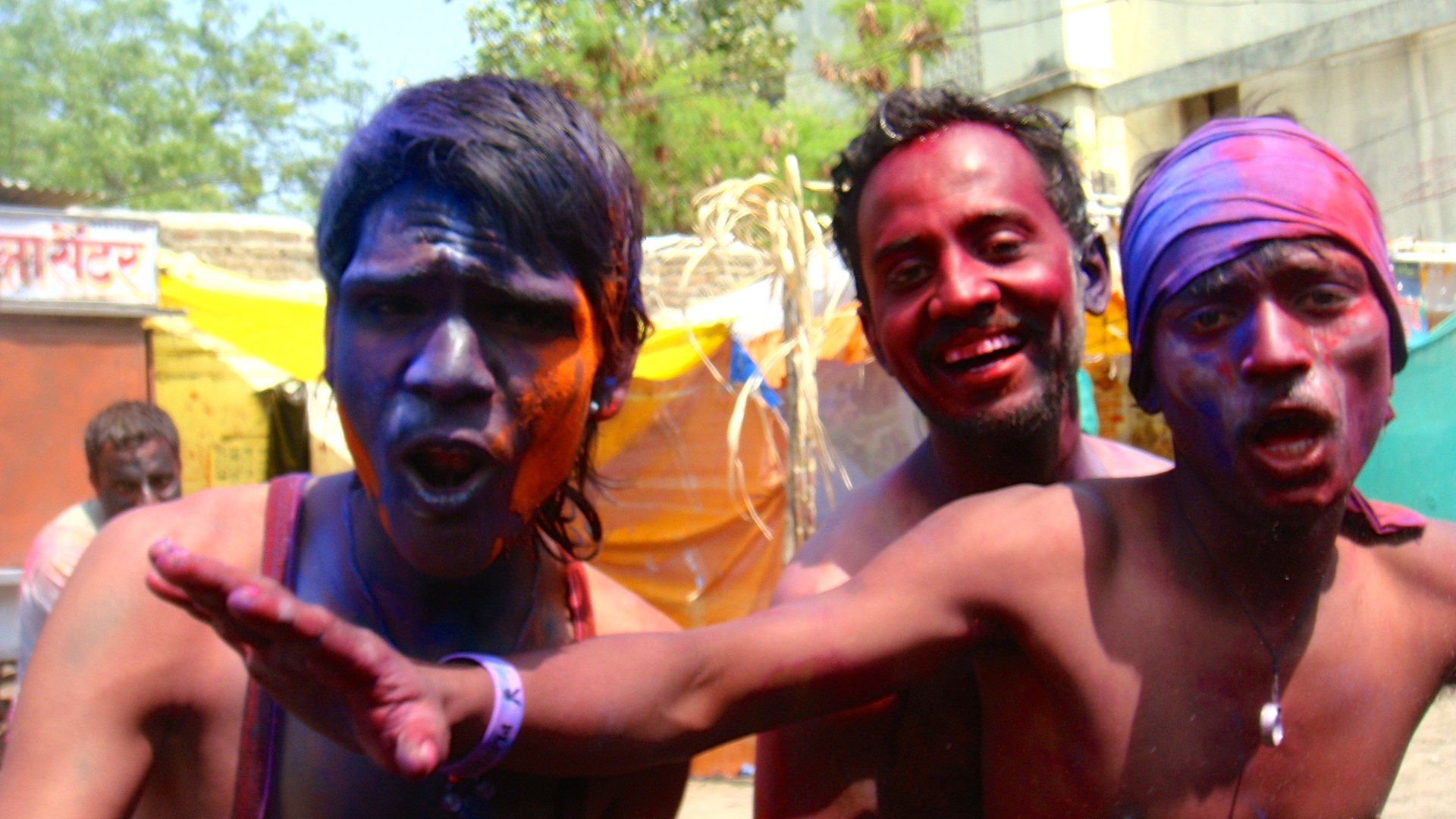
Families get in on the act too:
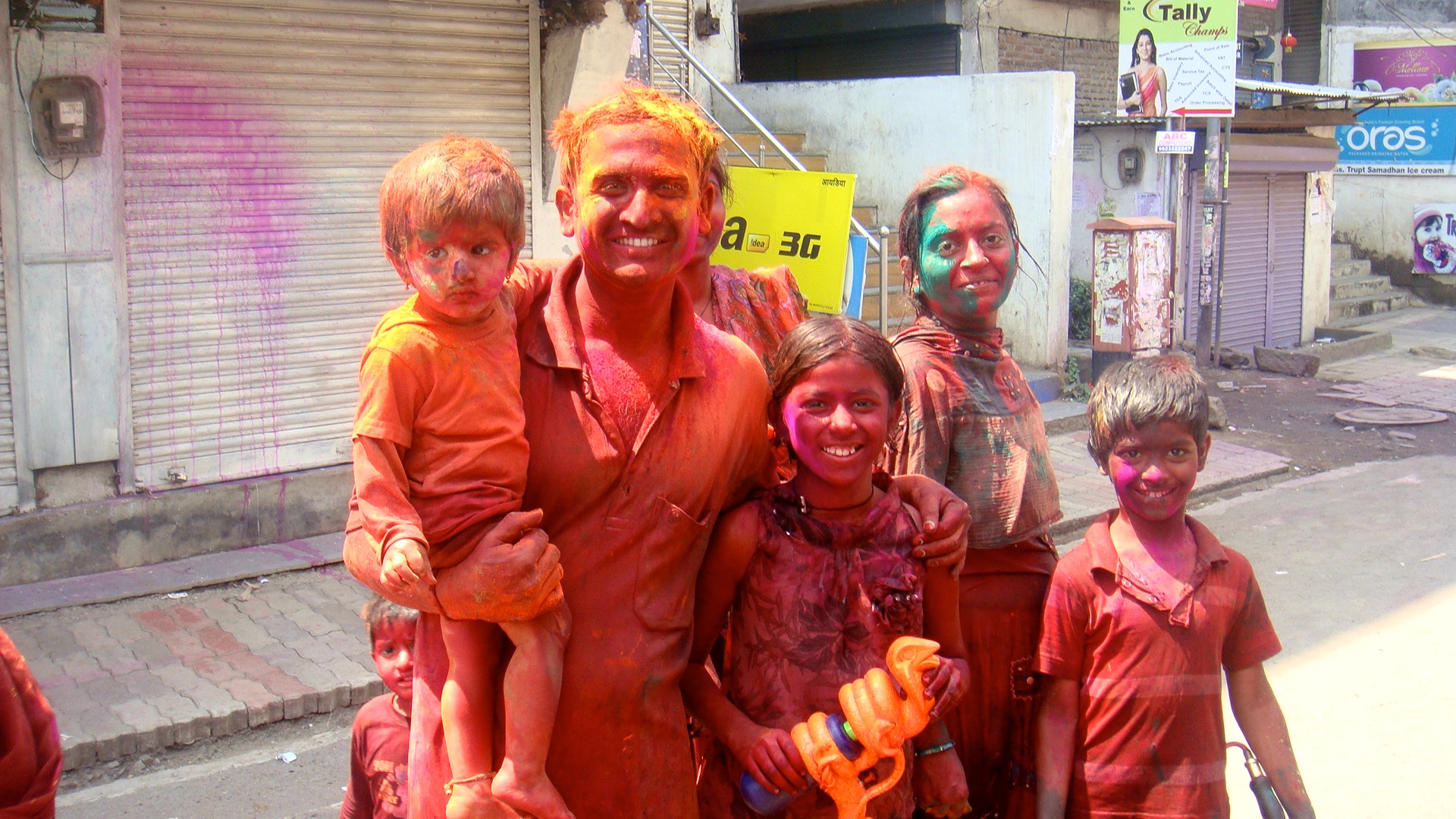
Then everyone gets on their bikes and heads off to the next gathering:

We didn’t escape unscathed:
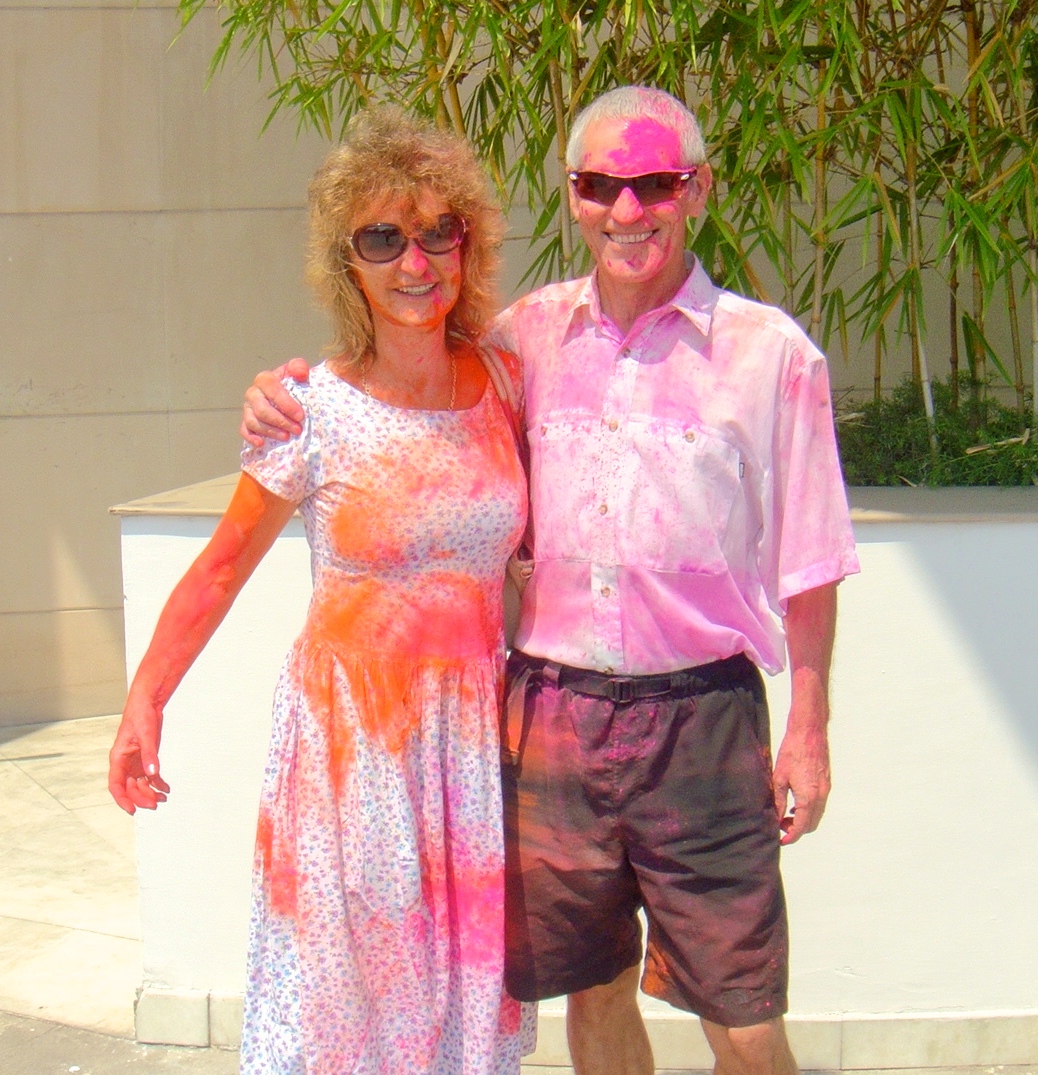 but it was fun!
Anyway – the caves. The reality is that the caves are not caves at all, they were all cut from solid cliffs at various times from 2,000BC to around 1,500AD.
Our first visit was to Ajanta, Ajanta has thirty caves set around the outside of a horseshoe bend of a beautiful valley. It seems the adage “Location, location, location” applied two thousand years ago:
 Viewpoint high above the caves.
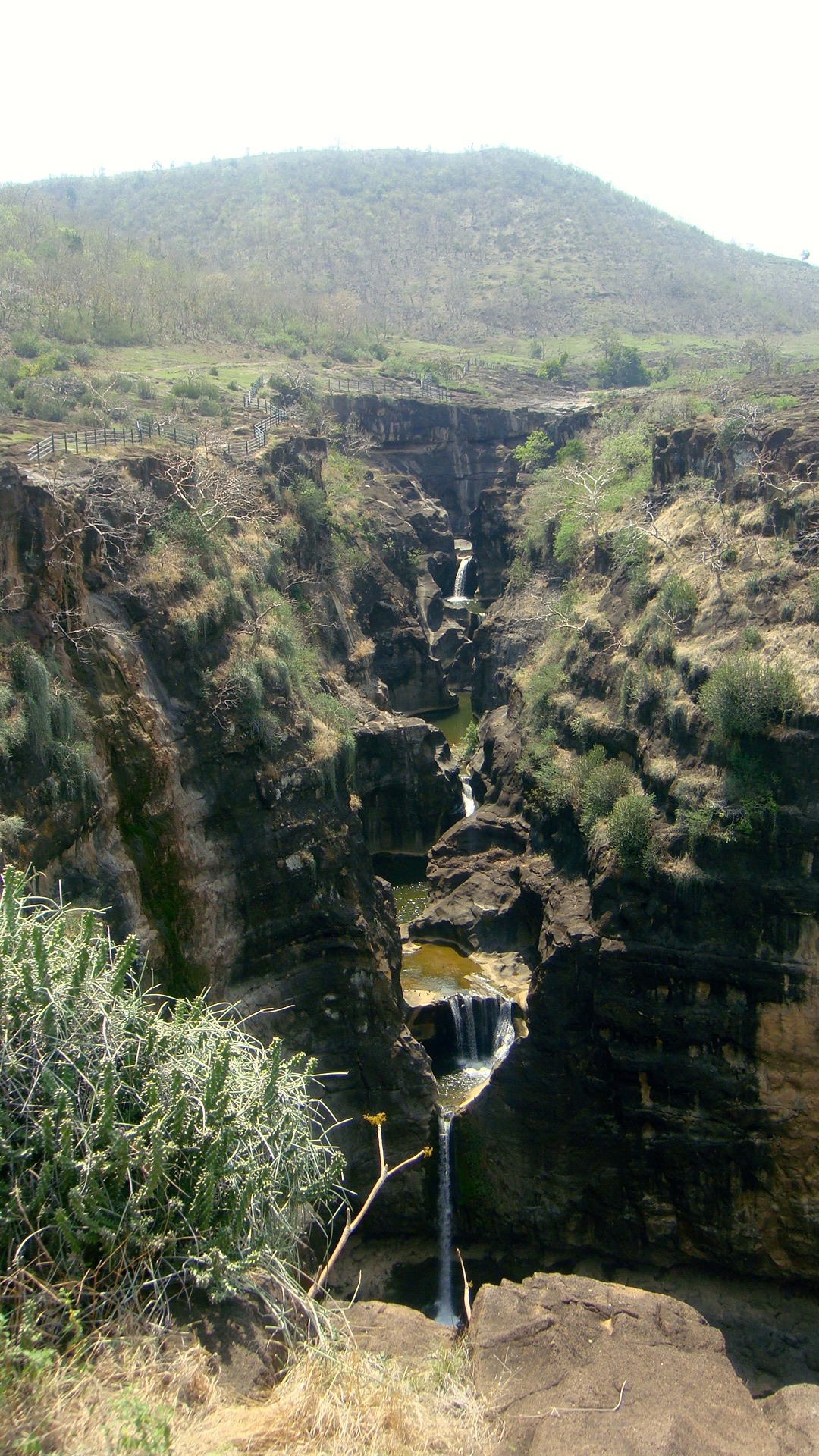
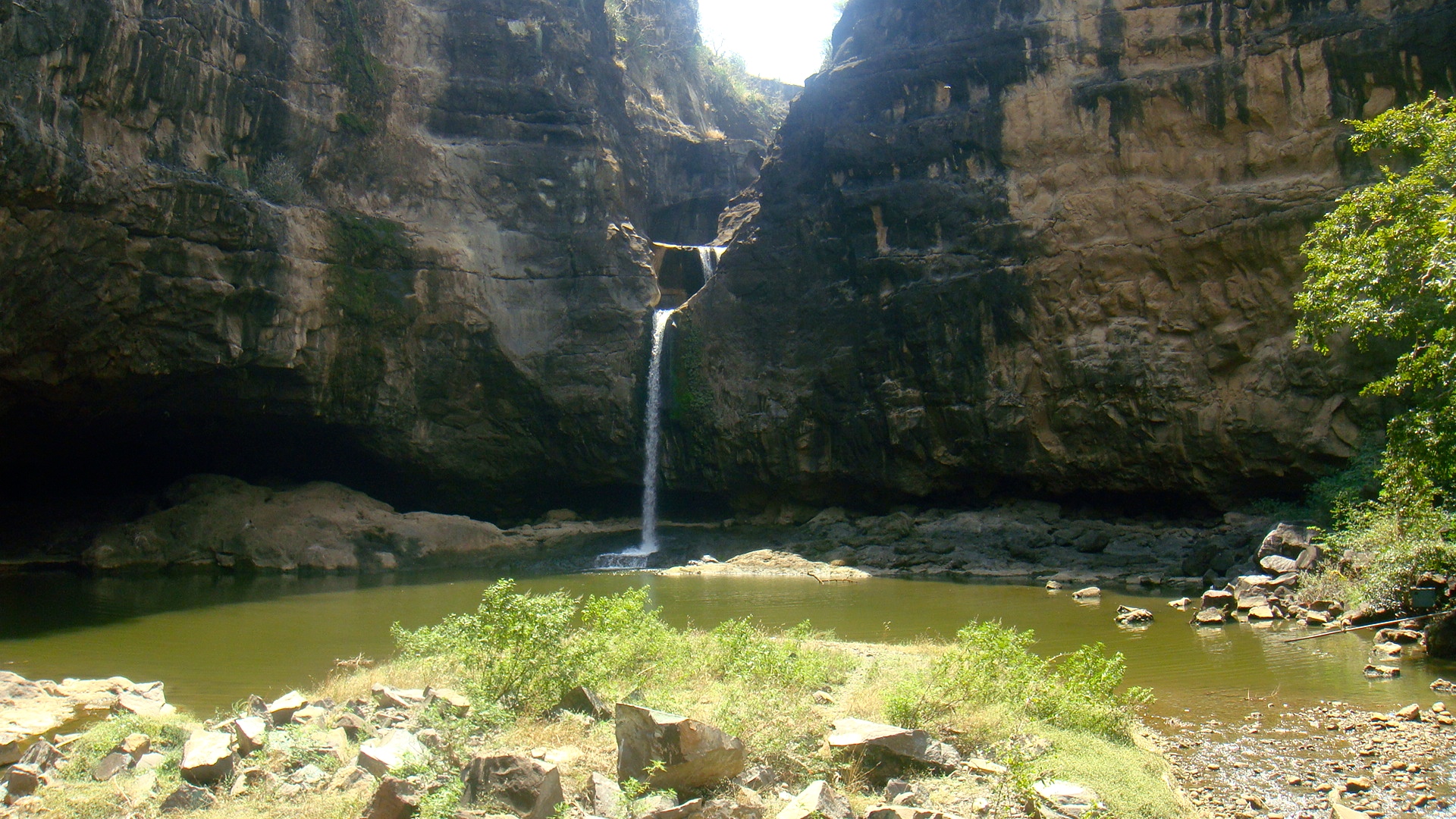
The Waghora stream in the valley is fed from a seven drop waterfall just upstream:
 The caves
The Ajanta caves were excavated in two distinct phases, six around 1,500BC and the remaining twenty four in a burst of activity from 450AD to 550AD. The caves were used by Buddhist monks for their annual retreat during the rainy season.
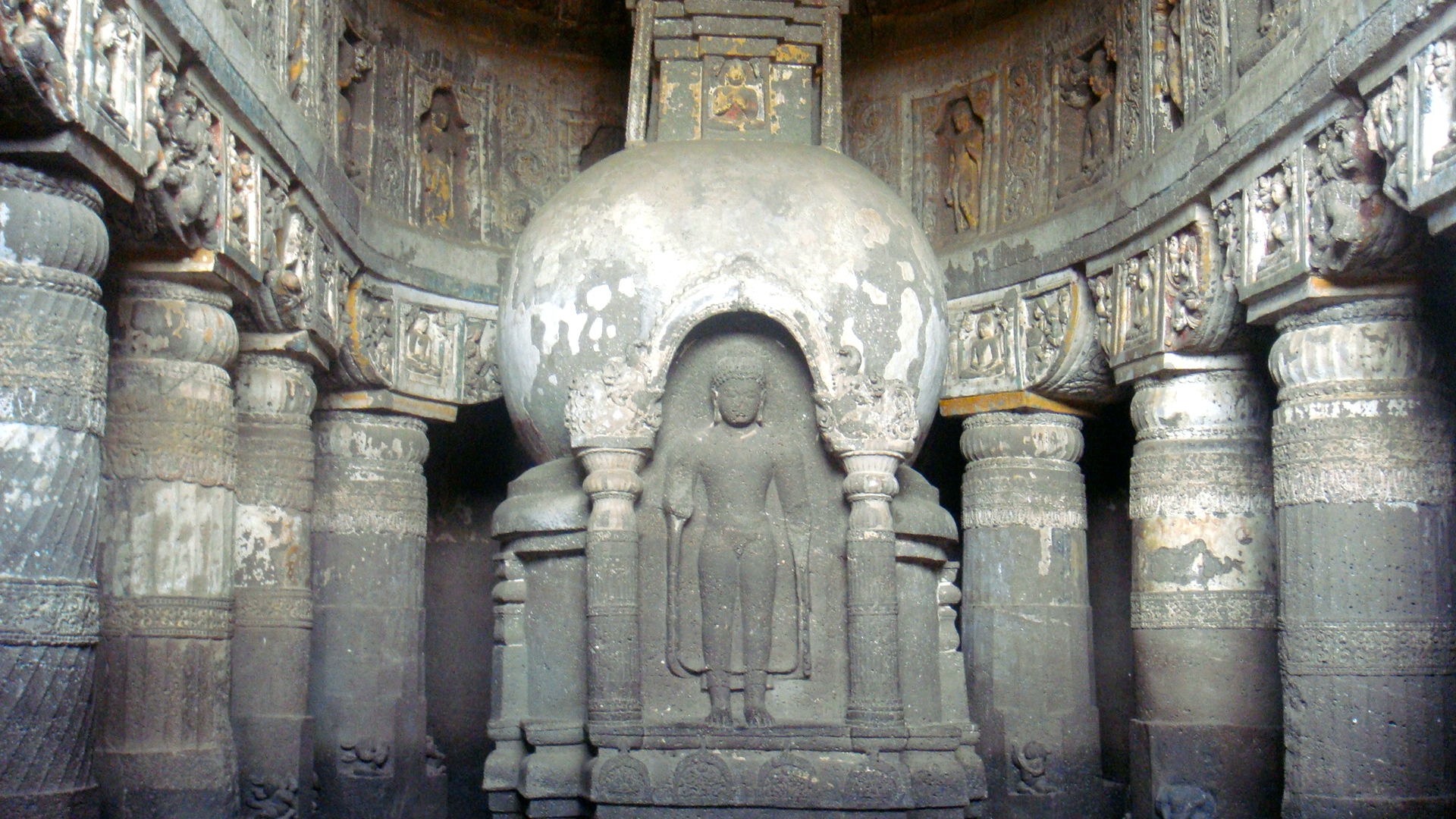
The caves were cut from the ceiling down to the floor and carved and dressed as the excavation progressed, everything is cut from the solid rock and sculpted in situ:
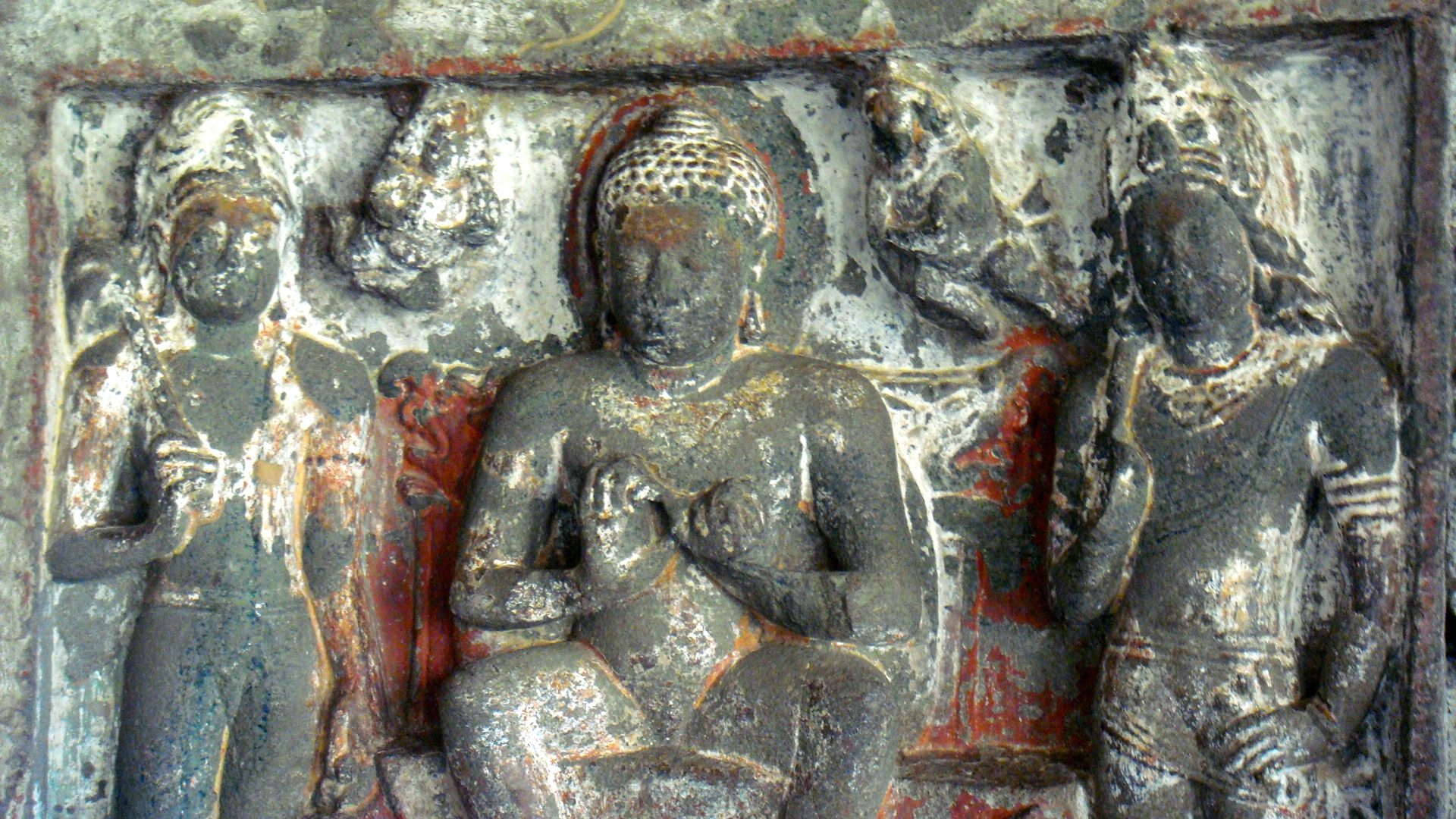
Ajanta is most famed for it’s paintings, difficult to get good shots because flash photography is not permitted but these shots give some idea of the quality of the work:
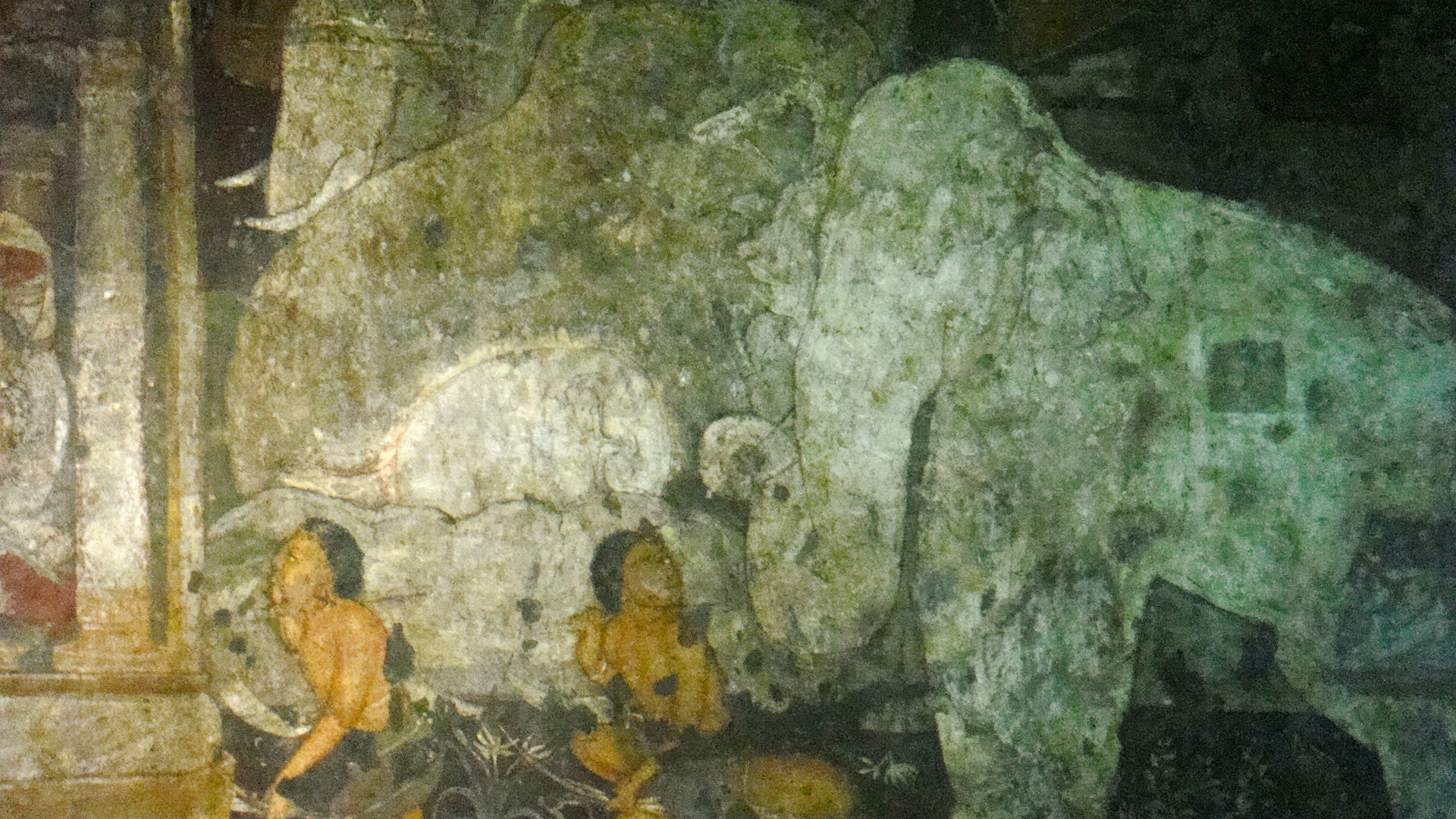


Ajanta – 10 out of 10!
The next day we went to Ellora. On the way we passed Daulatabad and it’s impressive fort. The picture shows the rows of fortifications and the virtually impregnable fortress set high on a rocky outcrop:
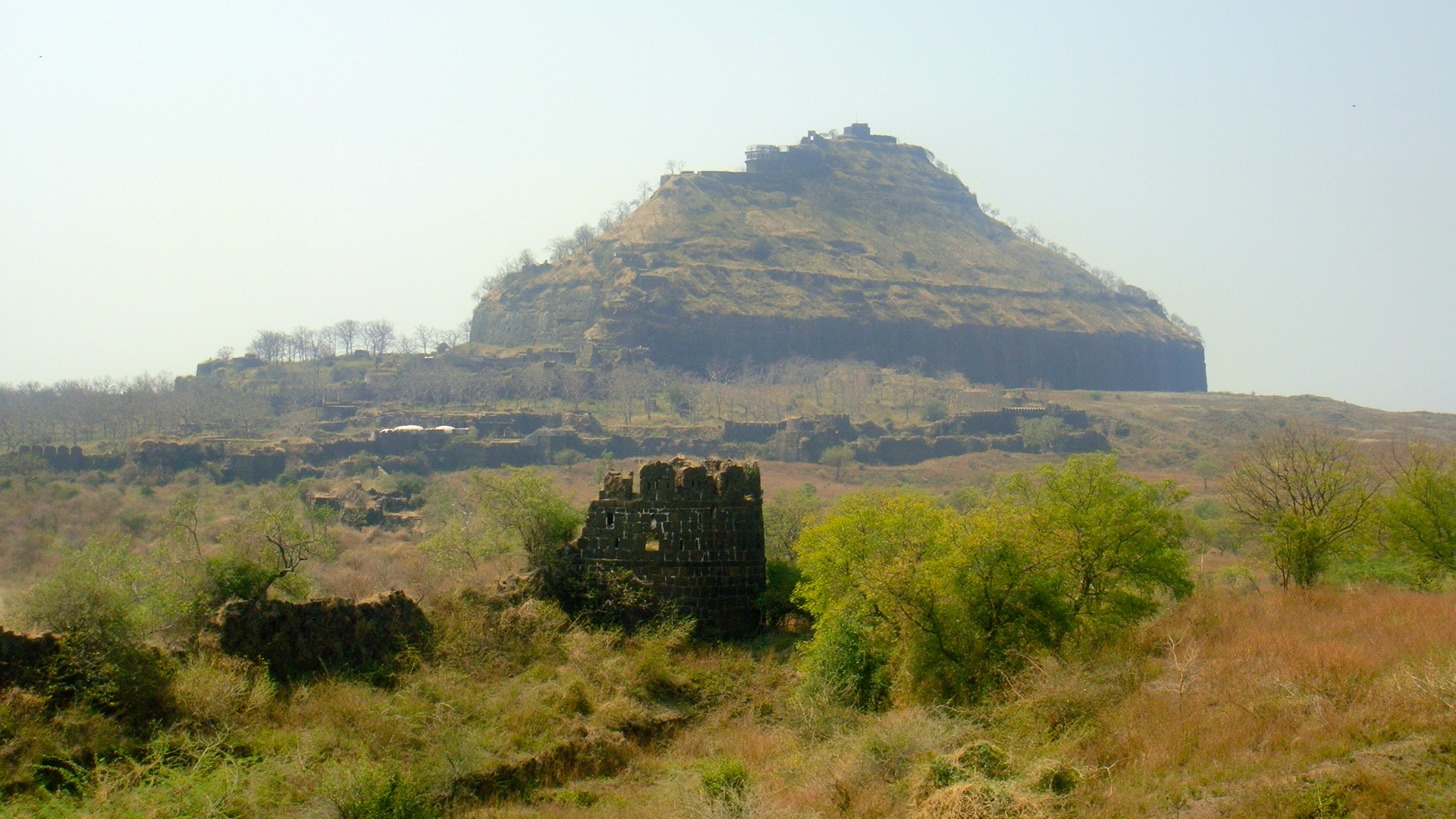
The steep vertical sides are not natural, the rock was cut away to improve the defences.
The fort was actually not impregnable and in the early 1,300’s was taken by Qutb-ud-din Mubarak Shah Khilji who was soon succeeded by Muhammad-bin-Tughluq. Up to this time the town and fort had been known as Deogiri. Muhammad-bin-Tughluq renamed the town as Daulatabad and in 1328 moved the capital from Delhi. Moving the capital proved to be hugely unpopular and was soon reversed, the only thing that stuck was the name. But Daulatabd had it’s few years of fame as the capital of India!
Ellora was very different to Ajanta. The location is not so attractive (how could it be?) and the scale is bigger. Ellora is also much more recent having been carved between the 5th and the 15th centuries AD. Ellora has thirty four caves, caves 1-12 are Buddhist caves, caves 13-29 are Hindu (Brahmanism) and caves 30-34 Jain.
The nearest cave to the entrance is cave 16, this is actually not a cave but rather a massive temple hewn from the rock. The scale of the temple is breathtaking:
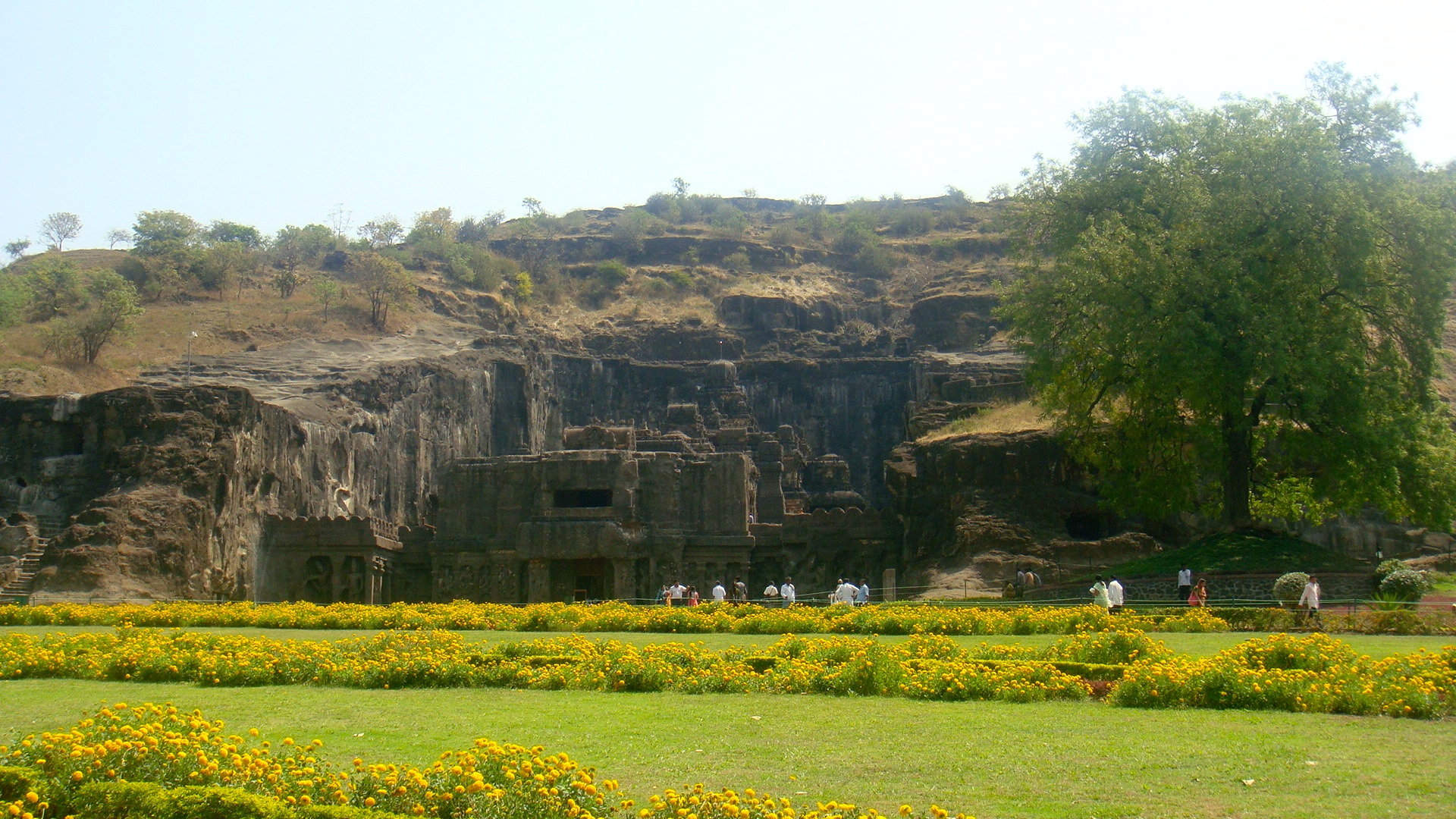
but perhaps only apparent with something to compare to, look for the person in red in the centre of the photo below:

Some caves were huge, this was dormitories:

and this a meeting room:
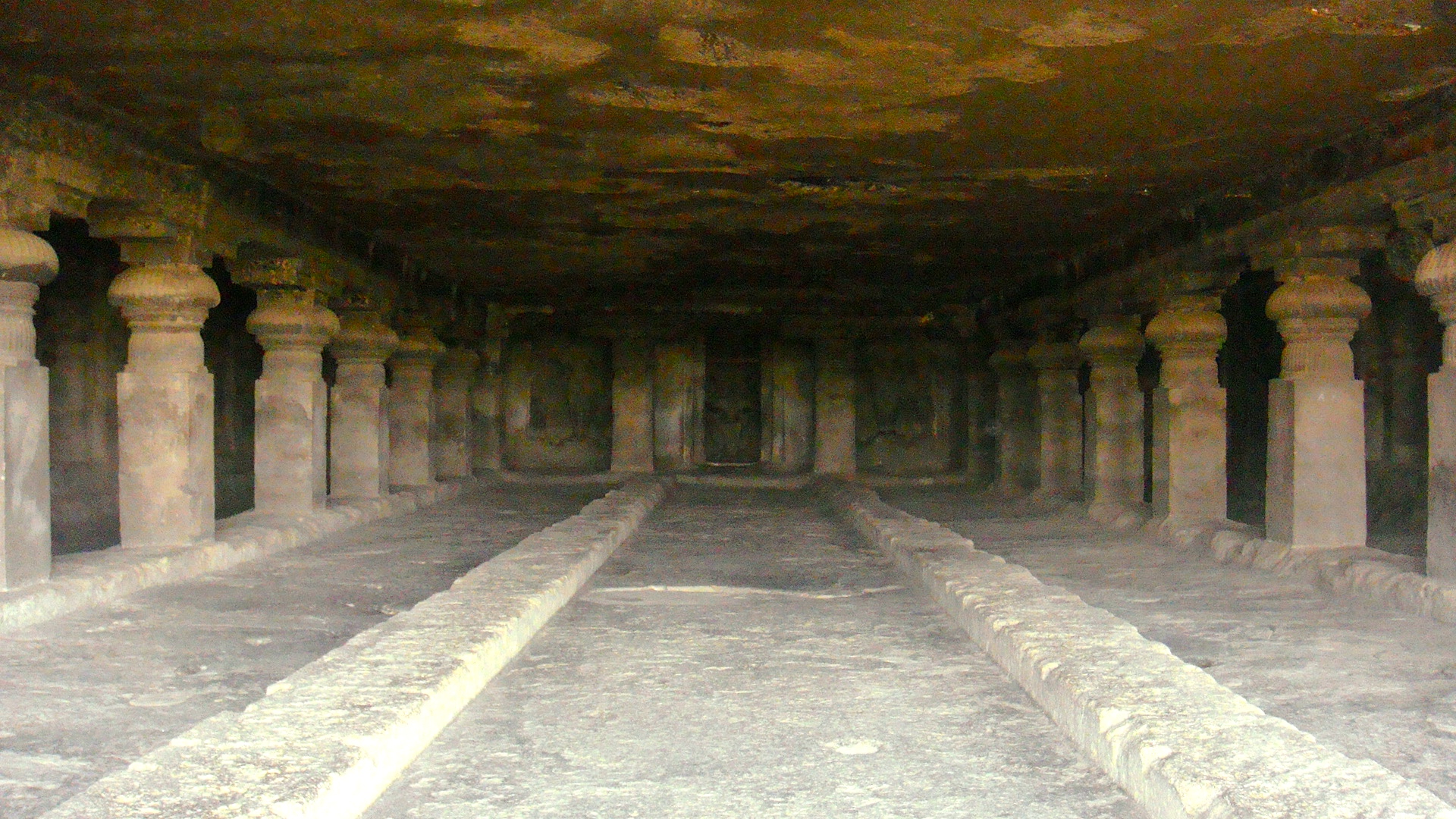
Some were small and intimate:

The Ellora caves are also famous for their art, we loved the paintings in the Jain temple (cave 32):
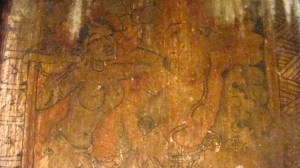

Several other caves also had wonderful paintings:
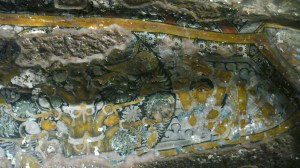
and great colours:
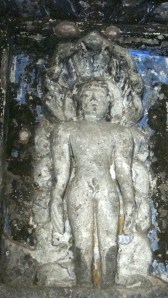
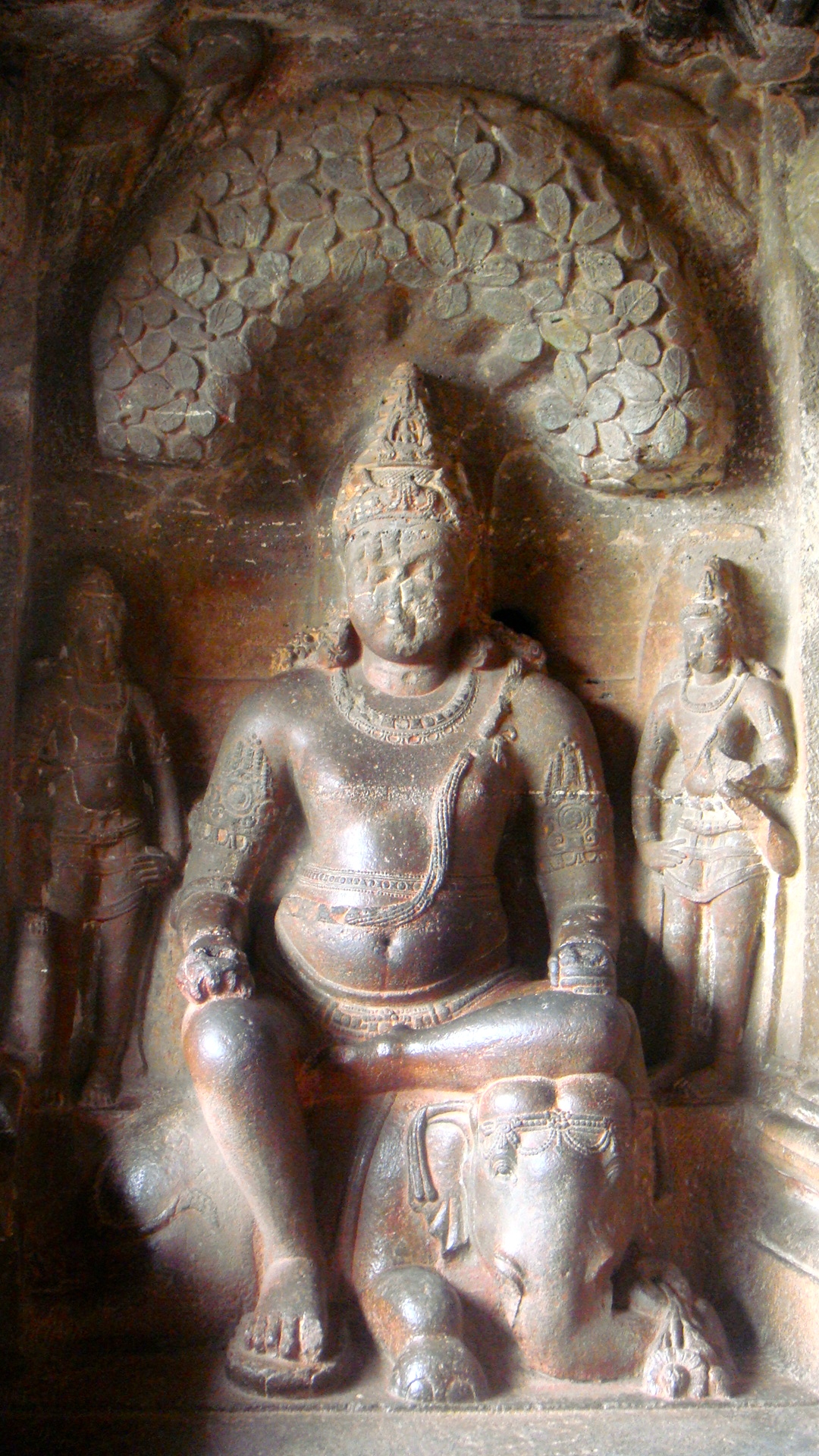
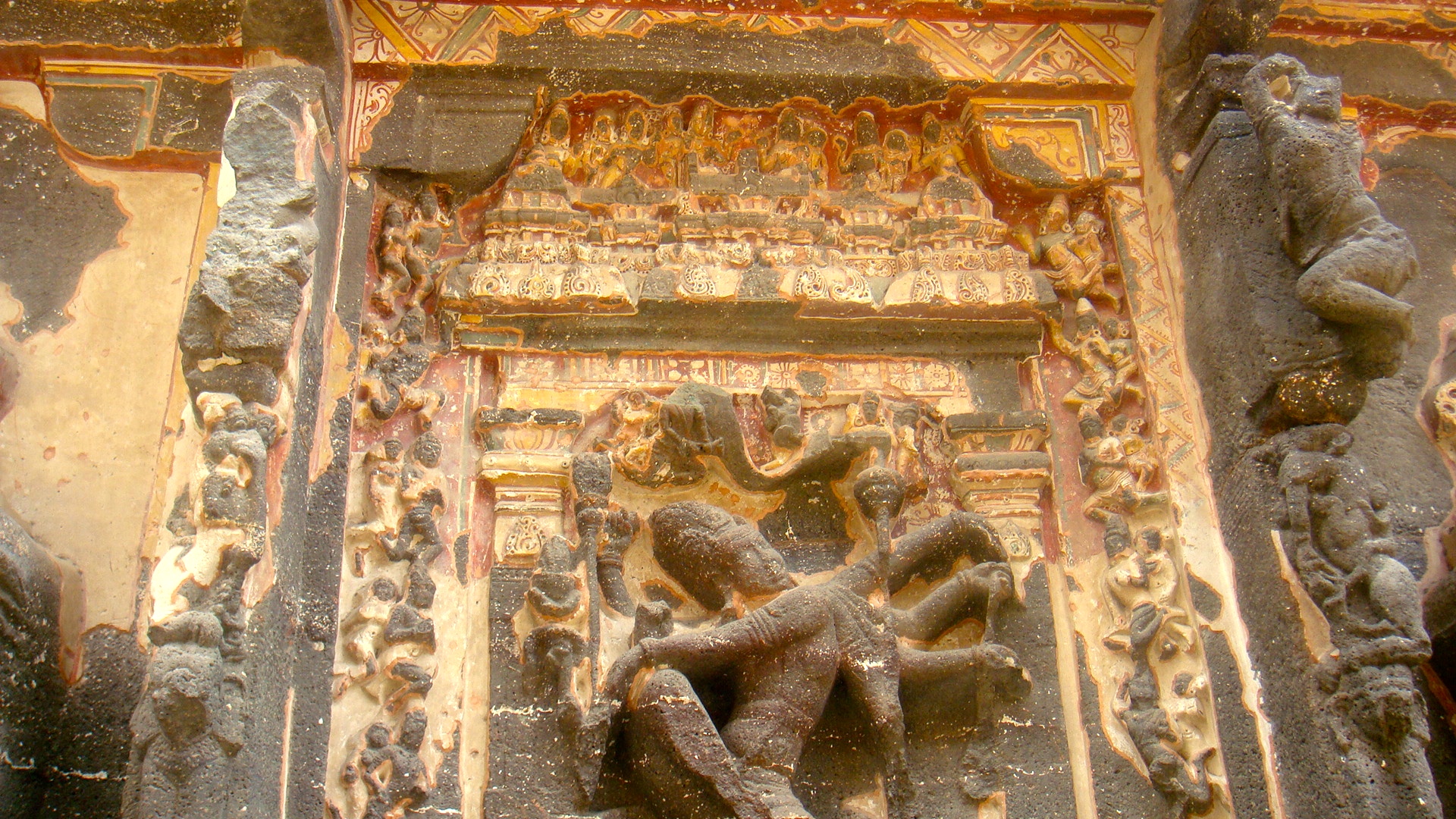
There were interesting carvings:

and well preserved sculptures:
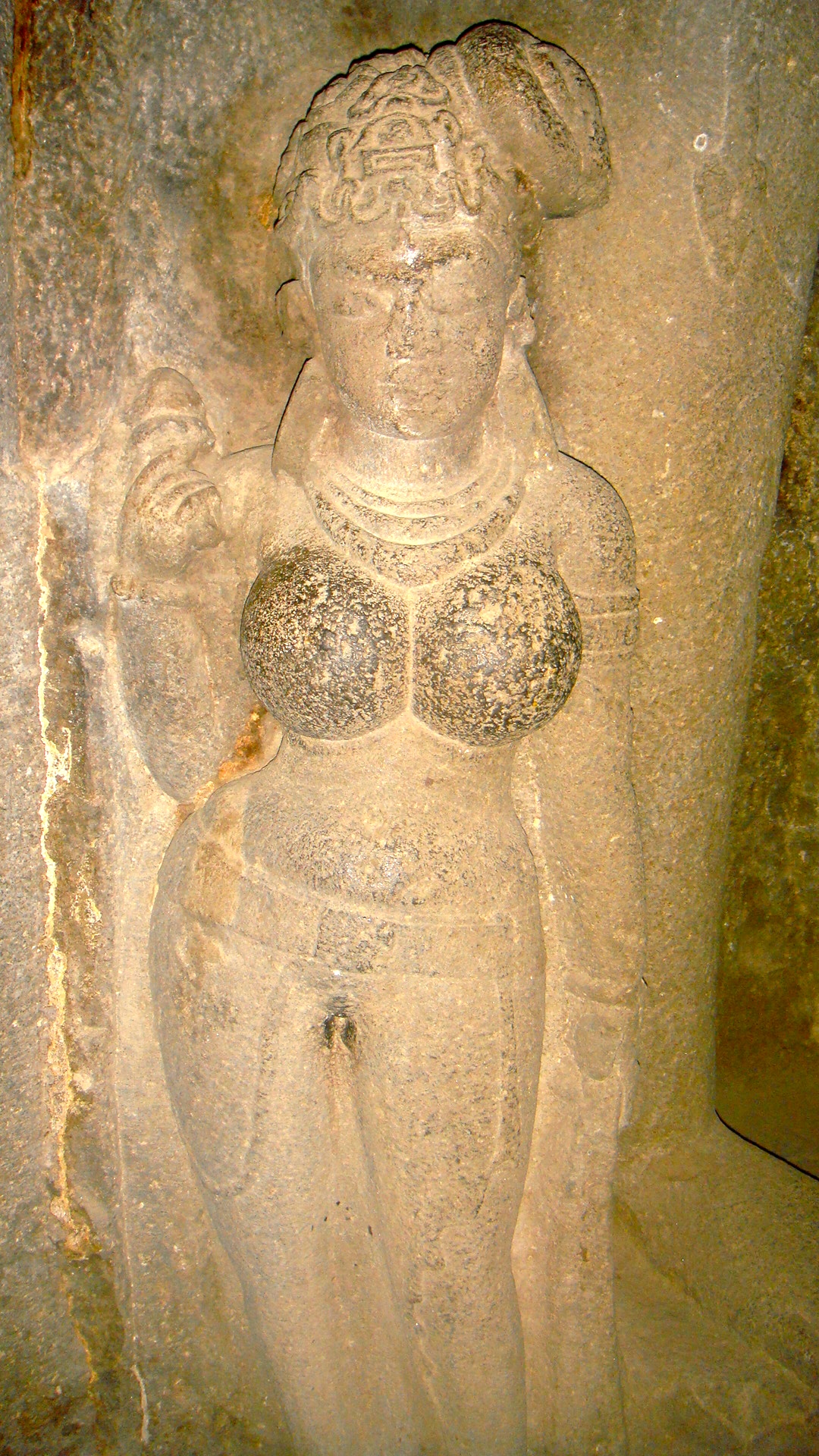



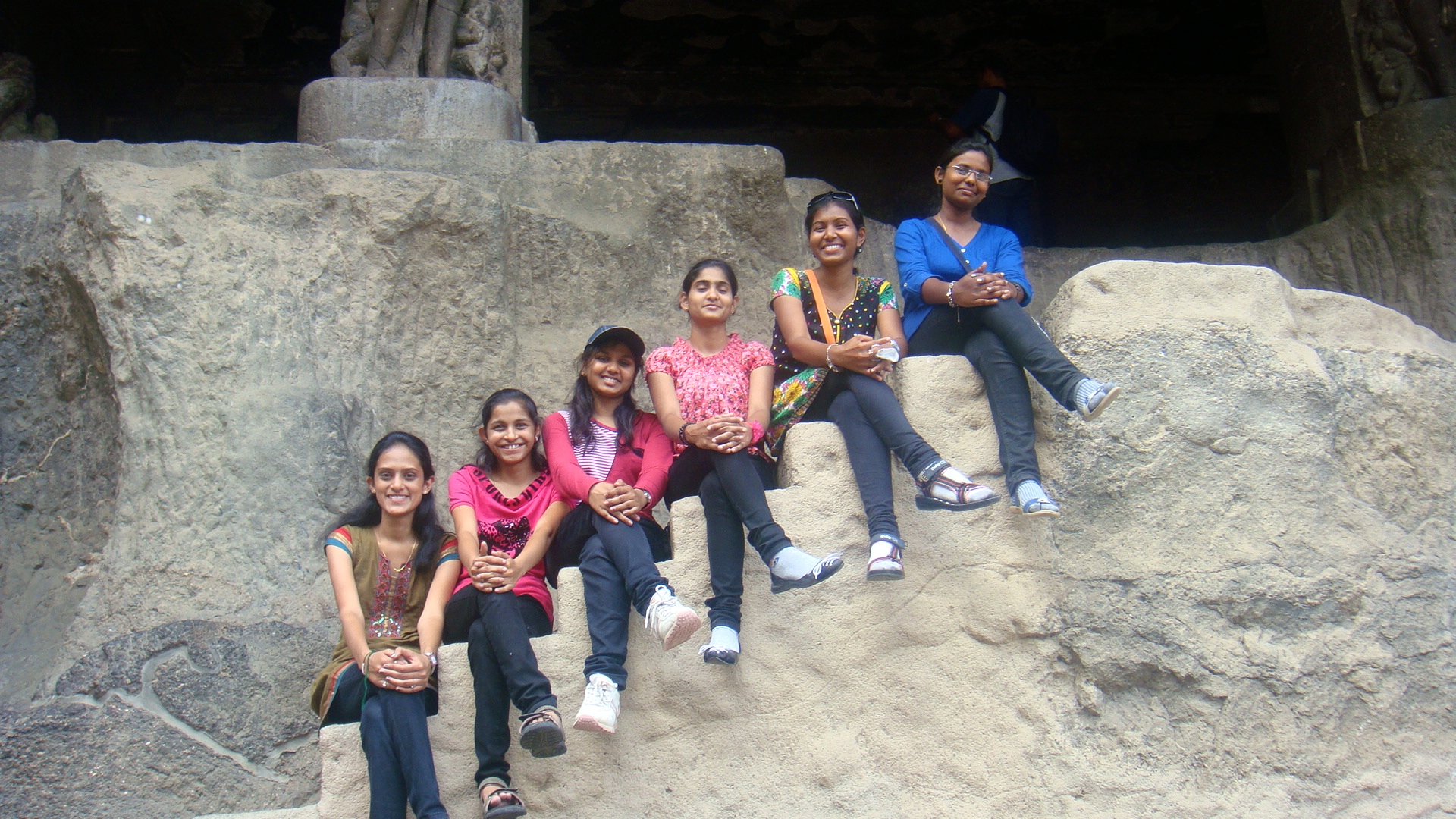
There were some very attractive visitors:
and some not so attractive residents:

We would have given Ellora 10/10 but sadly the Indian scourge is rife here. Some of my Indian friends may disagree with me (and I’d love to hear other perspectives) but in my reality India is littered with rubbish. Most people throw their rubbish away the moment it becomes rubbish regardless of where they are. The average person won’t walk ten feet to a bin to throw away a wrapper, they just drop it where they stand. We’ve even seen people stop their car on the motorway, open a door and throw out their used fast food containers. We’ve seen people unwrap new purchases and drop all the packaging on the street around their feet. We’ve seen Fathers drop sweet wrappers and then give the sweets to their children – quite a message. People here keep their houses and their own few square feet clean but are happy to turn the rest of the country into a rubbish tip. This truly is the tragedy of the commons.
Sadly most of the World heritage sites we have visited have been strewn with litter (including the Taj Mahal). Ellora was no exception:
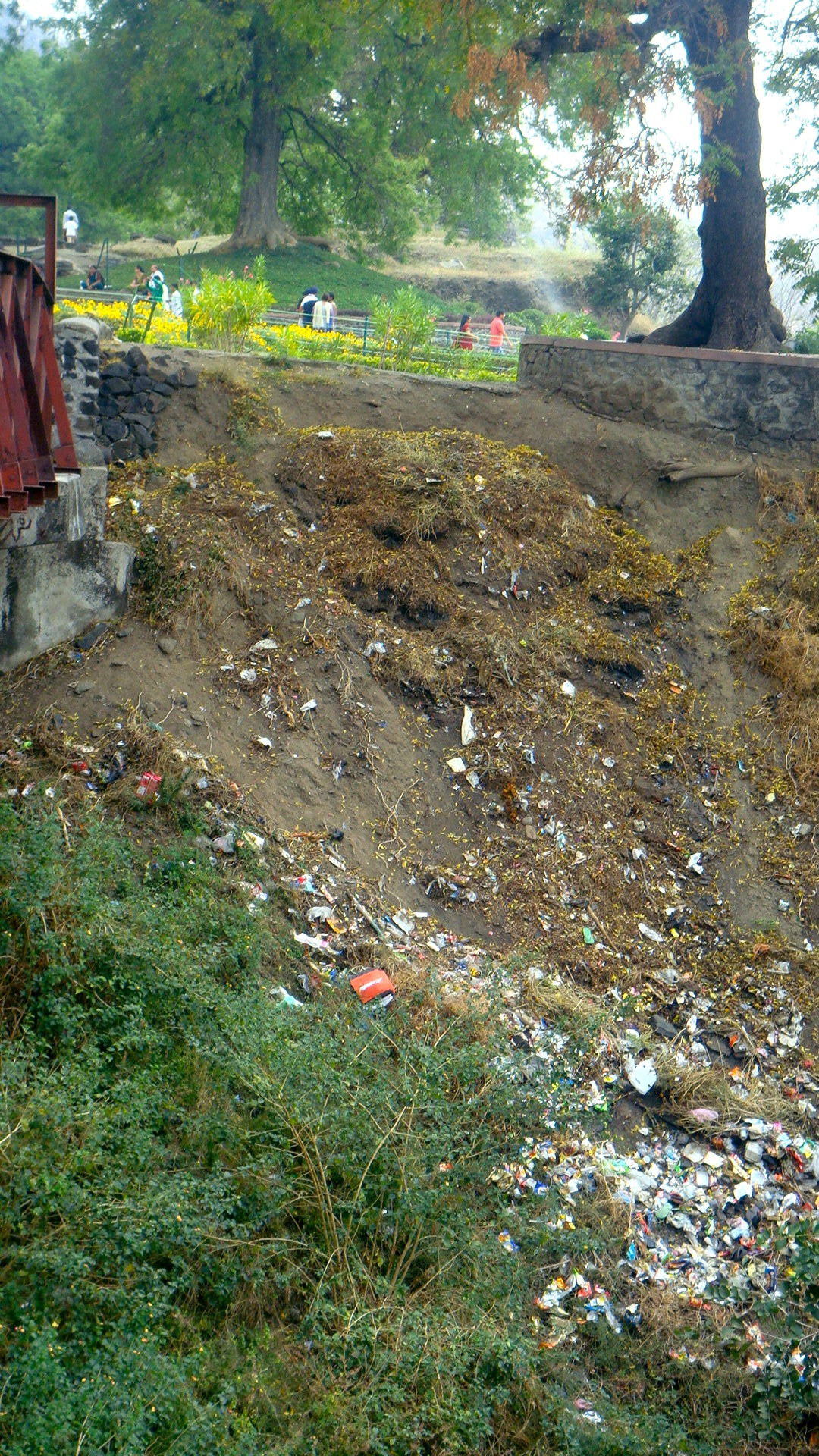
I have asked many Indians about this behaviour, generally they blame the government! The sad fact is that of all the problems India has this one truly is in the hands of the people and individually and collectively they could fix it. Unfortunately I don’t think they even recognise it as a problem. So rant over, Ellora gets a seven!
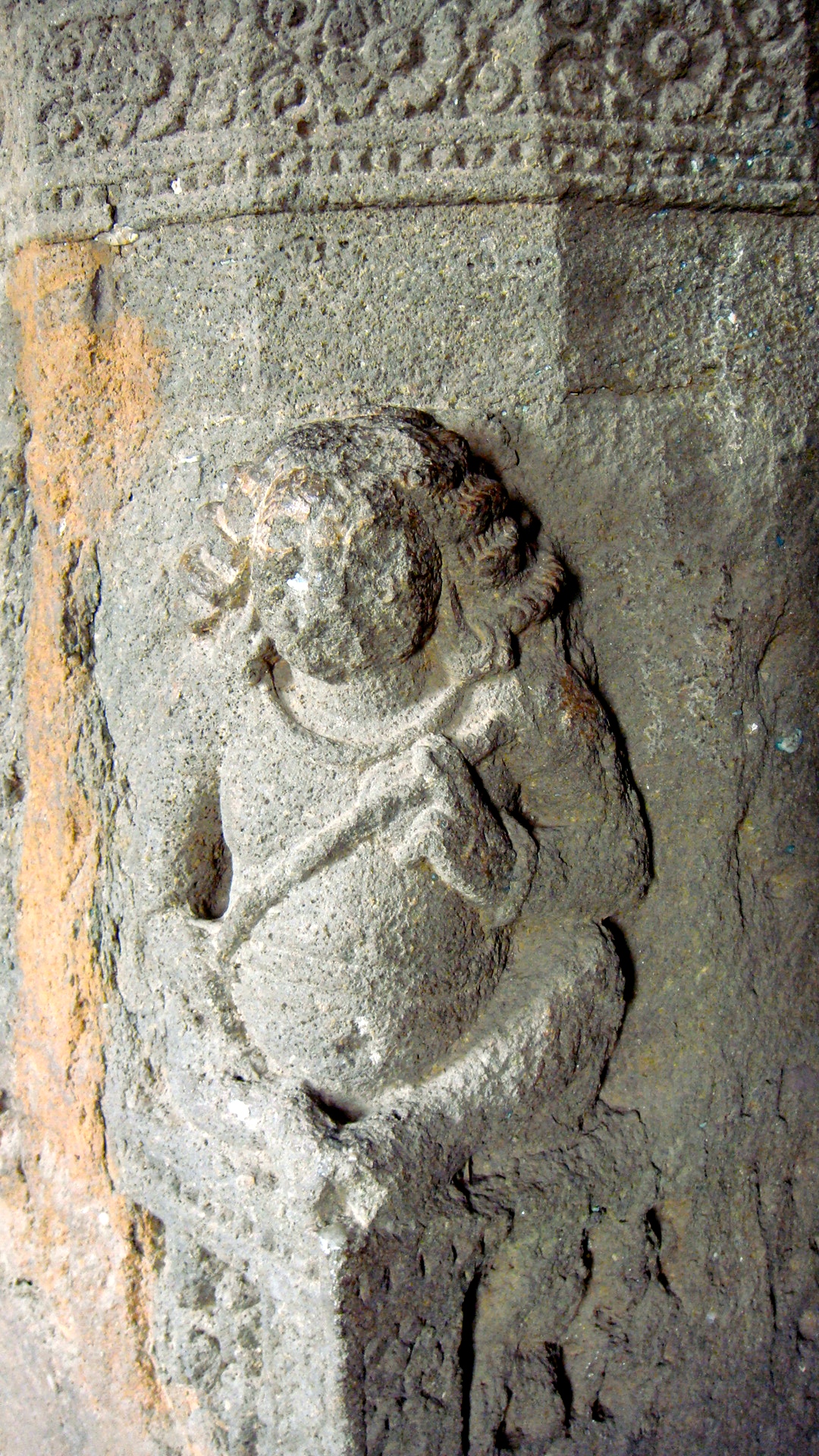
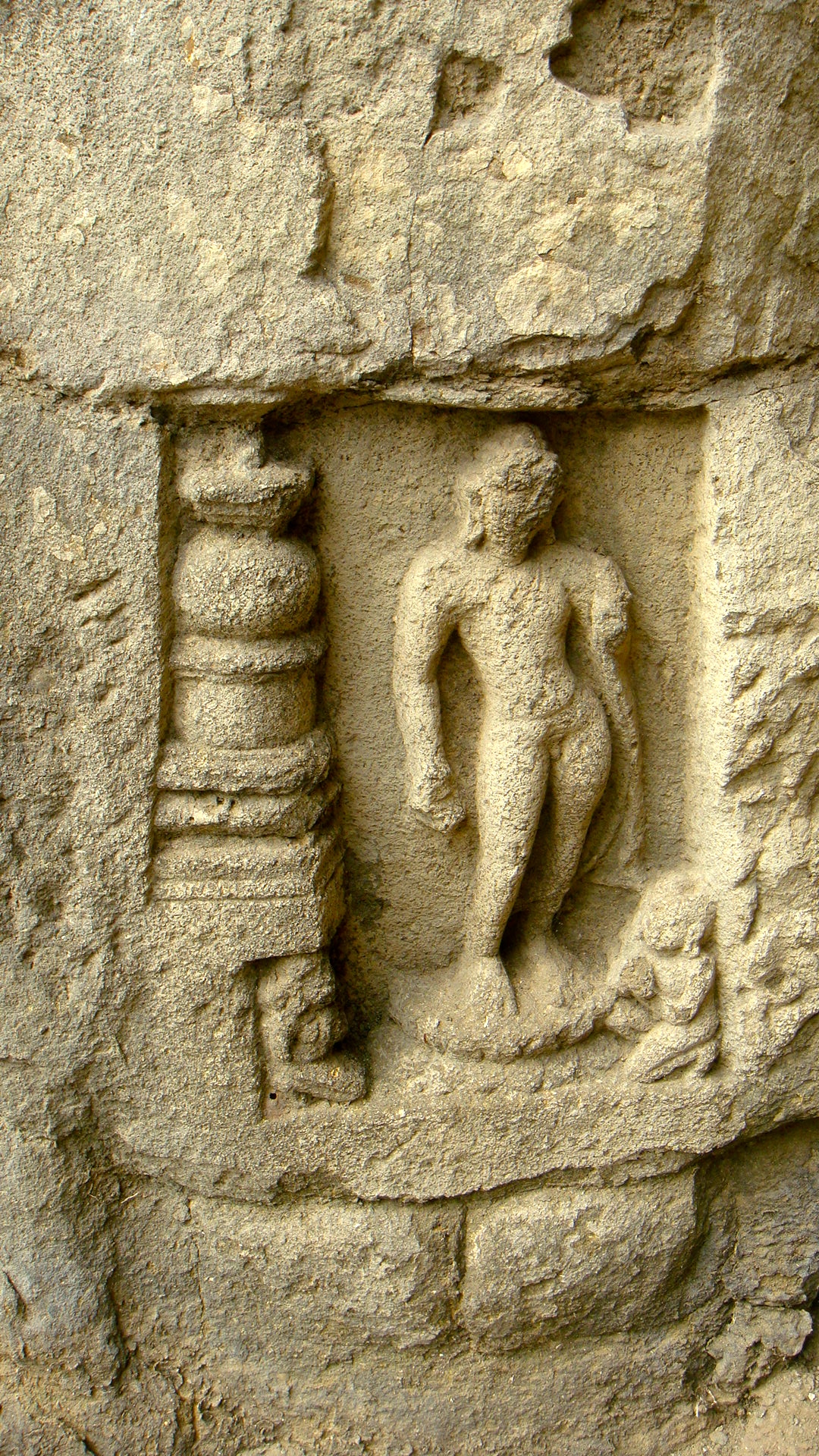
On our final day we went to the Aurangabad caves. There are twelve Buddhist caves dating from the 2nd to the 7th century AD. The caves are smaller in scale and accomplishment than those at Ajanta and Ellora but still interesting:
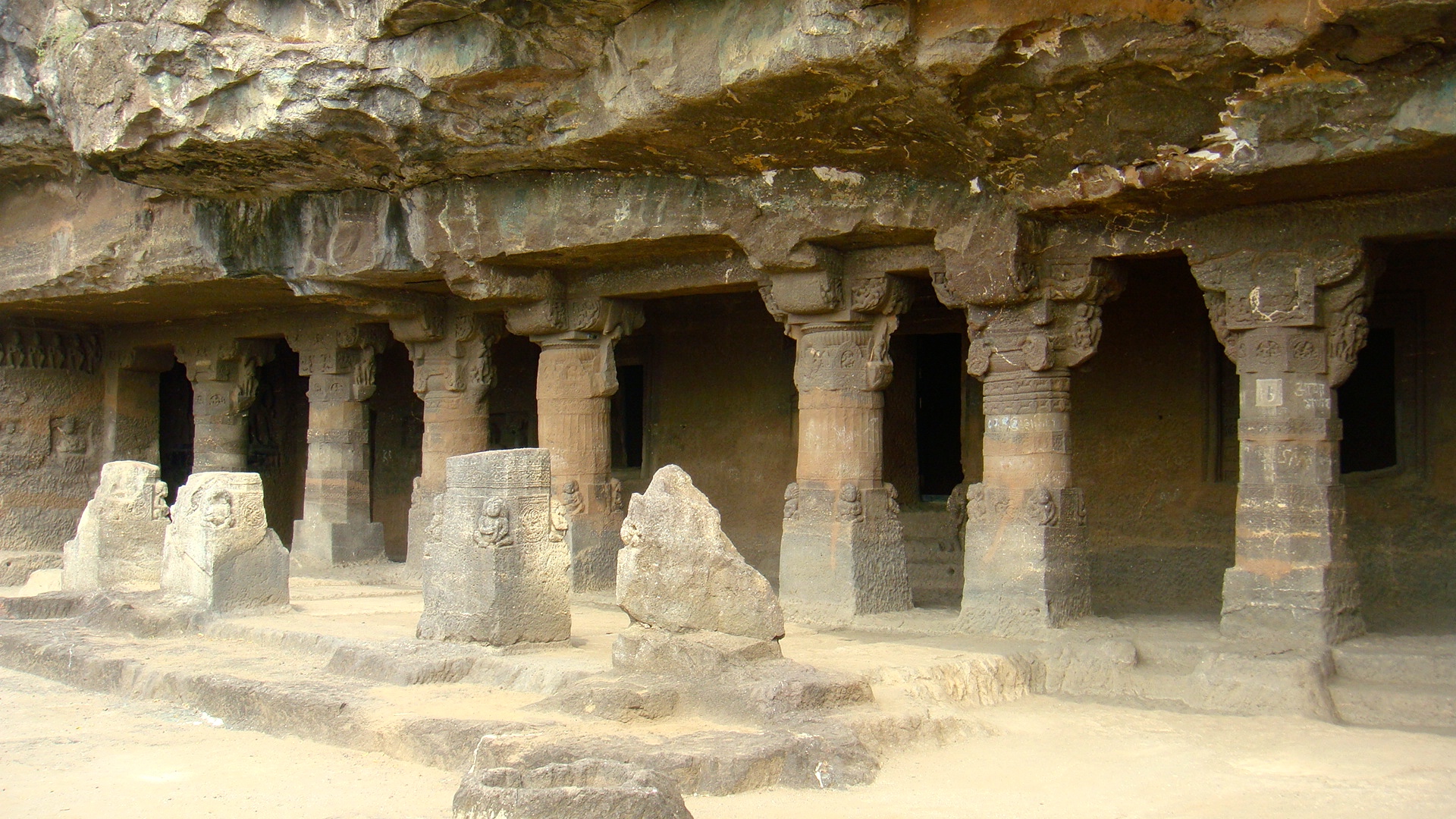 The largest cave
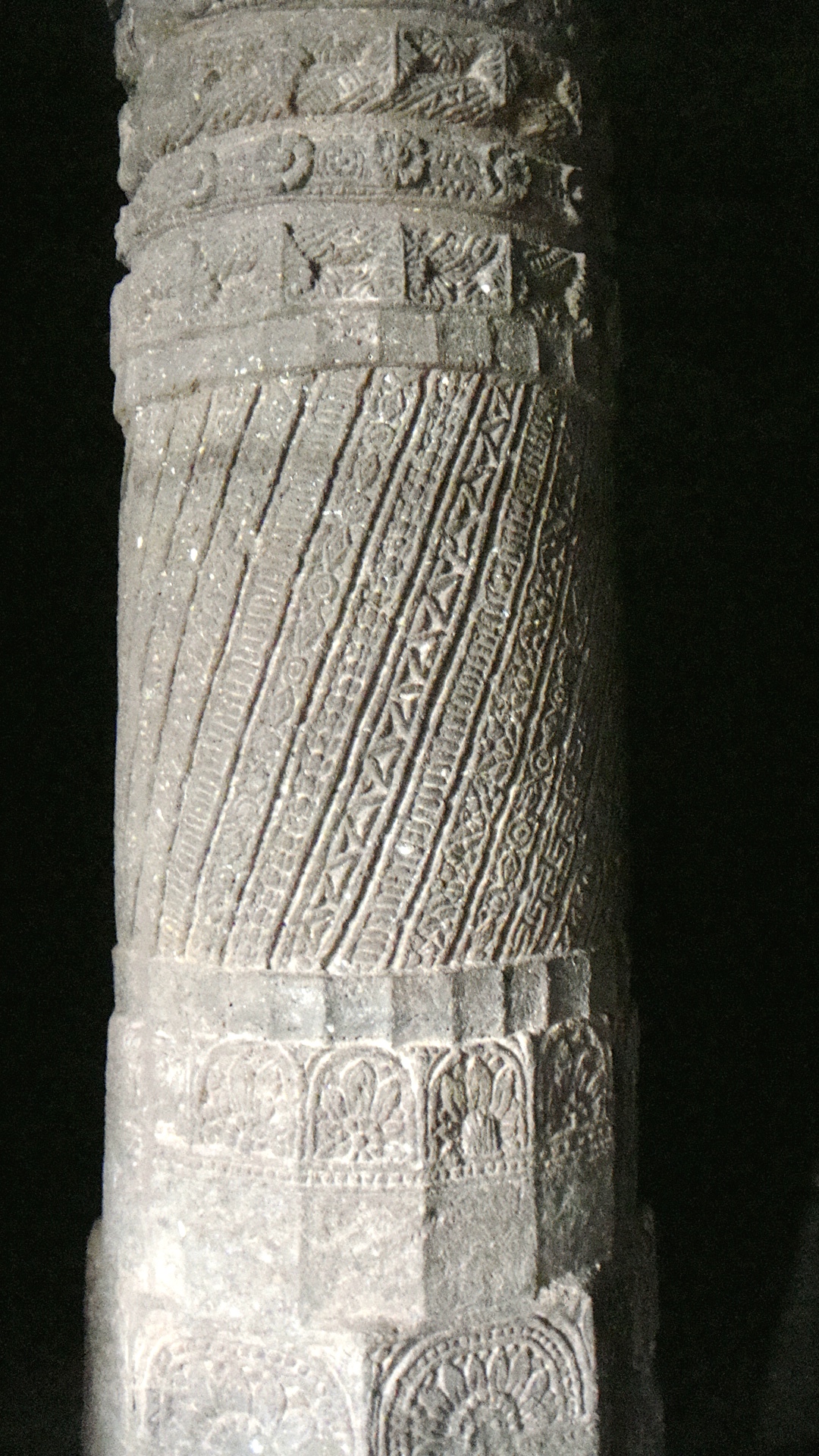 The first helical design we have seen in India
From the caves we went to the Bibi-Ka-Maqbara (“Tomb of the Lady” in Urdu), a mausoleum built between 1650-1657 by Prince Azam Shah, son of the Mughal Emperor Aurangazeb in memory of his mother, Dilras Banu Begum (posthumously known as Rabia-ud-Daurani). The mausoleum is very similar to the Taj Mahal, perhaps not surprising since the Taj Mahal is the mausoleum of the Prince’s Grandmother, Mumtaz Mahal.
 Same shot, different setting!
In a horrific piece of architectural vandalism a mosque was added around one hundred years after the mausoleum was completed. The mosque destroys the original symmetry.
The grave itself is very simple:

The mausoleum was built on a budget but despite that is very beautiful with some splendid water features:

From the mausoleum we could see the Aurangabad caves in the distance:

We spent the rest of the day lazing by the hotel pool. It was in auspicious day – I managed to beat Leishia at backgammon (a very rare event!):

So that’s that, final stop Udaipur then home to see Titch! Time for one more blog? Probably:-)
The route from Hampi to Pune was 570km so we allowed two days. The road was so good that by lunchtime we had already covered 300km so we kept driving and reached Pune before dark (this was our highest daily mileage, our average for the entire trip was running at 280km).
Pune was once a beautiful city but has grown to become something of a mini-Mumbai but without the attractions of Mumbai. We ventured out regardless and went to see the remains of the Shaniwar Wada Palace:
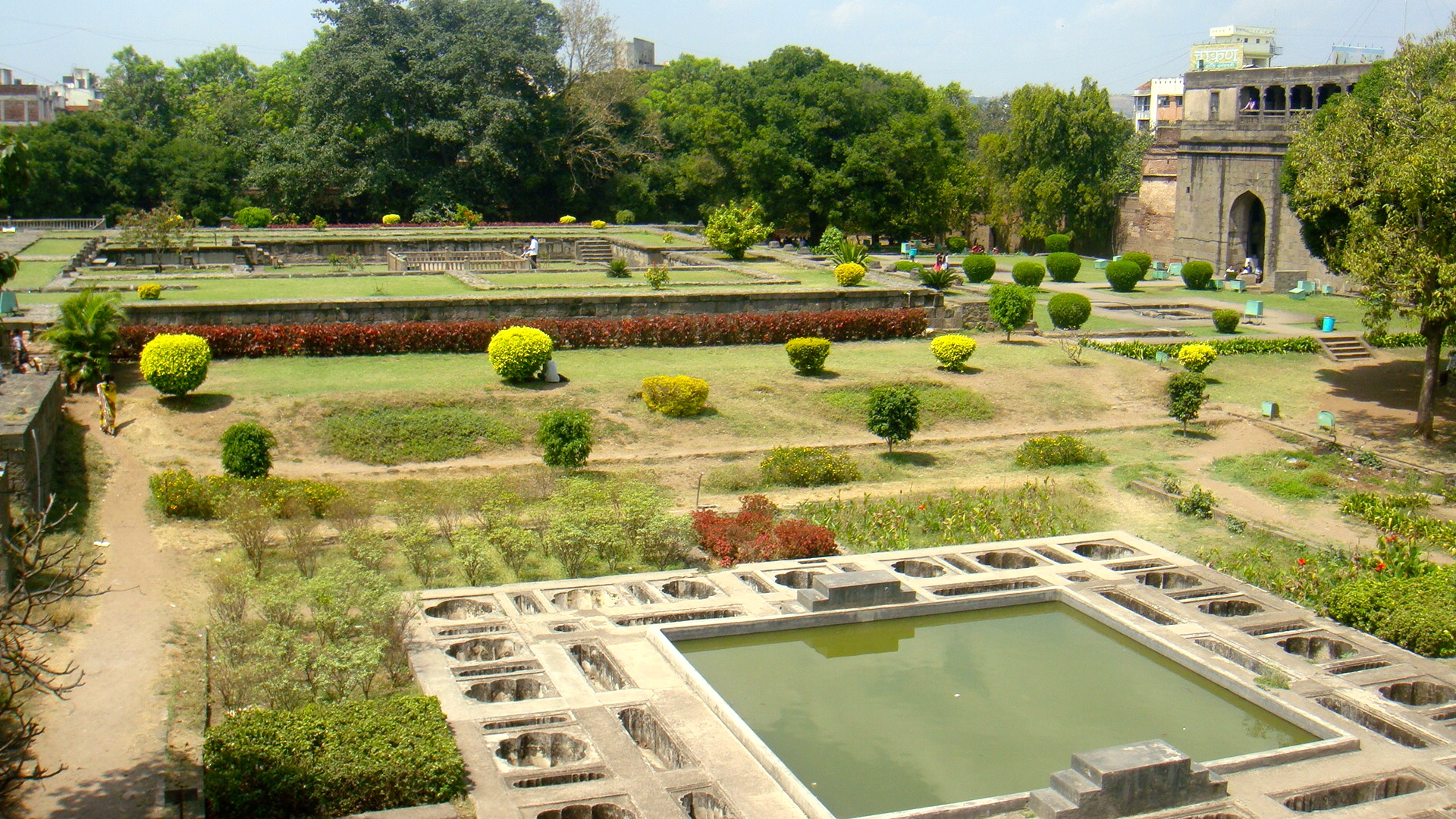
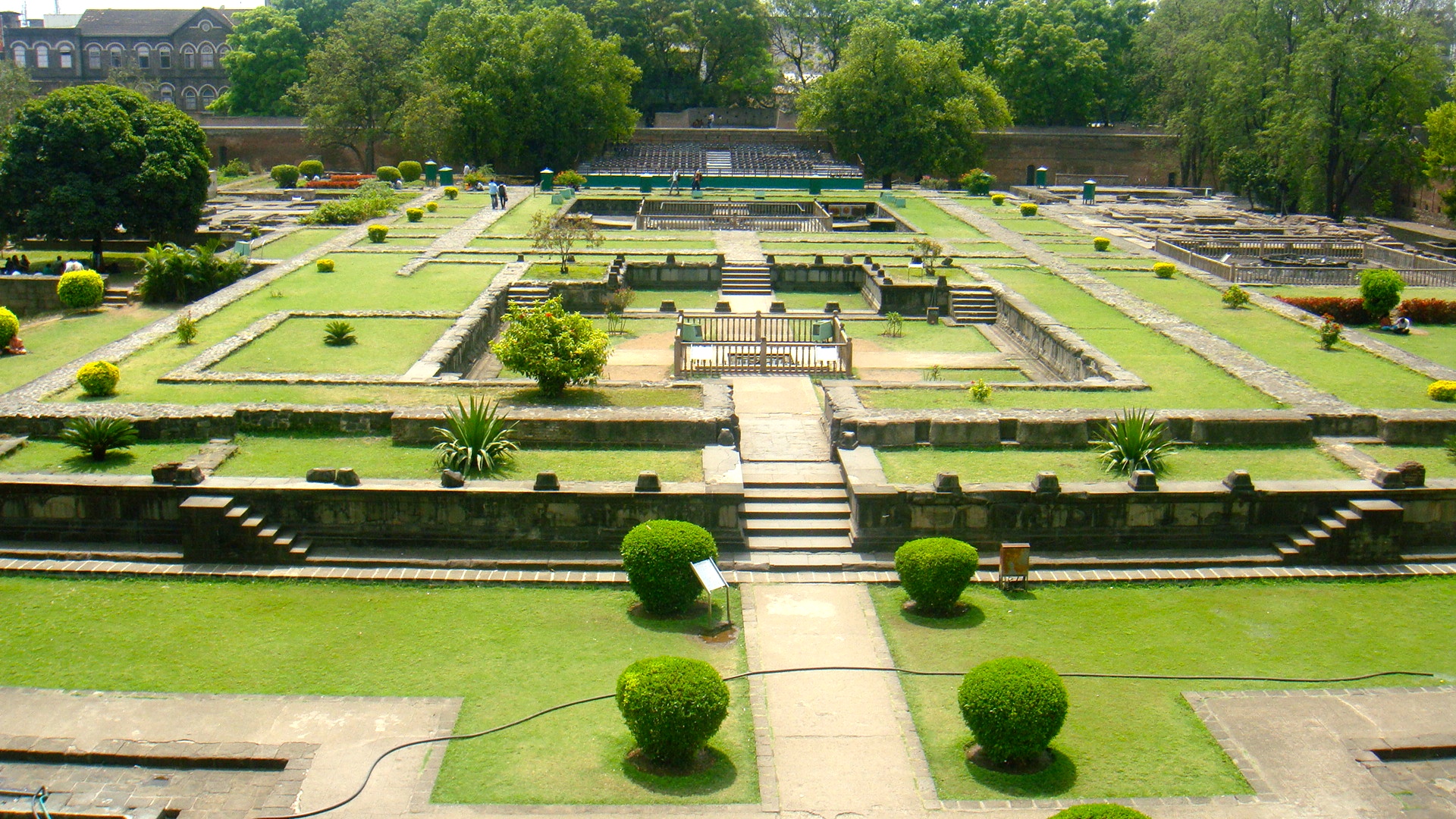
The grounds are something of an oasis in the bustling city, sadly the palace itself burned to the ground in 1828.
After the palace we walked to the local vegetable market which gets my “best laid out veg in India” award, every display was a work of art:


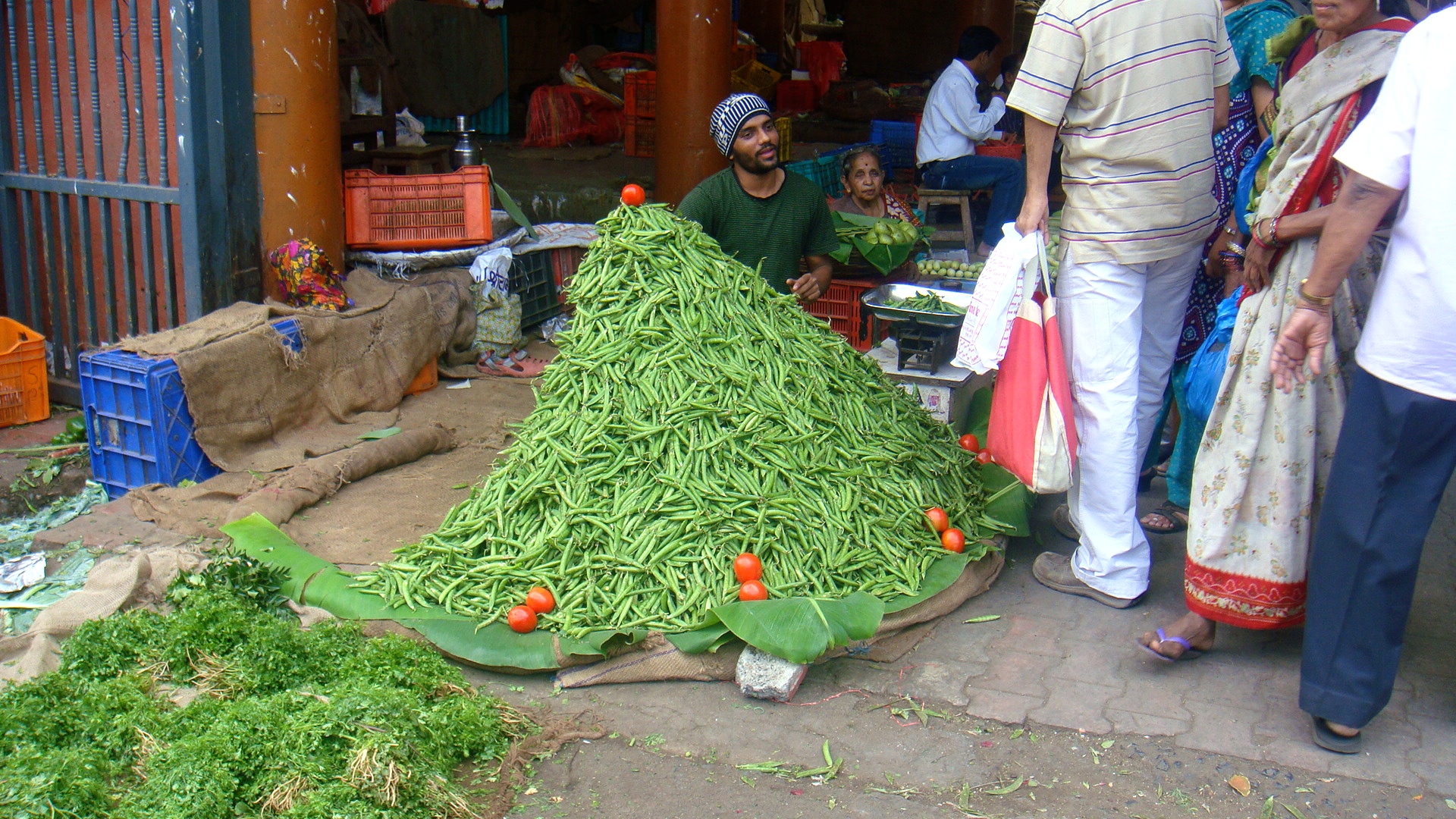
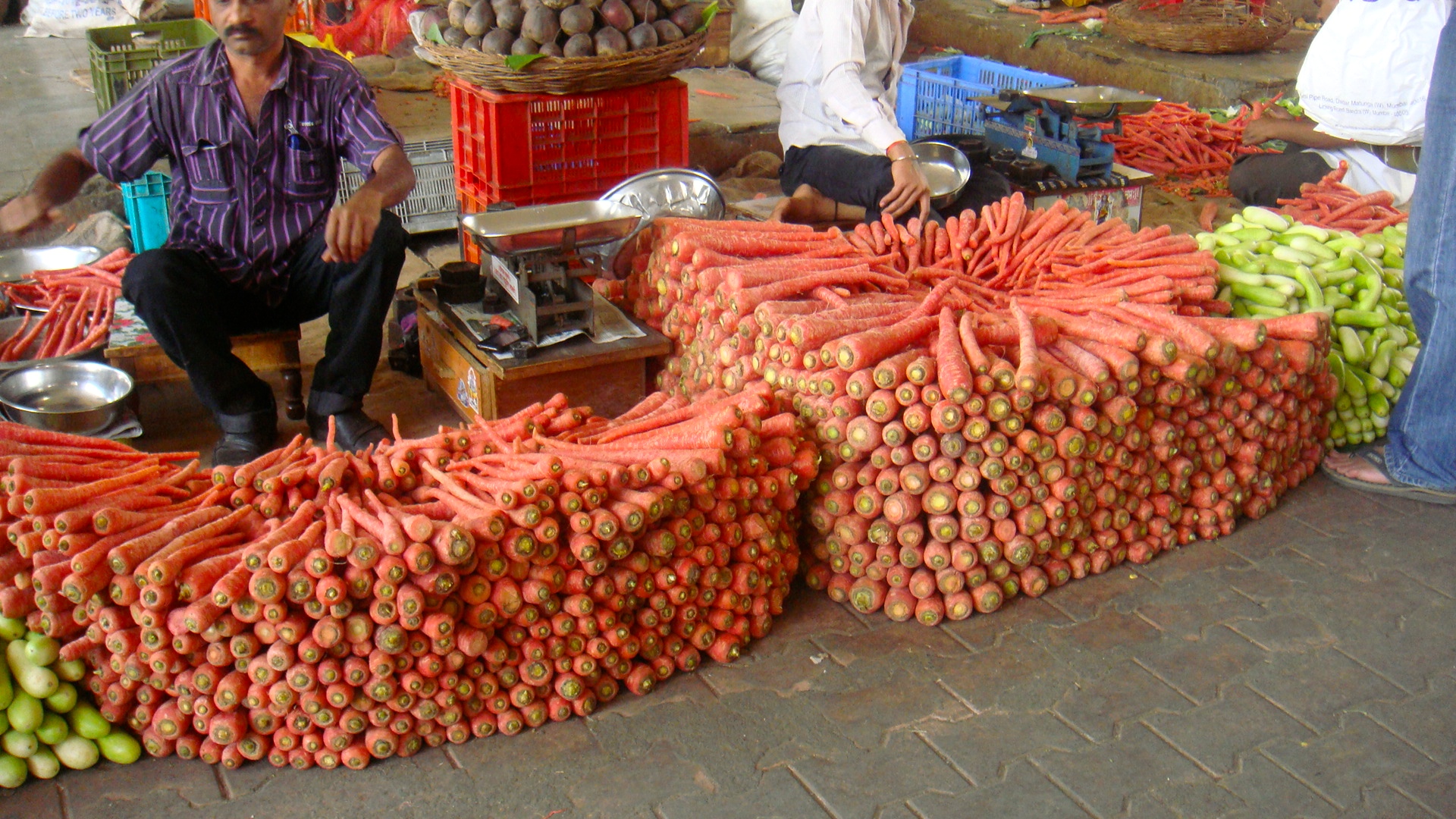

This was interesting as well, a lady peeling garlic:

Not much else to say about Pune except the wonderful surprise we had from the staff at the end of breakfast on our final morning:
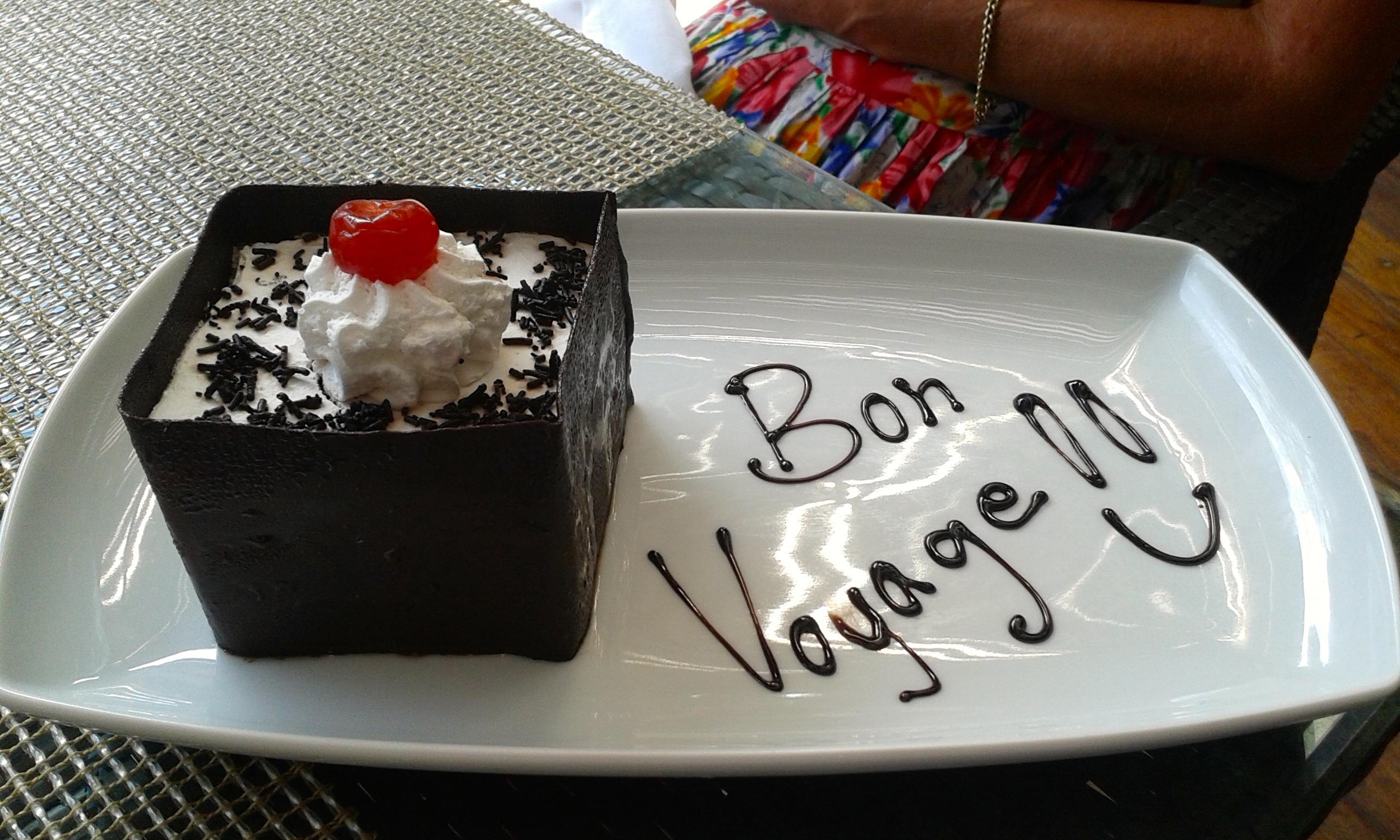 Thank you Courtyard Marriot, Pune!
From Pune we headed back to Mumbai where we met up with Taruna and Anand for dinner the first evening and with Yatin and Twinkle and their lovely children Jay and Rhea the second evening. Unfortunately no photographic records survive however this joke from Yatin on corruption in India does:
The government issues a request for tenders to build a new bridge. A builder from Bangalore quotes 30 million rupees and when asked for a breakdown says “20 million is materials, 5 million is labour and 5 million is my profit”. A Gujurati businessman also supplies a quote but for 90 million rupees. The official asks for a breakdown and the Gujurati says “30 million is for you and 30 million is for me”, the official says “But what about the bridge?” to which the Gujurati replies “The Bangalorean can build it!”.
Our “business” in Mumbai was to get Elsie loaded into a container ready for shipment back to the UK and to get our precious carnet stamped. The process should have been simple but of course it wasn’t! Rather than explain it (which I can’t anyway because I still don’t understand it) I’ll just give you a flavour of the day:
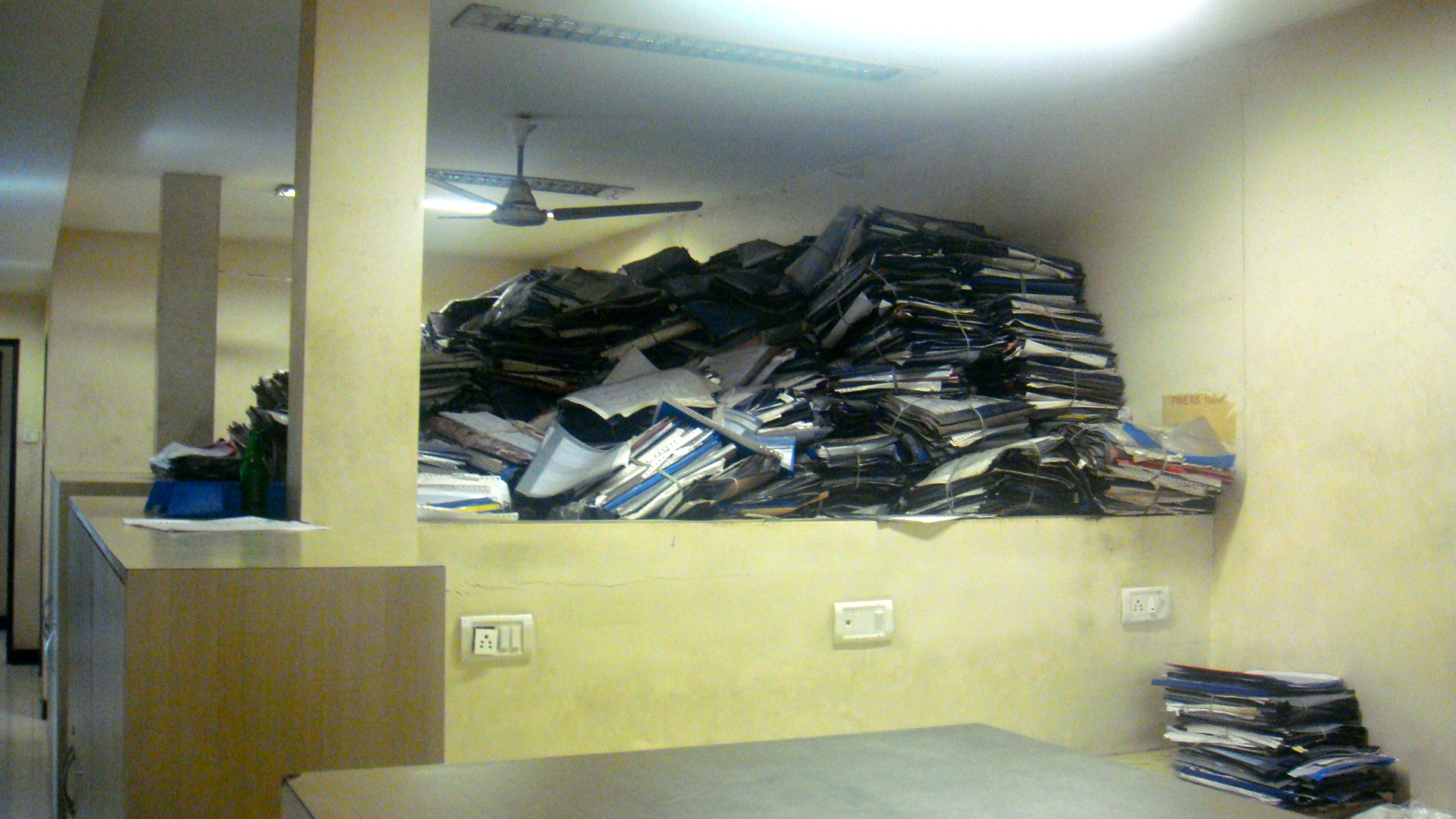 The office filing system
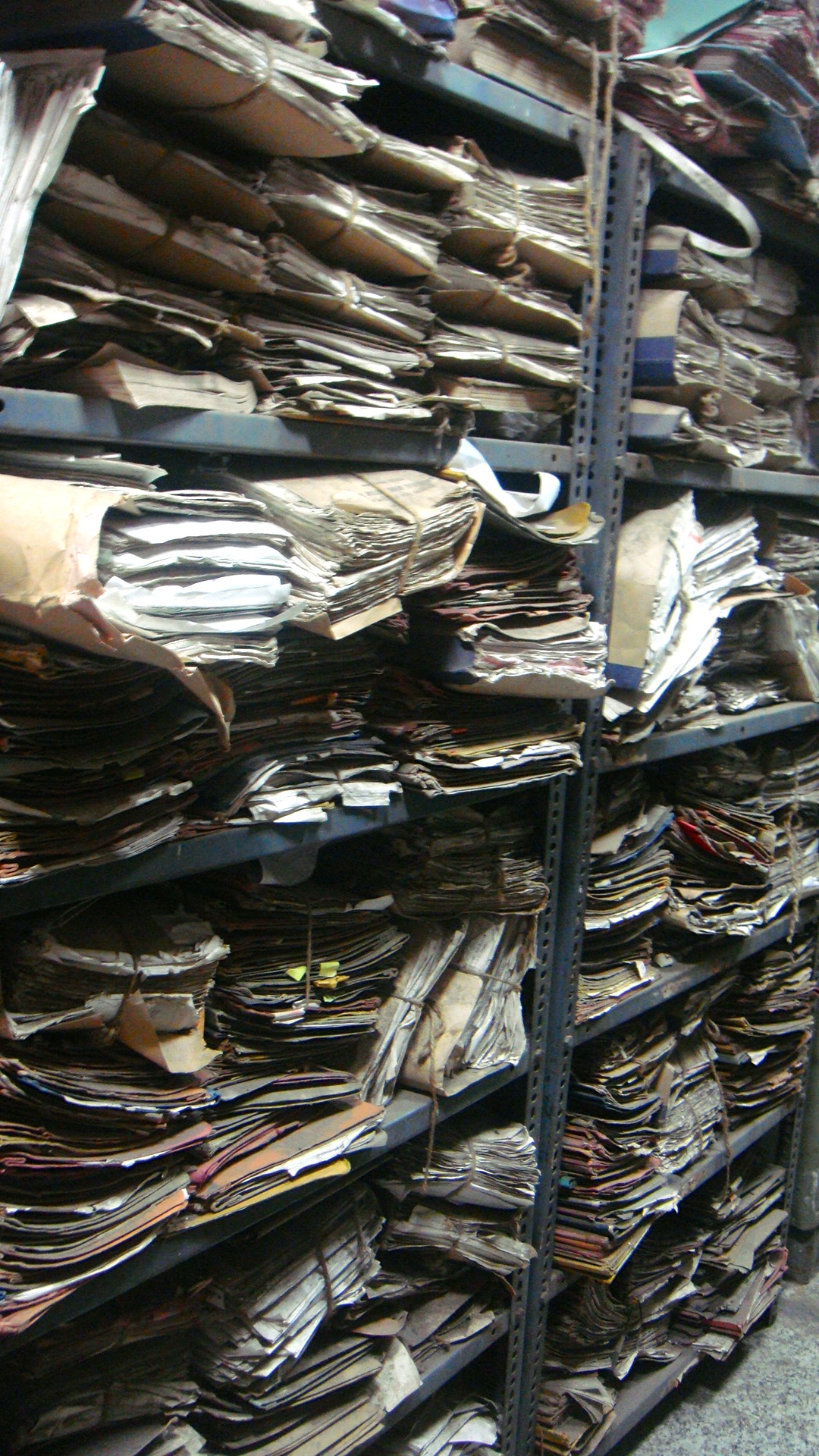 Another office filing system (we went to lots of offices!)
 A waiting area (we did a lot of waiting!)
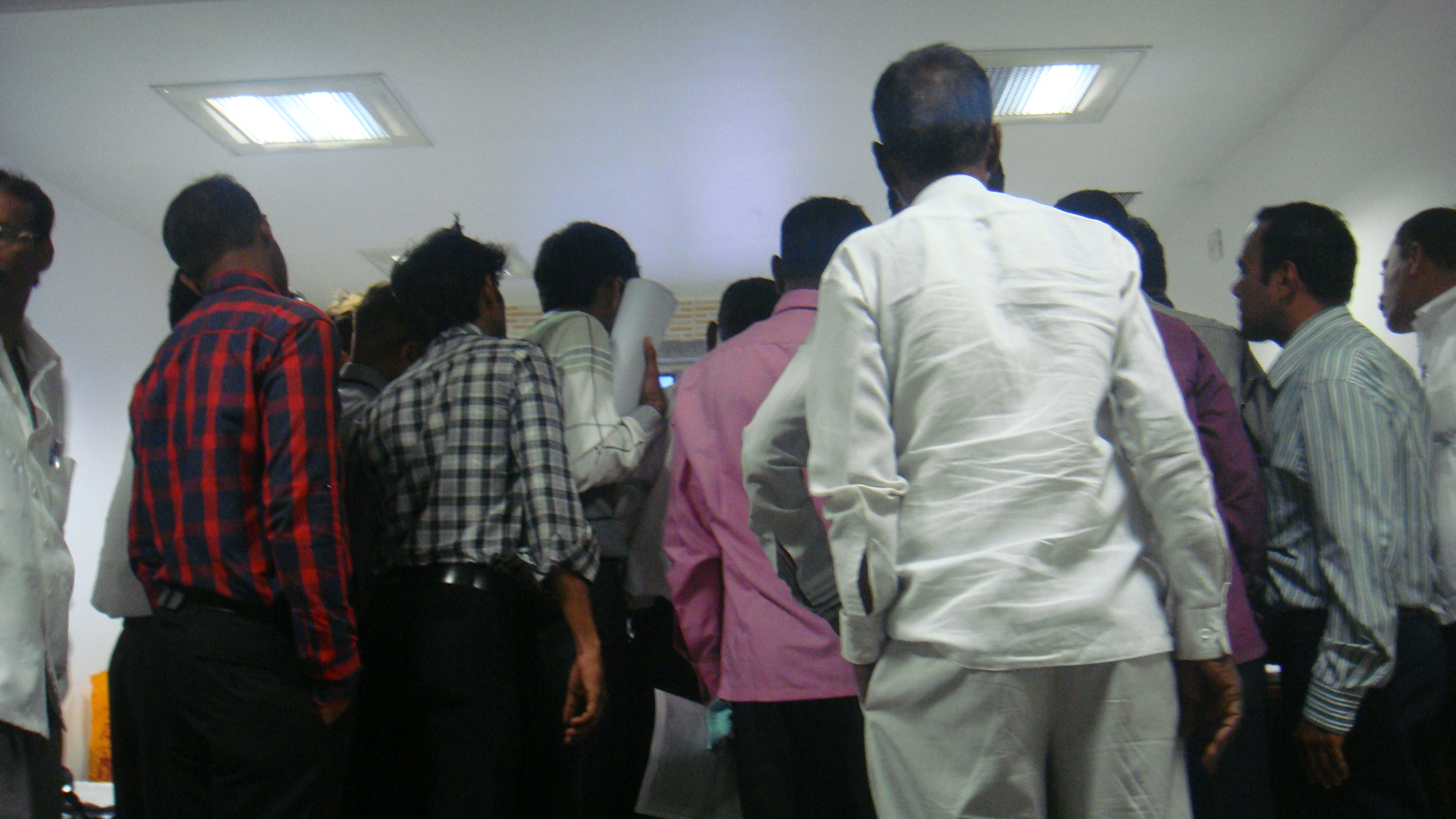 The scrabble for a signature.
Somewhere behind the crowd is a very important person who signs your very important documents. This procedure is repeated all day until all your very important documents have very important signatures.
Having said I won’t explain the process I think I will … 1) Arrive at 10am, 2) Go to an office, 3) Wait, 4) Get something signed, 5) Repeat steps 2, 3 and 4 until 6pm, 6) Stuff container.
We had been warned we would need a full day and to bring books and water. We did and we did! Any way all’s well that ends well:
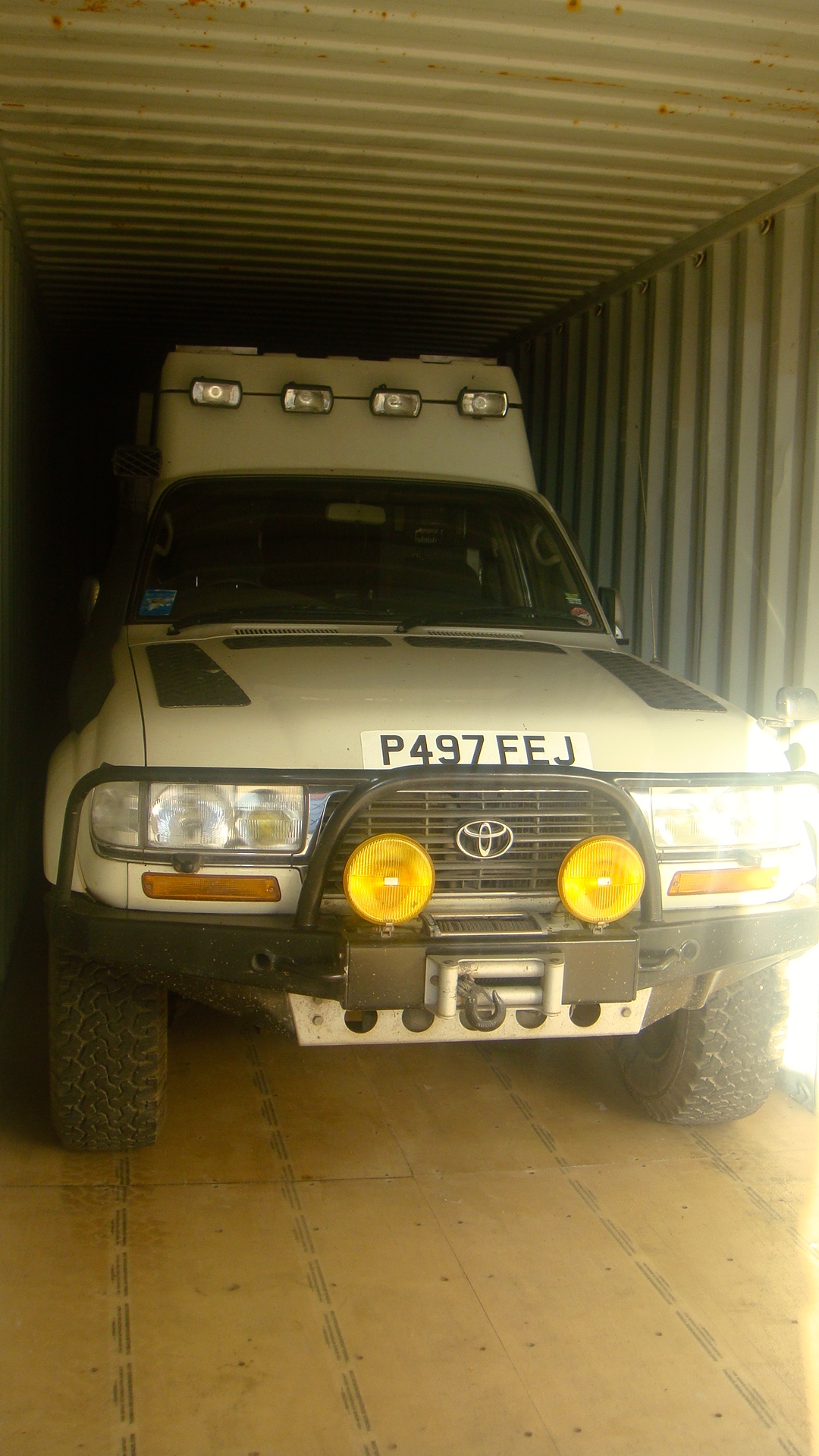 Elsie in the container ready to be lashed.
In the evening we had a very enjoyable Parsi dinner with our new friends Piran and Jasmine:

Hopefully we will meet again next summer when they come to Europe for a bike trip.
Our special treat (which we saved for last :-)) was the opportunity to view a private collection of vintage cars. The present owner shuns publicity, suffice to say that the collection was curated and restored by his late Grandfather. There were a lot of vehicles, here are a few shots of our favourites:
 1928 Daimler
 and a pristine engine compartment
 A beautiful Rolls
 and a pristine engine compartment
 Wonderful wire wheels
 A Riley
  and another
 An entire row of Americana
The collection itself is never displayed so it was a rare privilege to be able to see it.
Anyway life goes on, next stop – the caves at Ellora and Ajanta!
It was a short drive from Chitradurga to Hampi but still long enough to see yet more road accidents. This accident was probably the most horrific we have seen, it was a truck whose load of steel rods had moved forward and forced the cab down and into the road:

This a truck which had simply run off the road:
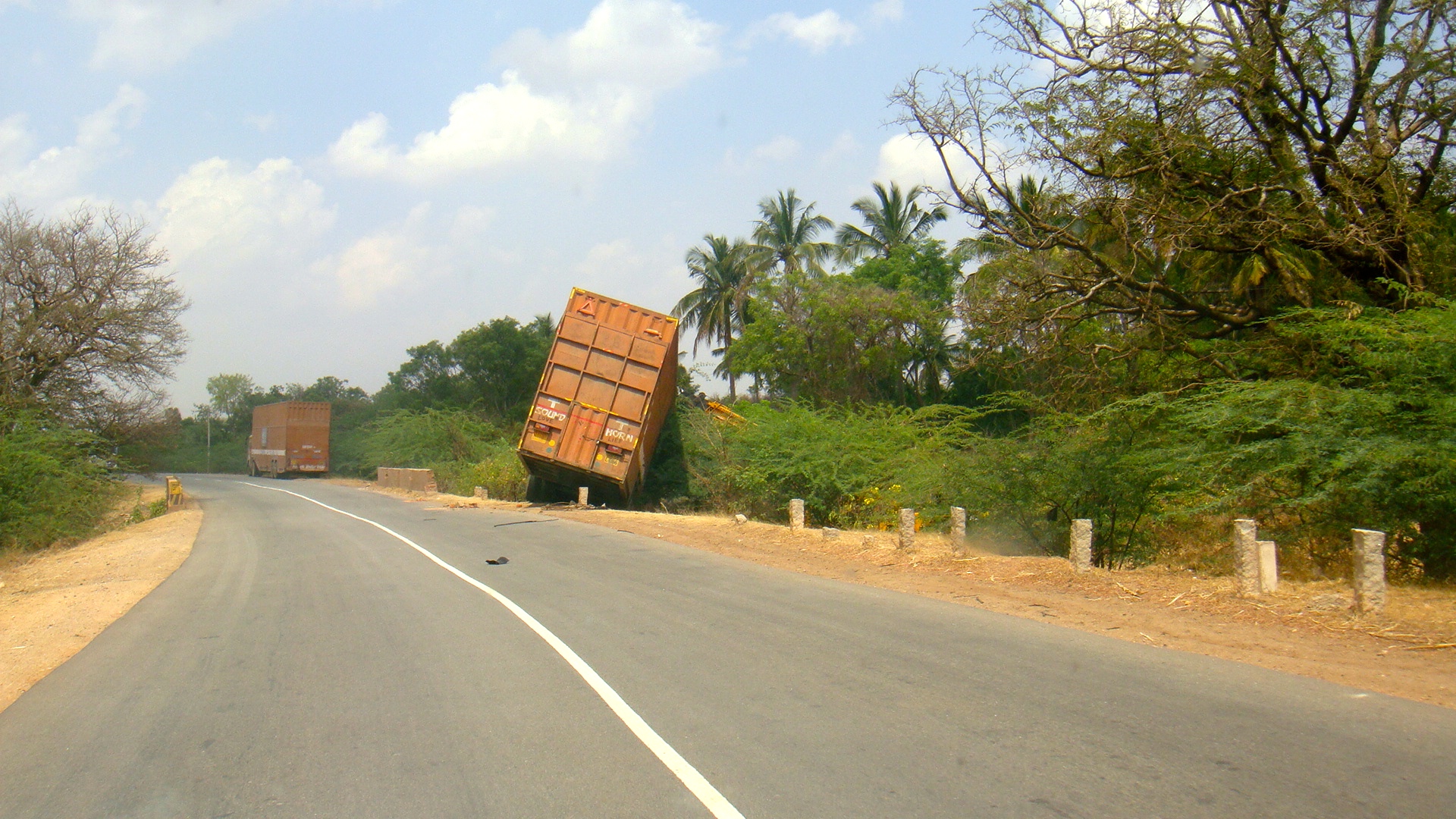
There are any number of reasons for these accidents. Overloading is an obvious issue, vehicle condition is another, tyres especially:
 Not that sort of tyres I prefer to trust my life to!
Although we have come to expect them we are still surprised by the number of truck accidents we see, “someone should do something”.
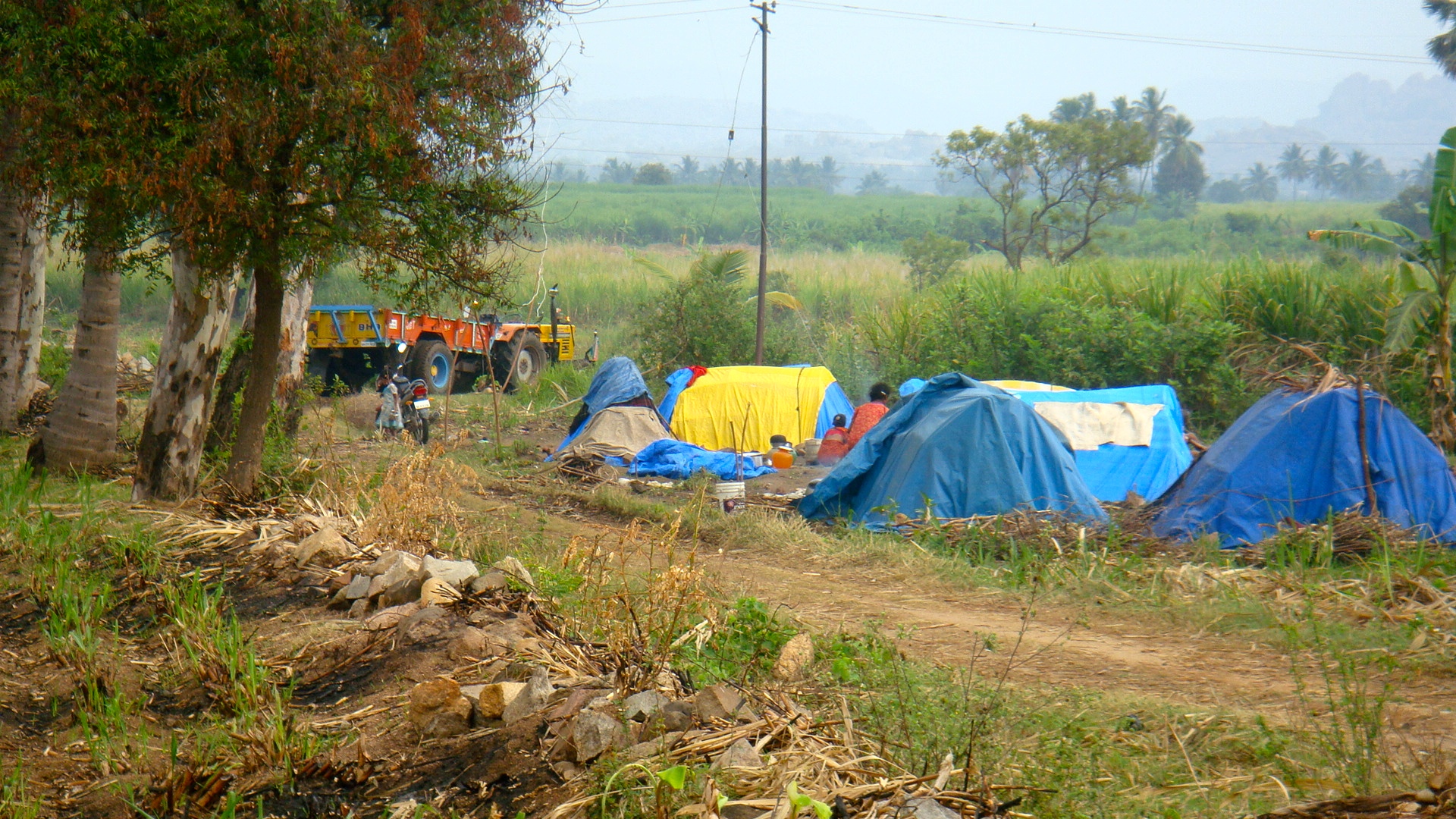
Travelling back north we have seen a lot of migrant workers camping in the fields. Most of them have travelled west into Karnataka from Andhra Pradesh for the sugar cane harvesting season, here is a typical camp:
We also saw another troupe of dancing ladies:

We reached Hampi early enough to organise a tuk-tuk for the next day and were out bright and early to look around.
Hampi is a UNESCO World Heritage Site and was, from 1343 to 1565, the capital of the Vijayanagara Empire . The Empire rose to prominence as efforts to ward off Muslim attacks from the North started to succeed. The Empire became established and gained influence but suffered a massive defeat in 1565 at the Battle of Talikota when 140,000 Muslim troops switched sides and attacked their previous comrades from the rear.
By 1646 the Empire was an Empire no more.
Fortunately much of the capital has survived. There are over five hundred structures of interest in Hampi so seeing them all was never going to happen. Instead we decided to target the most spectacular sites the first of which was the Vijaya Vittala temple, we noticed a familiar carving at the entrance:
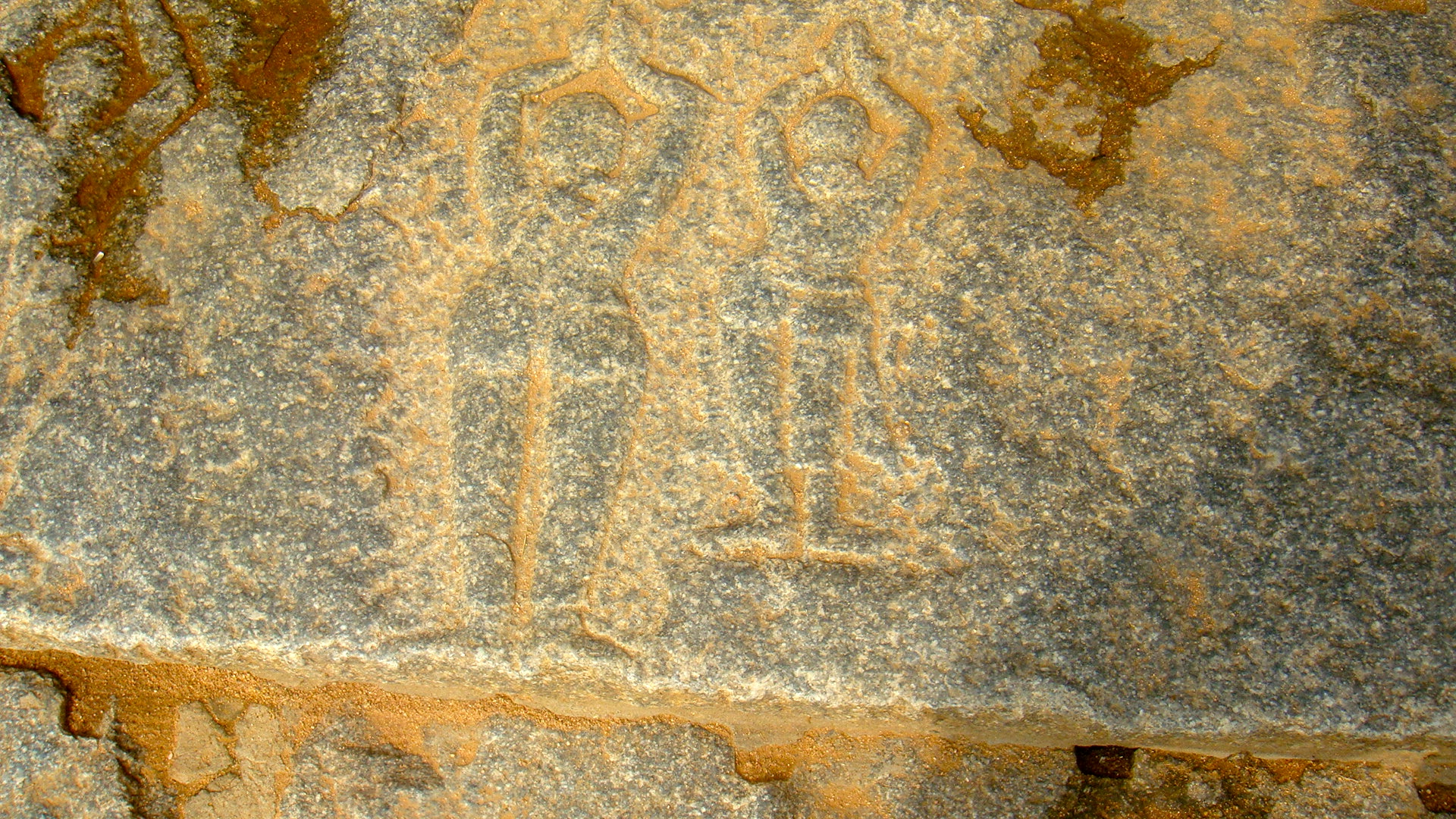 Ancient form of “Namaste”
Inside the temple complex is the Maha-Mandapa – the musical palace:
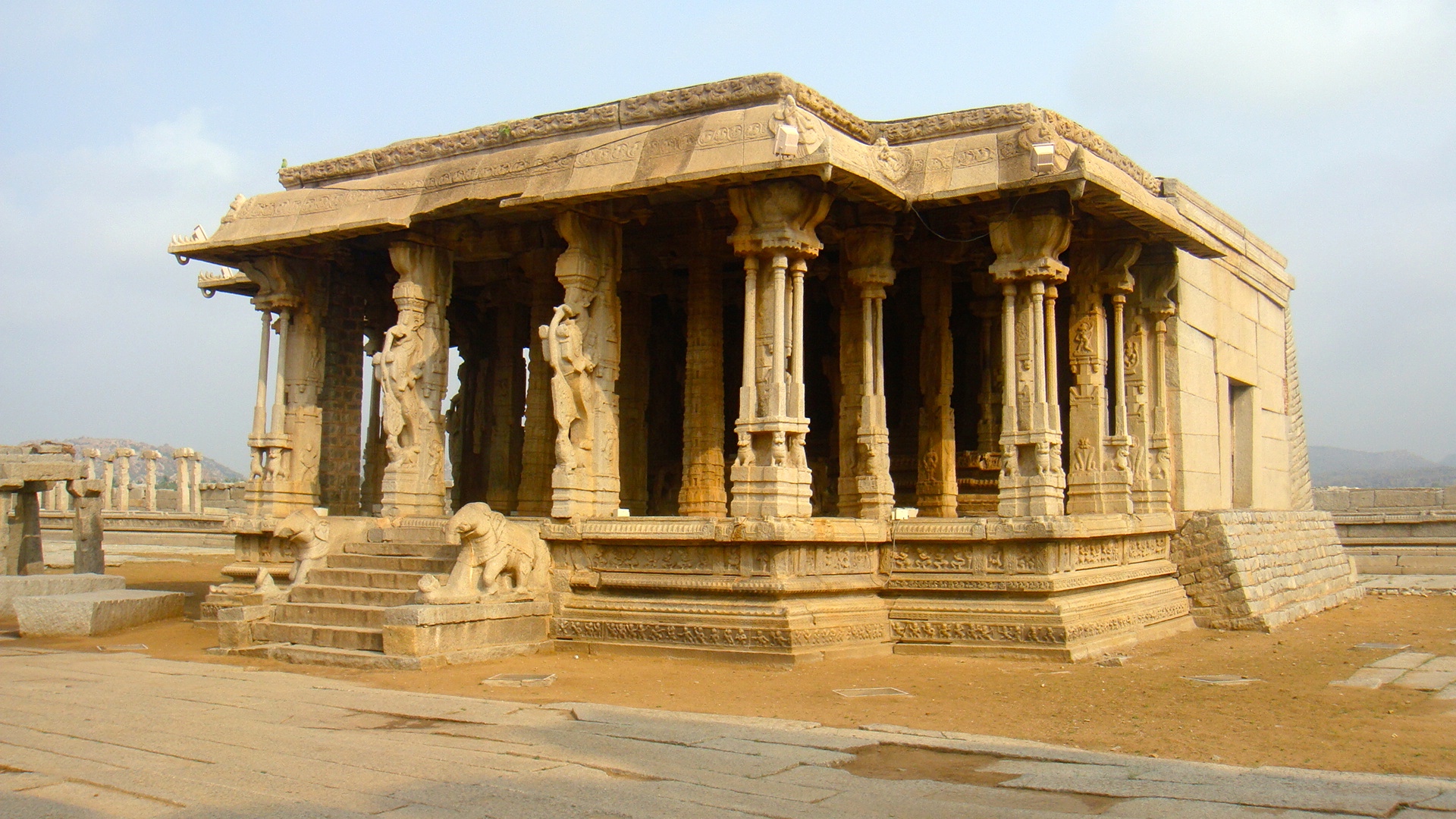
The most special feature of this palace is the many groups of stone pillars which when tapped emit perfect notes:

Close to the musical palace is the fabulous stone chariot:

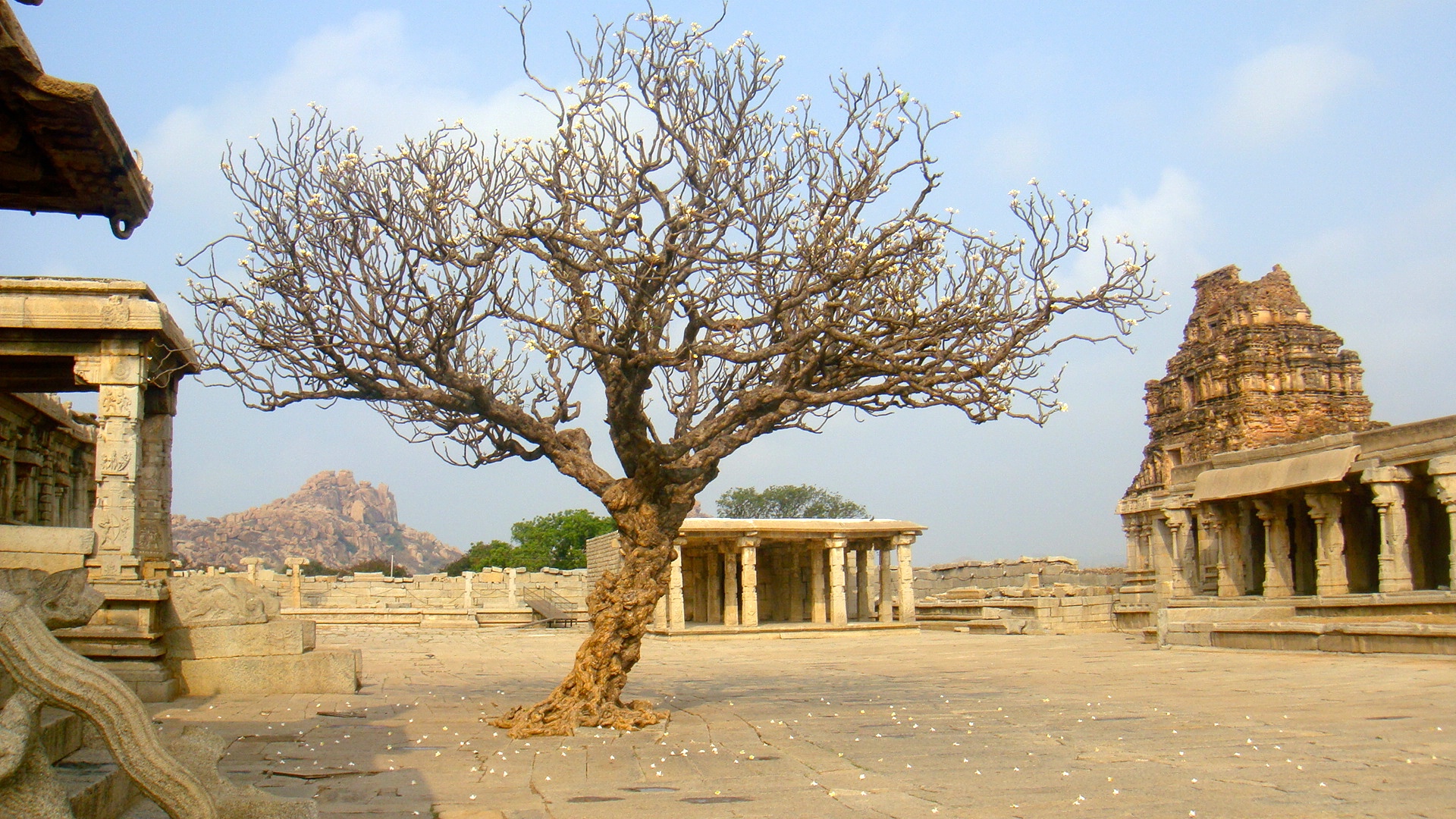
and in the courtyard this beautiful tree:
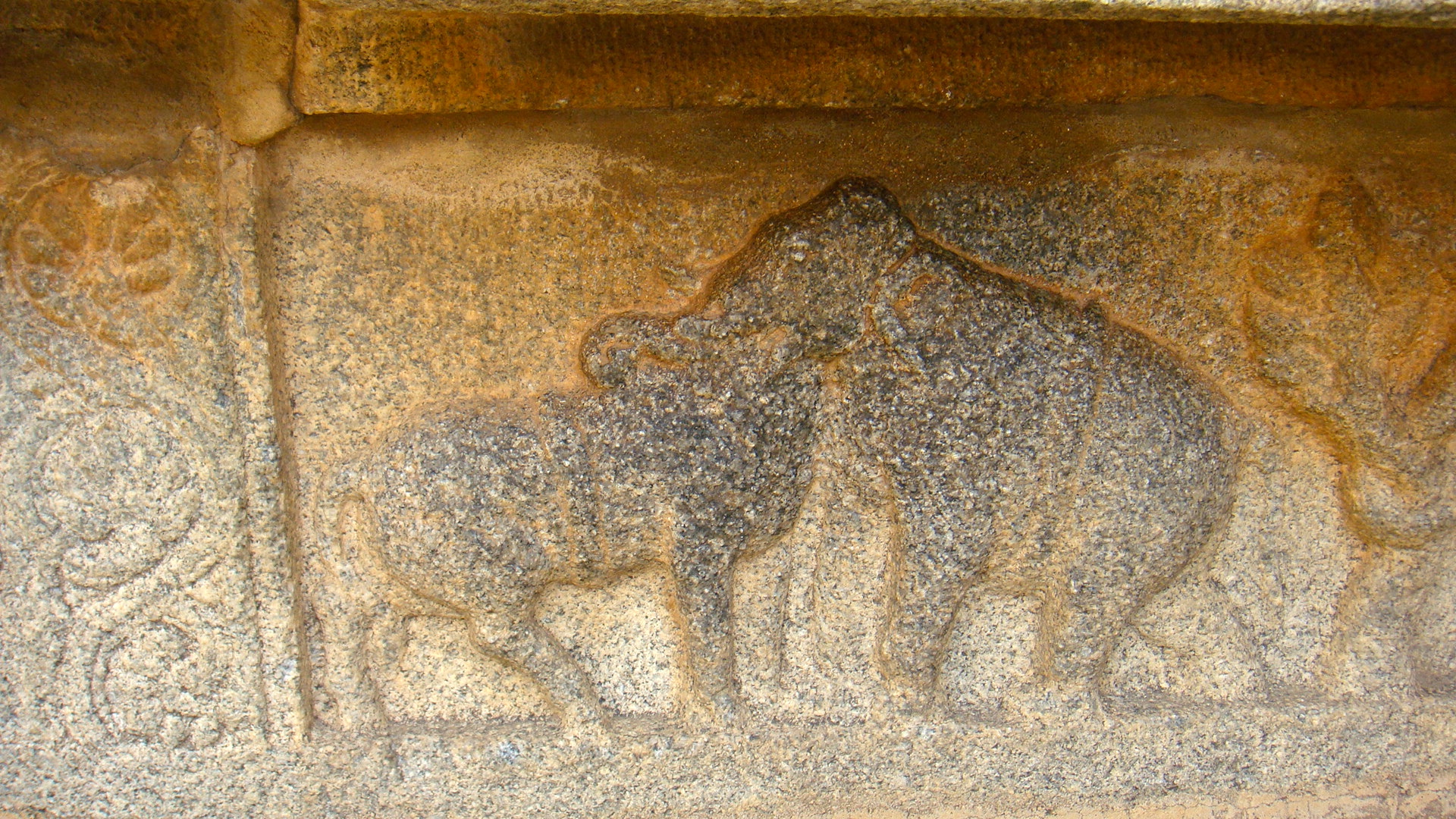
There were some interesting sculptures. Covering the torso and legs of the right hand animal below reveals an ox, covering the torso and legs of the left hand animal reveals an elephant. The two share a head:
This reminded us of Khajuraho:
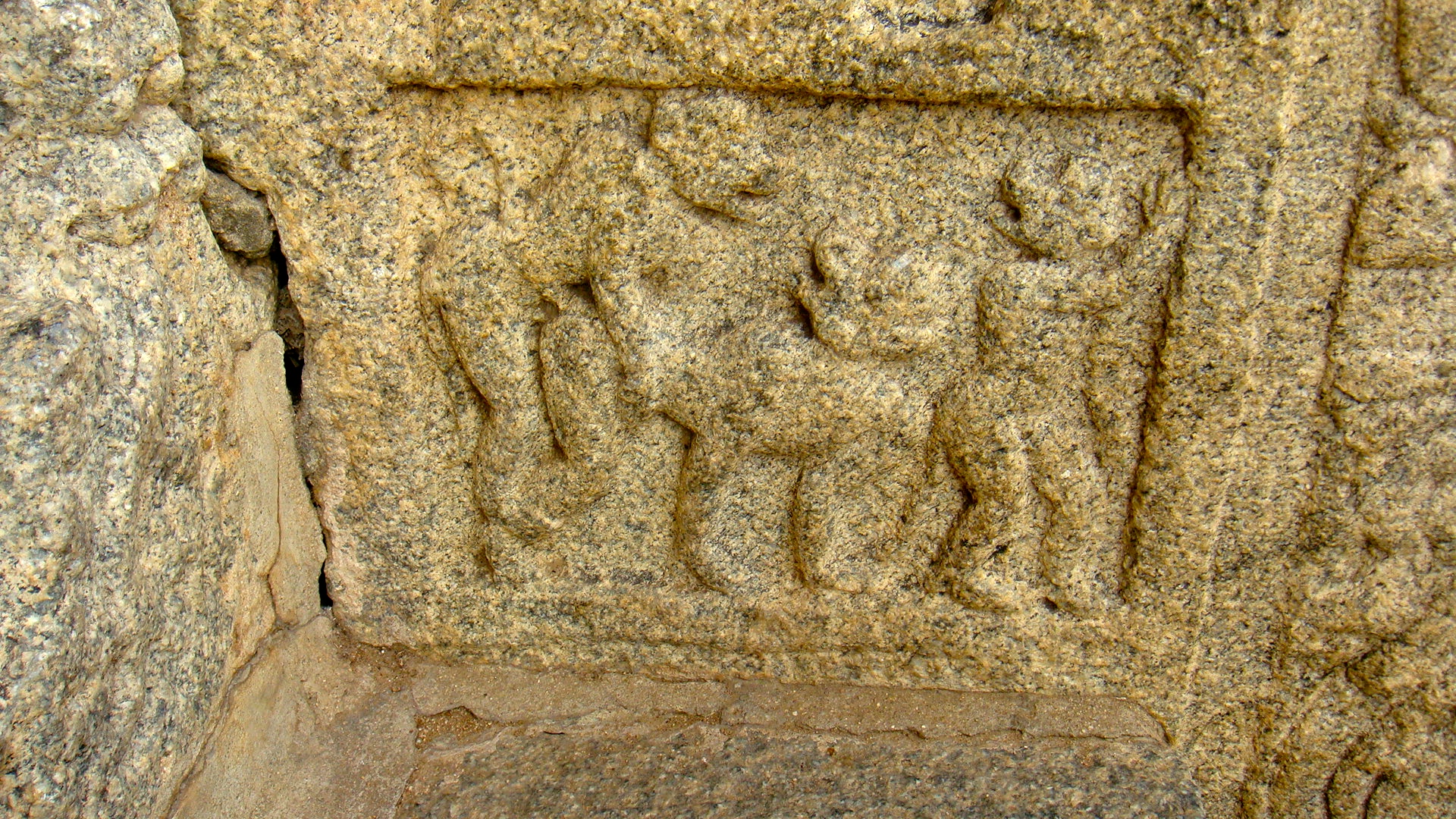 Monkey business!
Later in the Virupaksha temple we noticed a second Khajuraho-like carving:

We also spotted this elephant being attacked and seemingly taking some revenge:

Some of the sculptures were in surprisingly good condition:
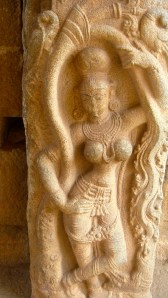

Hampi lies just south of the Thungabadra river. In it’s heyday there was an elevated stone bridge across the river, many of the pillars survive in place so we took a coracle ride to see them close up. This is an island in mid-stream where the pillars survive:

Leishia in our coracle:

The pillars from the coracle, the ones on the right stood in the river and have been pushed over by five hundred years of flowing water:

There are two huge bazaars in Hampi, this shot was looking down through what would have been a row of merchants shops:

 The same bazaar from a distance.
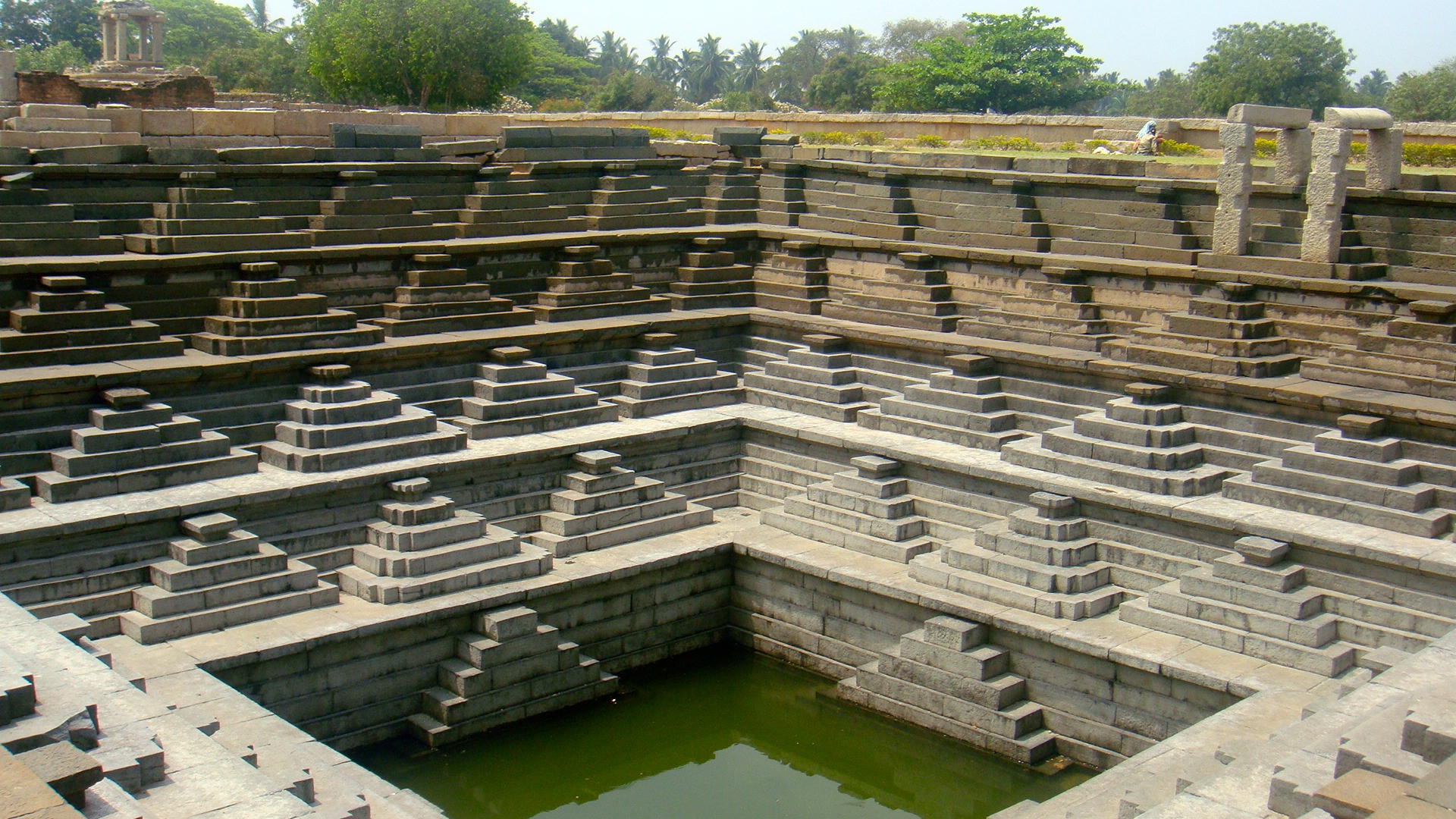
There is also a wonderful step well which was rediscovered and excavated in the eighties:
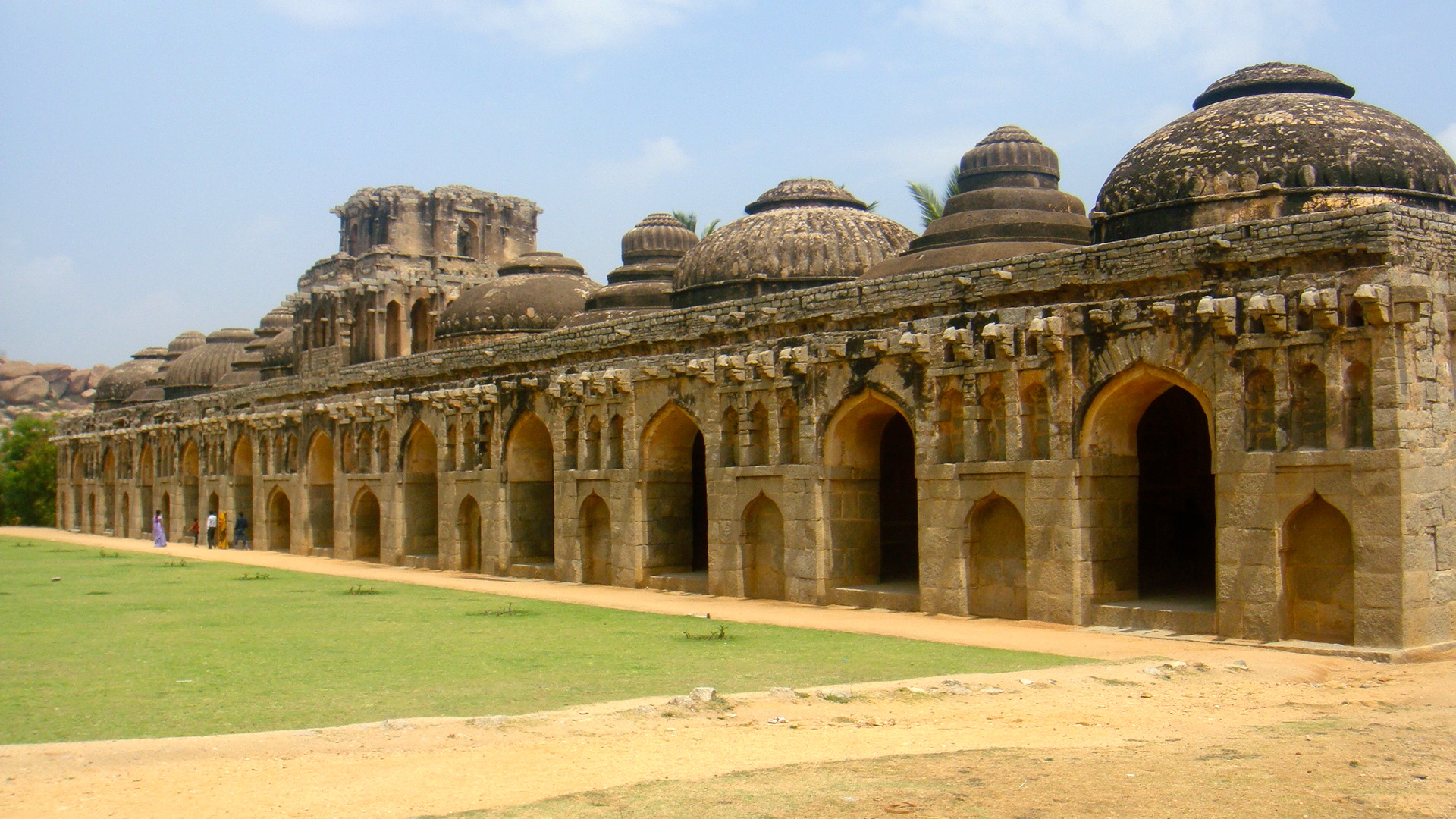
And this fantastic elephant stables with room for eleven elephants:
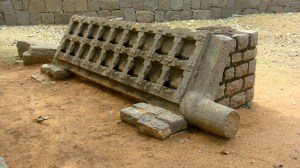
This was one of two solid stone entrance doors which were opened and closed by elephants:
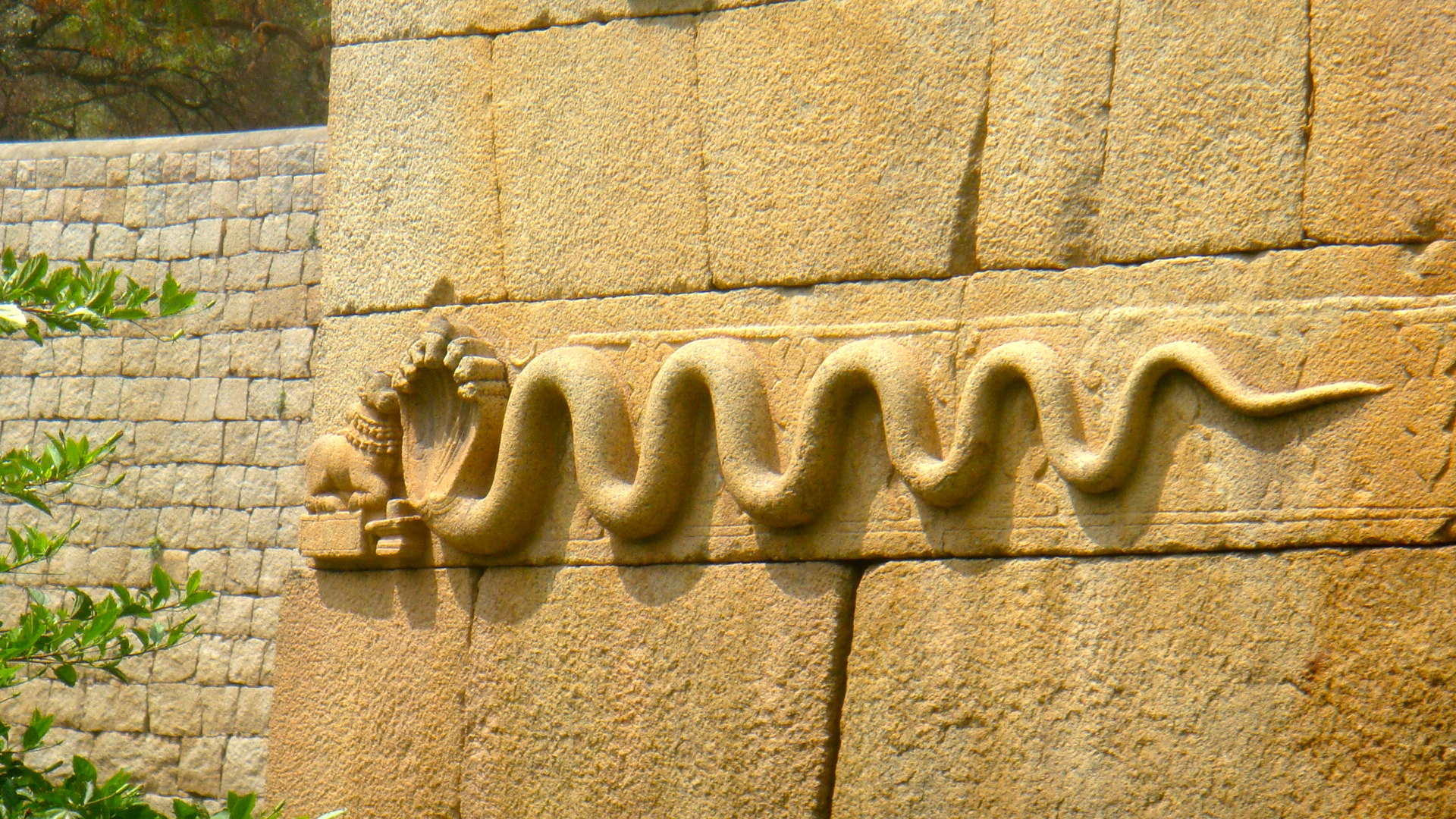
Just before we stopped for the day we came across this :
 Two cobras!
It would be easy to spend several days at Hampi. By four pm we were exhausted – we have a new name for it – “Unescoed”.
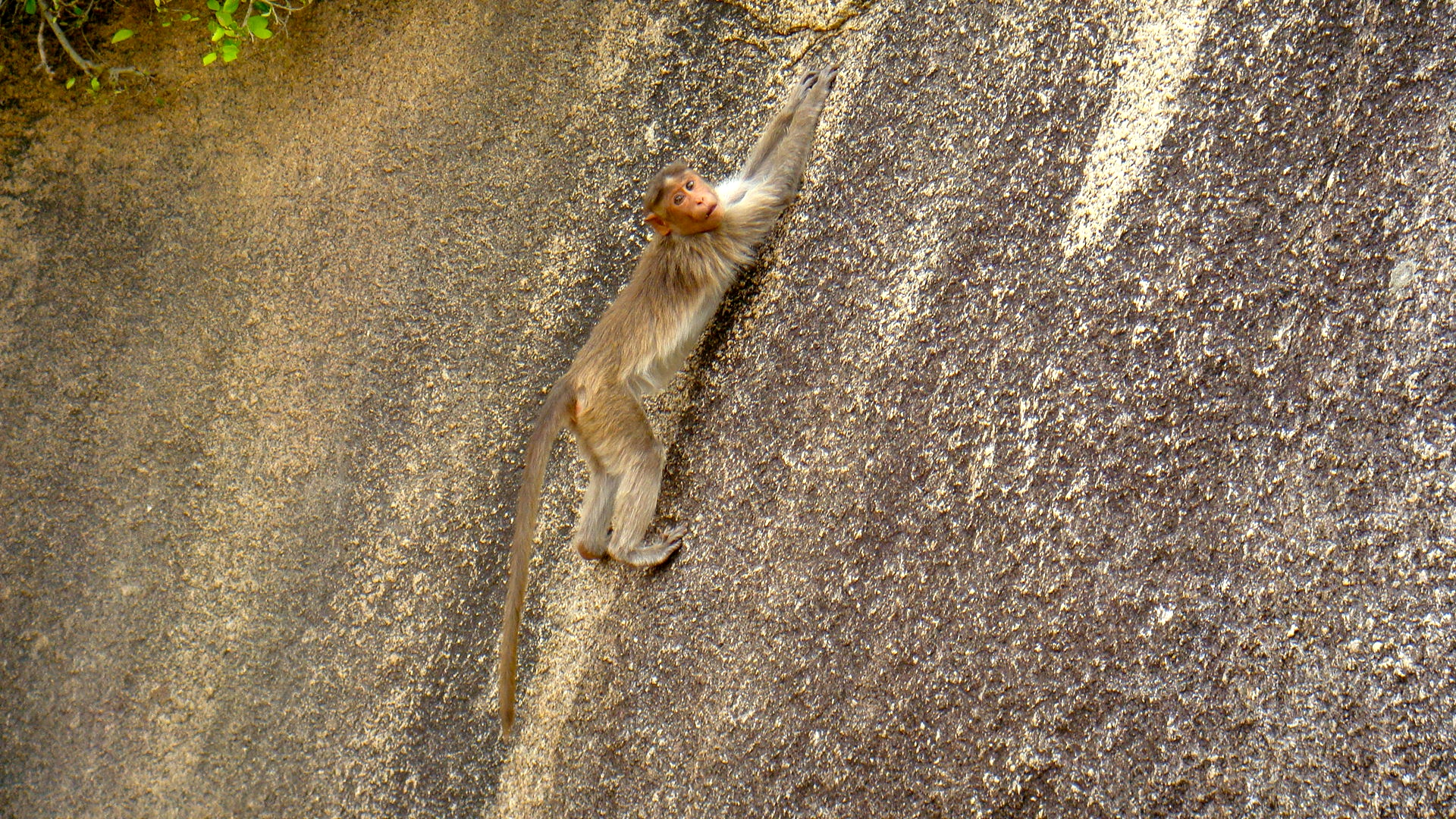
Chitradurga just happened to be the town we reached when dusk came. Chitradurga isn’t on the tourist map probably because it isn’t really on the road to anywhere and it doesn’t boast many tourist attractions – except one! But first – the animals of Chitradurga:
 Foxy Oxy
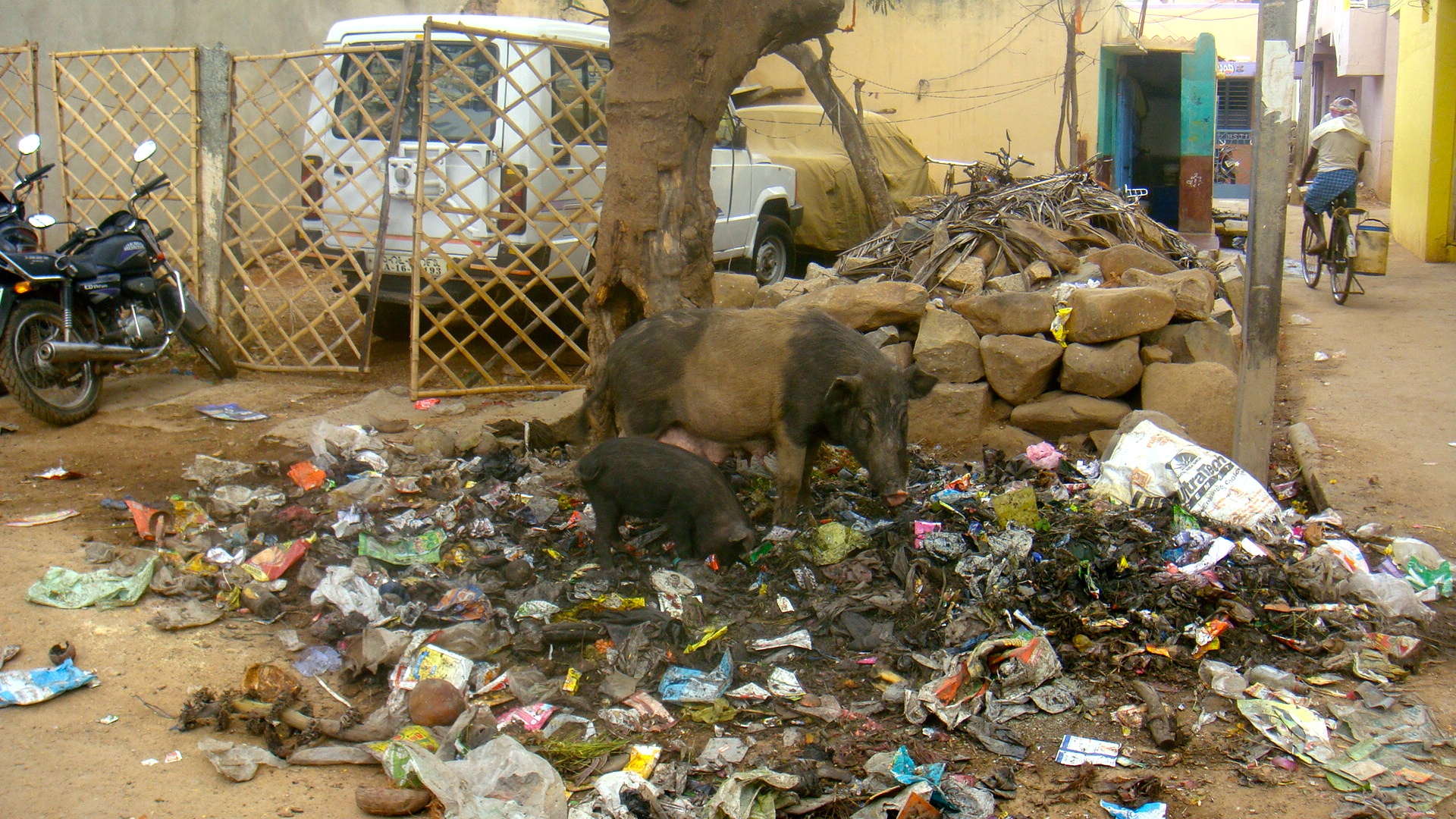 Pigs scouring the rubbish
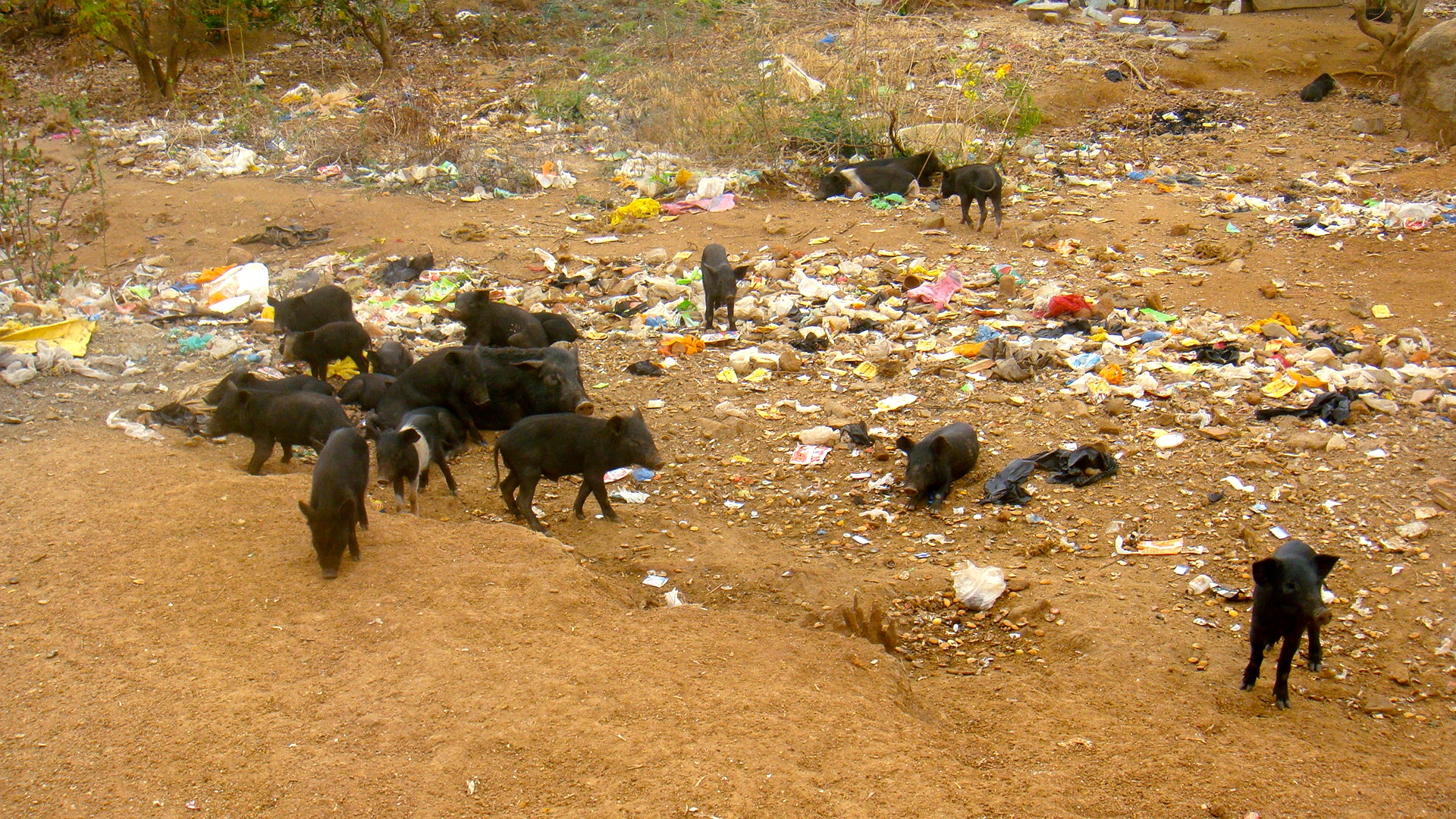 A litter in the litter
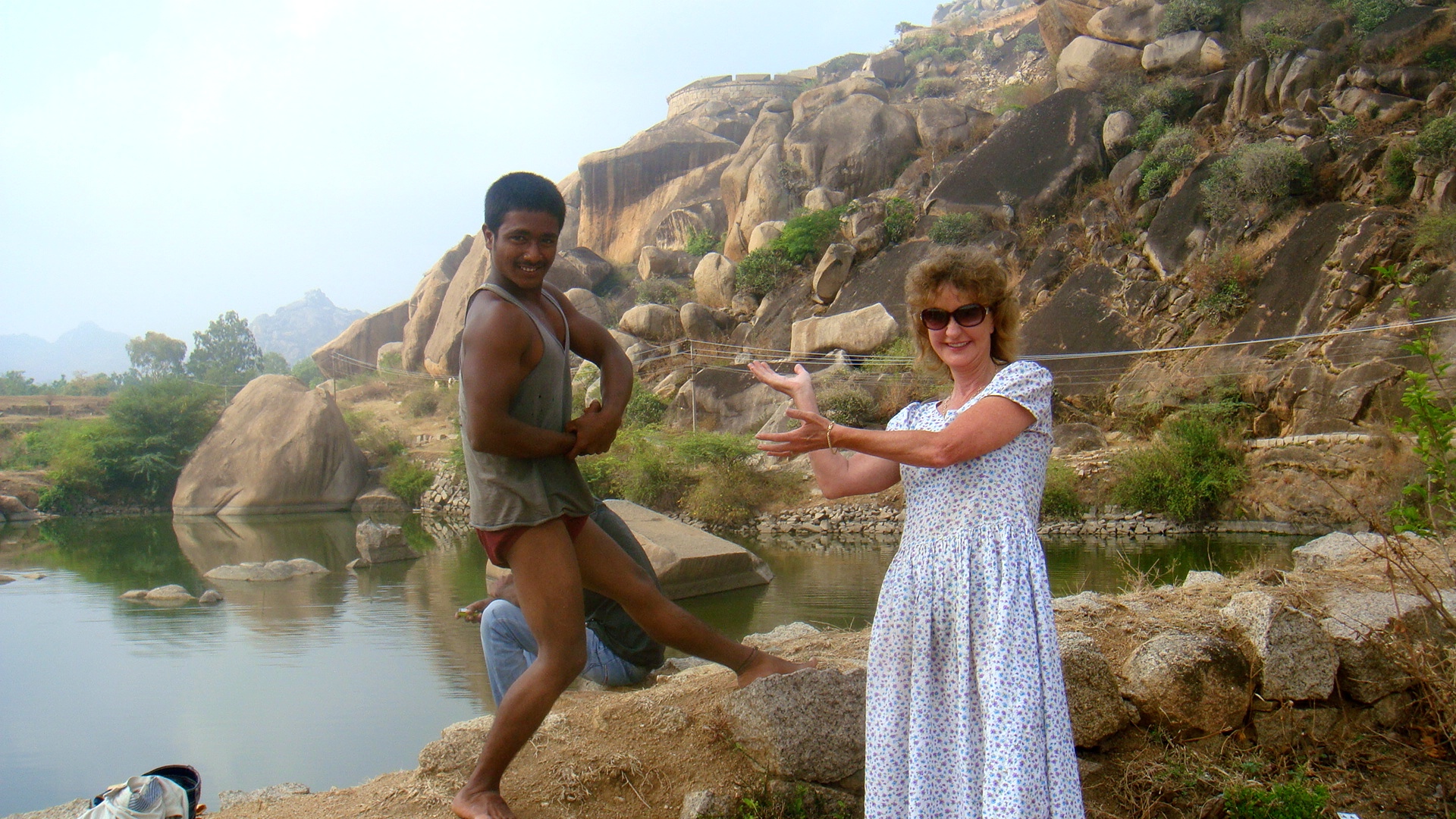
 What? Me?
 Monkey
So – the sole tourist attraction … Chitradurga Fort. The area around Chitradurga is dominated by hills which look like piles of giant pebbles. Those pebbles are apparently around 2,500 million years old:
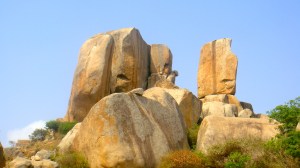
The fort has been built in and around the rocks, in the early 1800’s the British said “Every rock that could be used for offence or defence has been exploited. Every fortification commands others below so that with each formidable fortification gained the enemy is as much exposed to danger as ever”. The fort has seven concentric lines of defence and was considered virtually impregnable. The water supply could last for twelve years without any intervening rainfall so a siege wasn’t an option.
This was just one of the cisterns:

The British eventually gained the fort in 1799 having defeated Tipu Sultan at Srirangapatna just north of Mysore and were “relieved that we did not have to fight for this fort which would have cost us a deal of trouble and some bloodshed”. Tipu Sultan was killed at Srirangapatna and with his death came the end of the Anglo-Mysore wars which had raged intermittently since 1767.
Many of Tipu Sultan’s personal possessions were shipped to England and survive in the Royal collection and at the V&A including this (life sized) little gem, “Tipu’s tiger”:
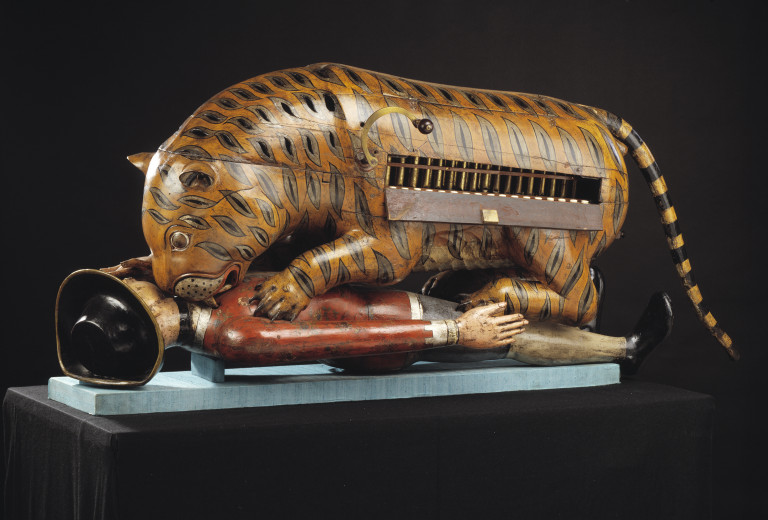 http://www.vam.ac.uk/page/t/tipus-tiger/
 The main gate
Wandering around the fort was illuminating:
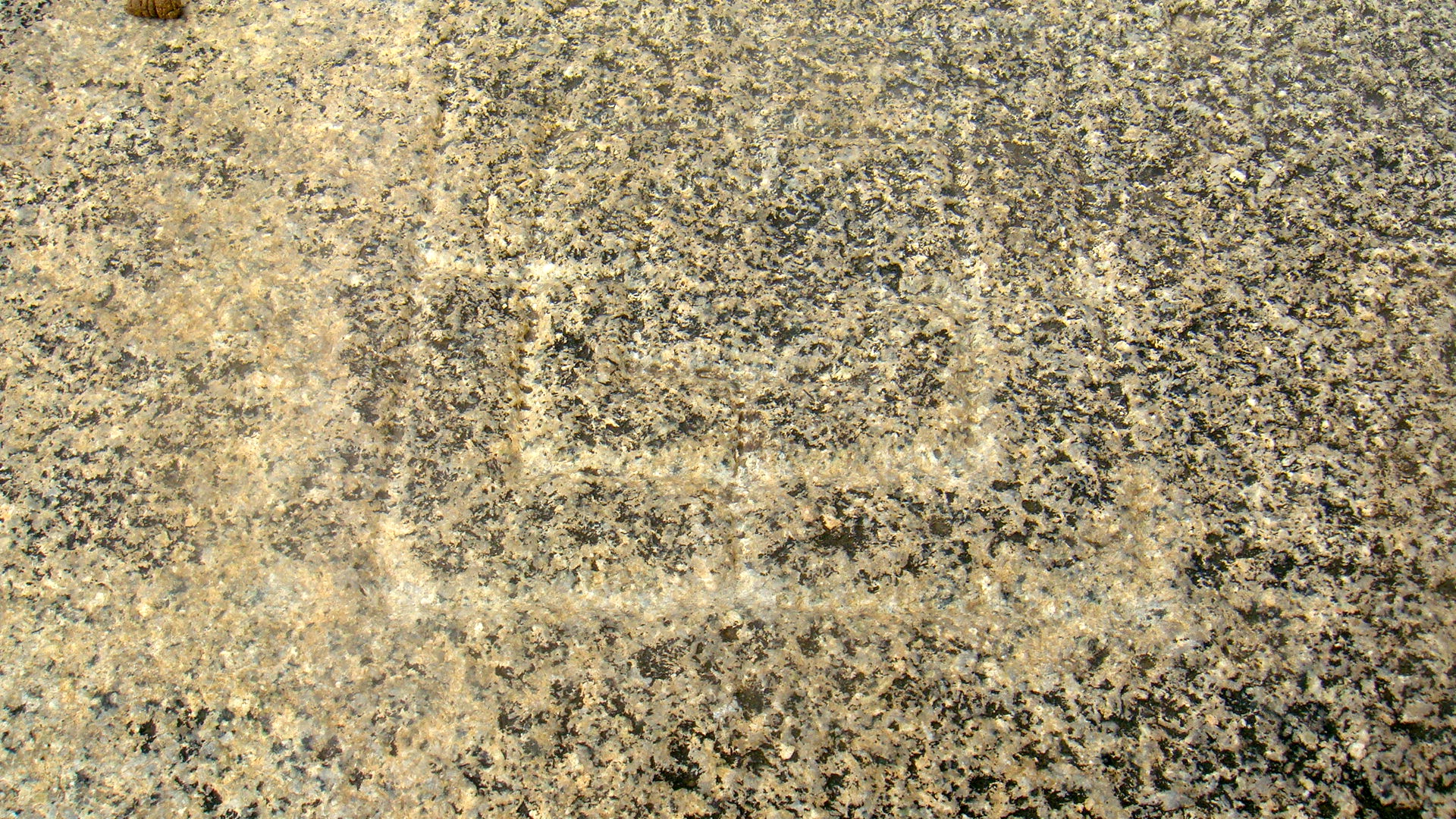 The game Navakankari (Kannada)
I used to play the same game when I was young, we called it Nine Men’s Morris. The game is played around the world and apparently emerged from the Roman Empire. Nevertheless it seemed strange to see it carved on a step here in India!
One rock was carved with the symbol below. It seems that before the current hands together action accompanying the greeting “Namaste” (“I bow to the divine in you.”) Namaste used to be said with the hands closed above the head:
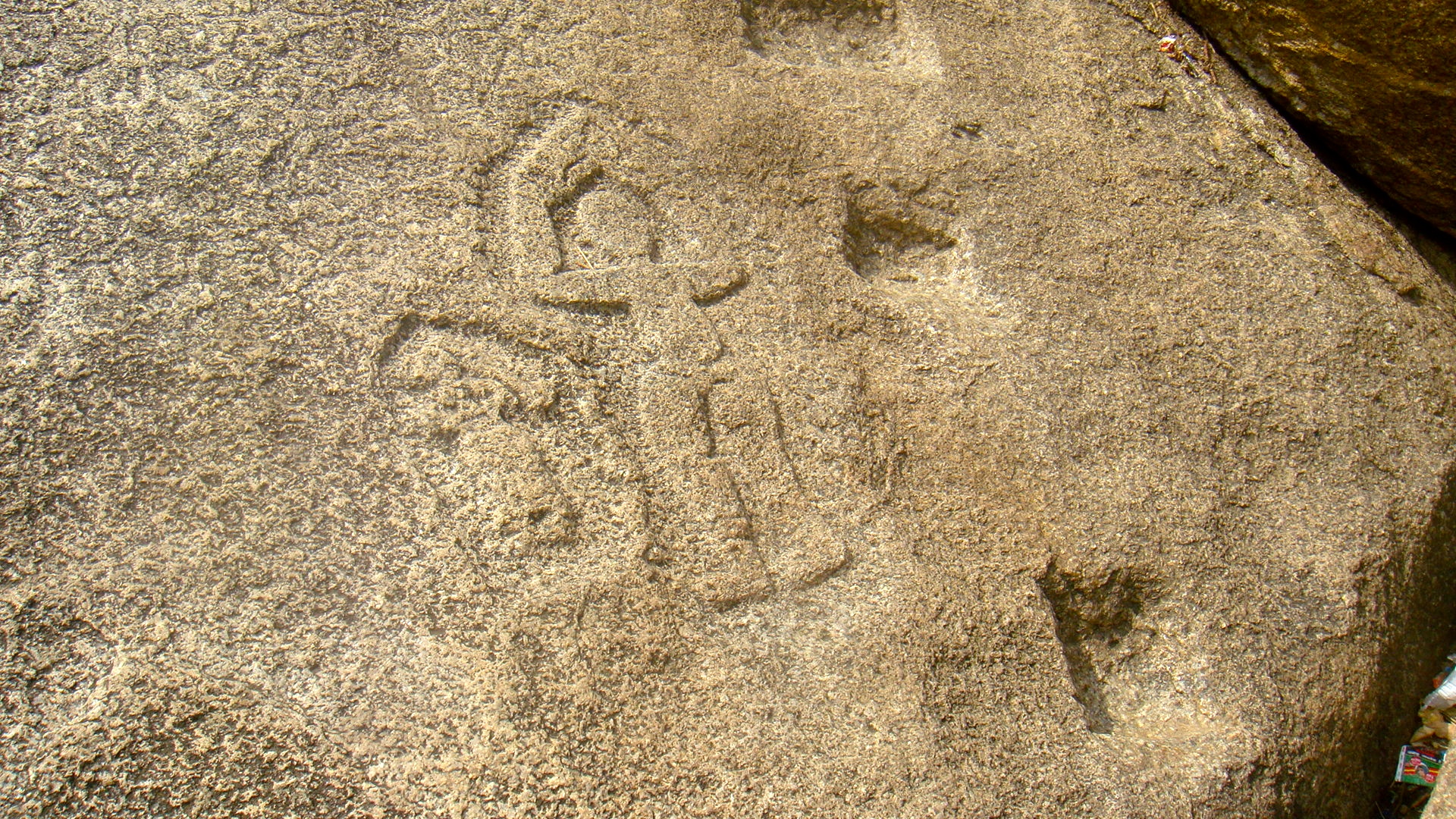 An early form of Namaste.
The symbol above was actually just to the left of a row of footholds cut into a huge rock:
 Footholds running all the way up the rock
You can see here how big the climb is (up to the circular battlement on the hill-top):
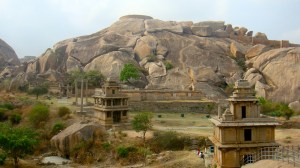 The climb in the background
I didn’t tackle the climb, I was too worried about the damage Leishia would have suffered from laughing at me had I fallen off!
The builders used the resources around them and fashioned stones from the rocks they had to hand. They cut a series of holes into the rock and then forced a wooden peg into each hole. Next they soaked the pegs, this caused the wood to expand and the rock to split! This worked for all sizes of rock, tall pillars were made in the same way. Elephants then moved the cut stones to the building site.
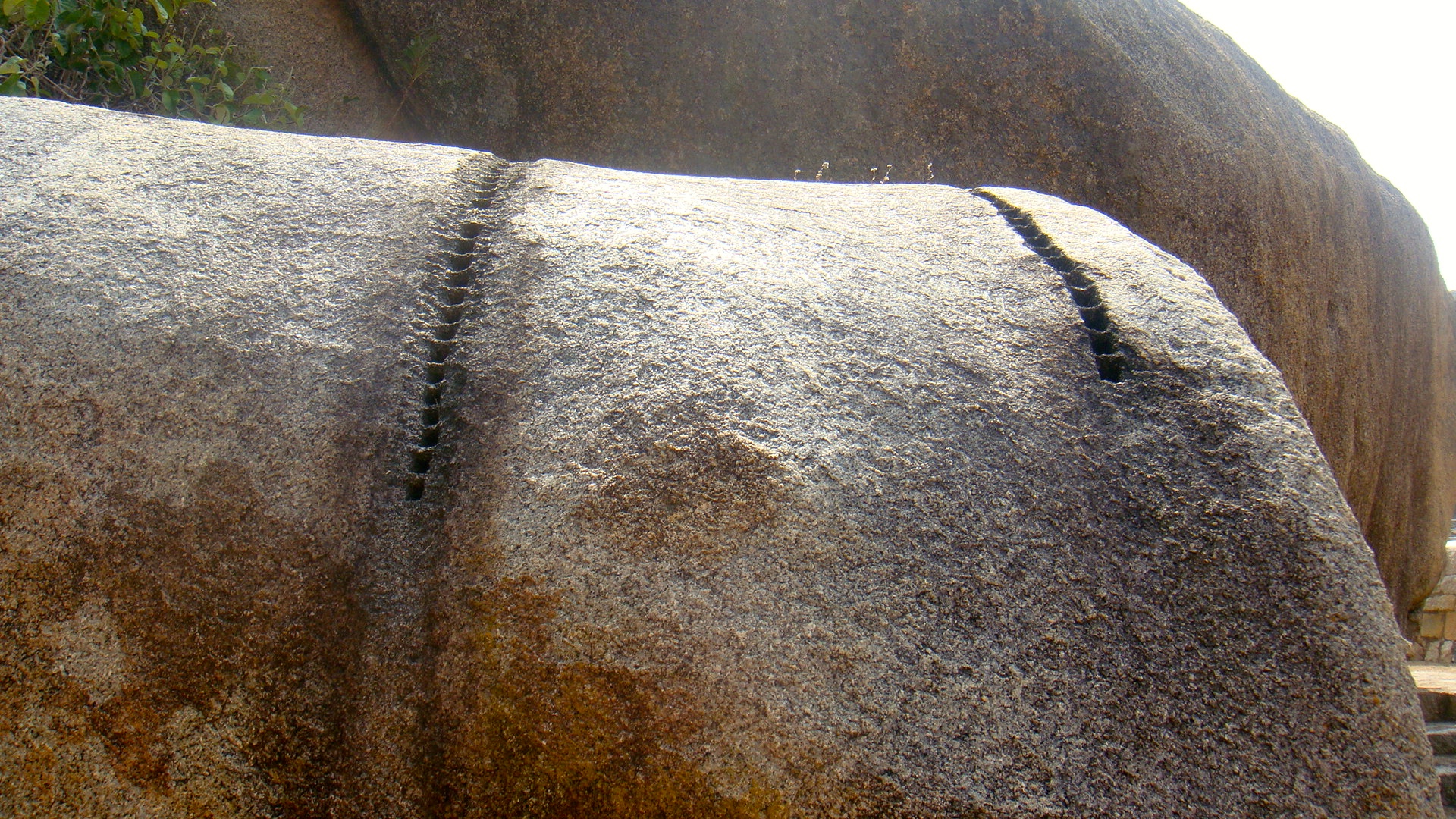 A rock abandoned mid-process.
The fort apparently had many secret entrances/emergency exits. The most famous of them is the “Onake Obavva Kindi”. In the local Kannada language “Onake” means Pestle (a wooden club used for pounding rice grains) and “Kindi” means hole. Obavva was a woman who thwarted the attempts of enemy soldiers to gain access to the fort through the Kindi by killing them with her Onake! Hence the name for the entrance way which would translate as “Pestle Obavva’s Hole”. The story of Onake Obavva has survived the test of time and she now is a symbol of the pride of Kannada women. The local stadium in Chitradurga is the Onake Obavva stadium!
This is me climbing up through the Kindi, luckily Obavva wasn’t around:
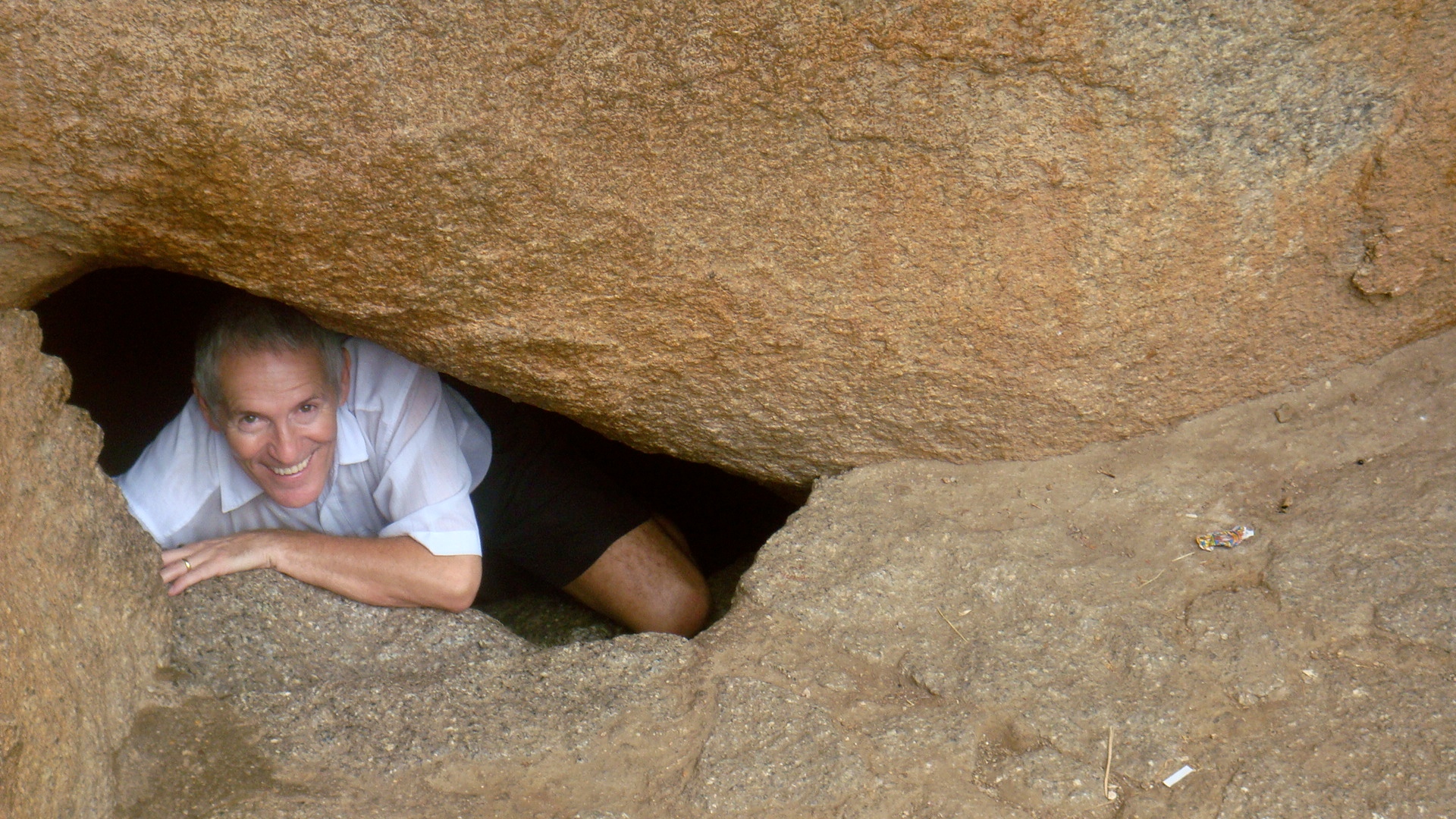 Staged? Surely not?
The fort also contained several temples and shrines:

very tame monkeys:
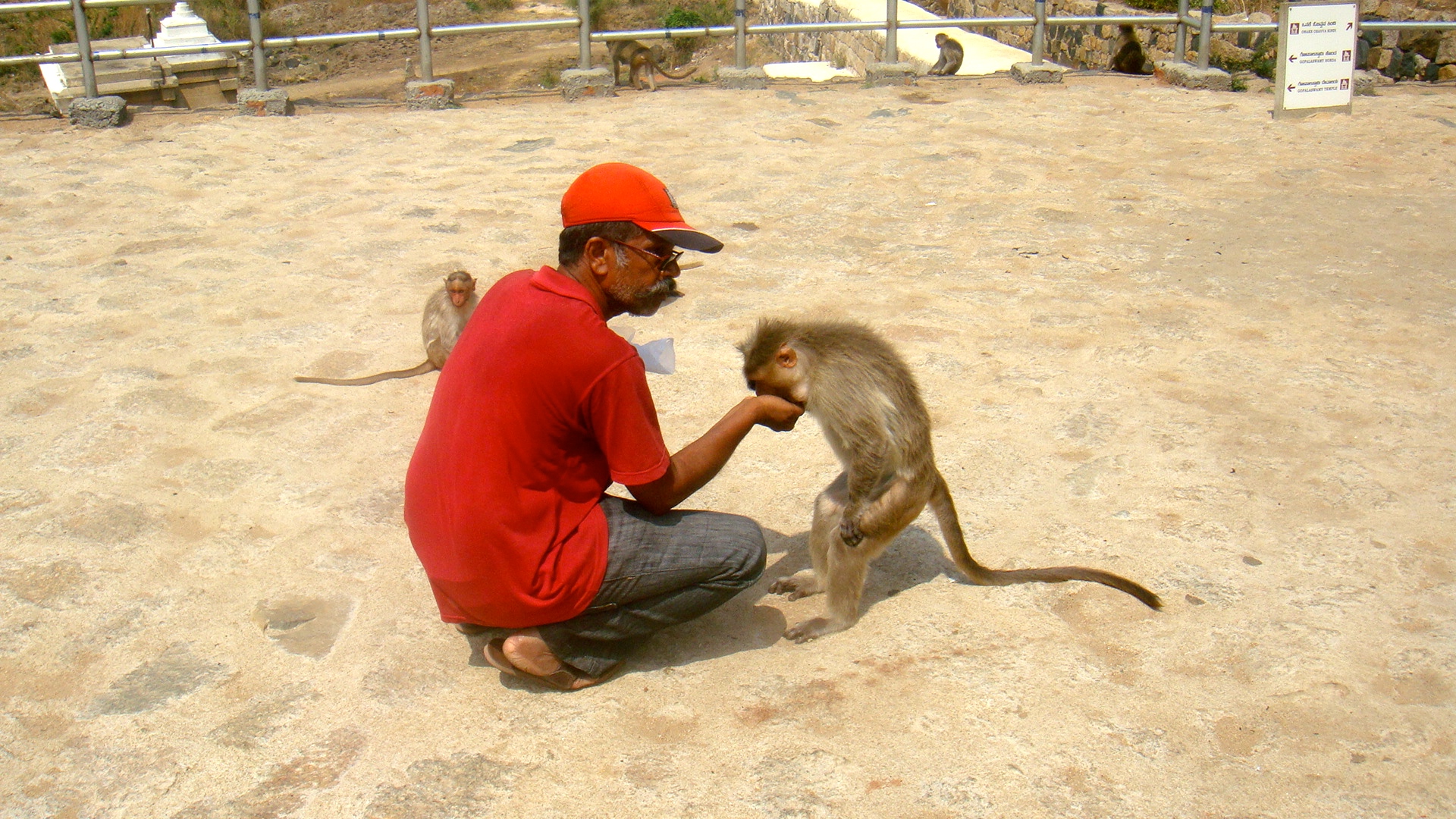
and super carvings:

So quite a fort – and quite a stroke of luck arriving in Chitradurga at dusk.
Kochi to where? Our next major destination after Kochi was Hampi, that meant two overnight stops, the first in Ooty, the second wherever we reached. We decided on the scenic route from Kochi which first took us north then east through the Parambikulam wildlife sanctuary then north again dropping down onto the plains before climbing again to Coonoor and Ooty.
We were following the Chalakudy river and passed the 80 foot high Athirappilly waterfalls:

Upstream from the falls is the Sholayar reservoir outlet:
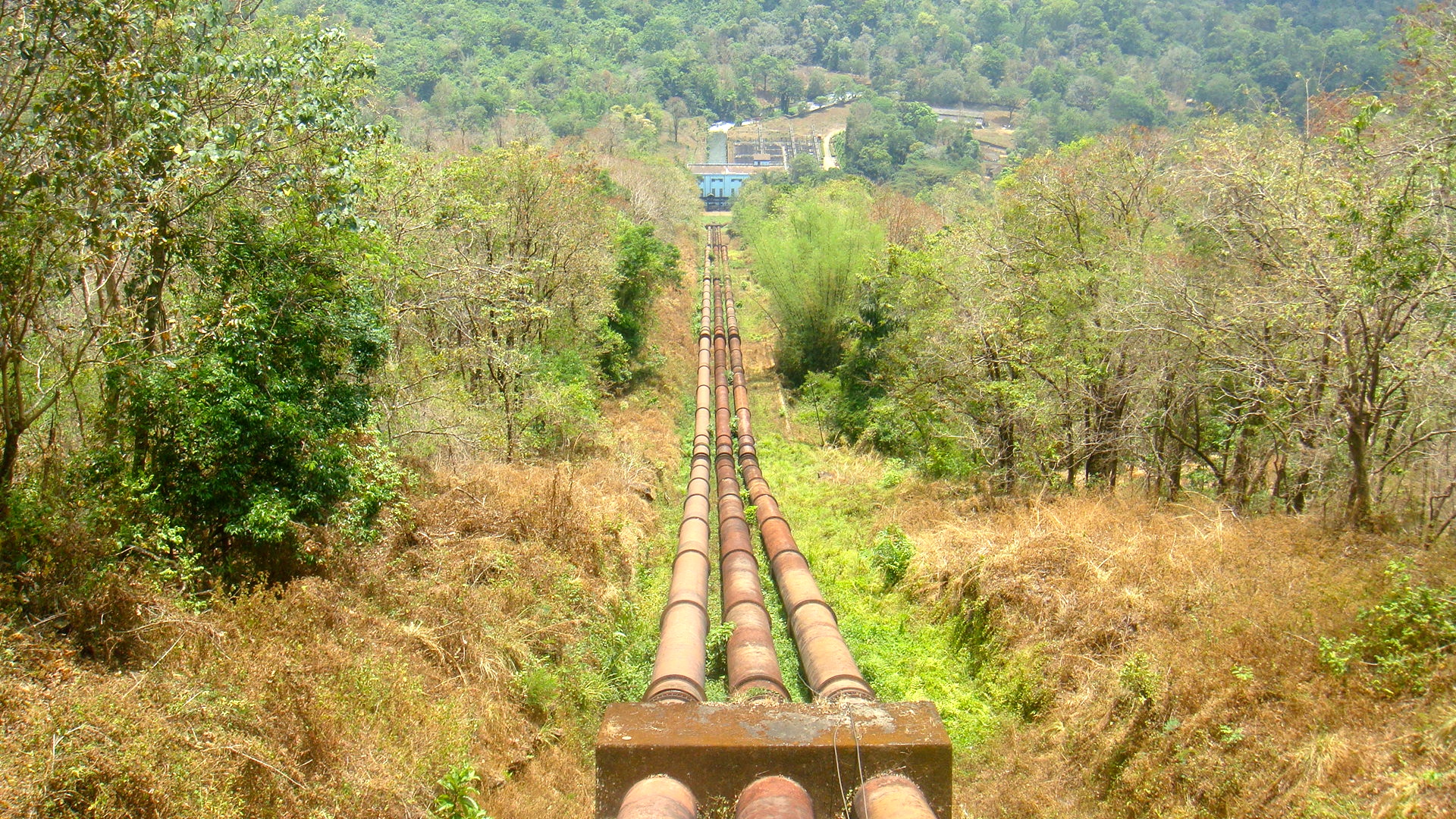
and further up still the reservoir itself:

We were making good time through the sanctuary until we came across a road gang laying new tarmac:
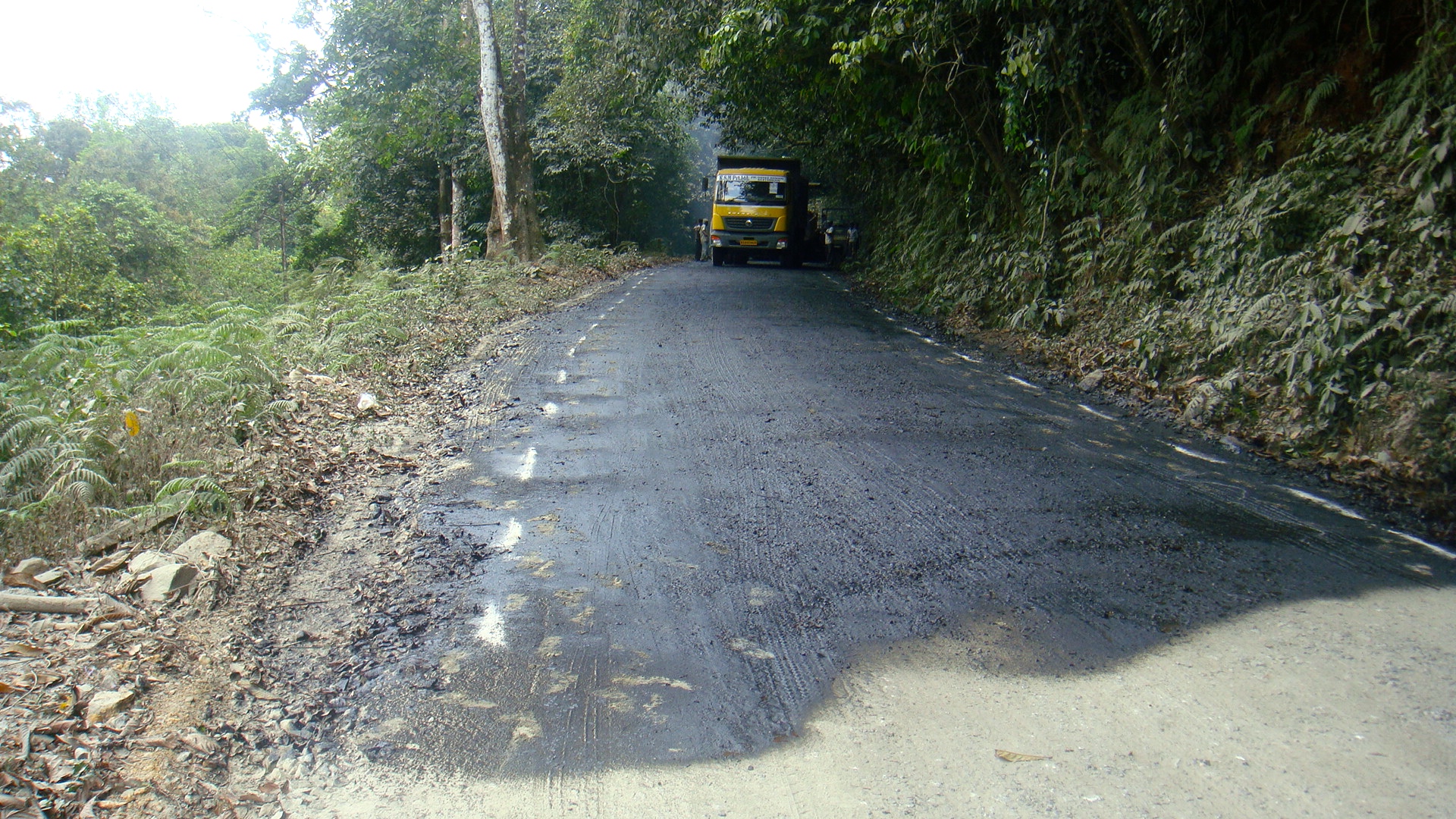
We had to wait whilst they sprayed the road and laid and rolled the new tarmac. We were given various estimates of waiting time ranging from two to ninety minutes. Nothing much happened for a while, there was a lot of shuffling of trucks, all kinds of discussions and then, suddenly, we were cleared to go.
We left the sanctuary, passed through Valparai and turned north soon to come across a huge climb with seventeen hairpin bends. We were back up in tea country and crossed a plateau scattered with tea workers cottages:
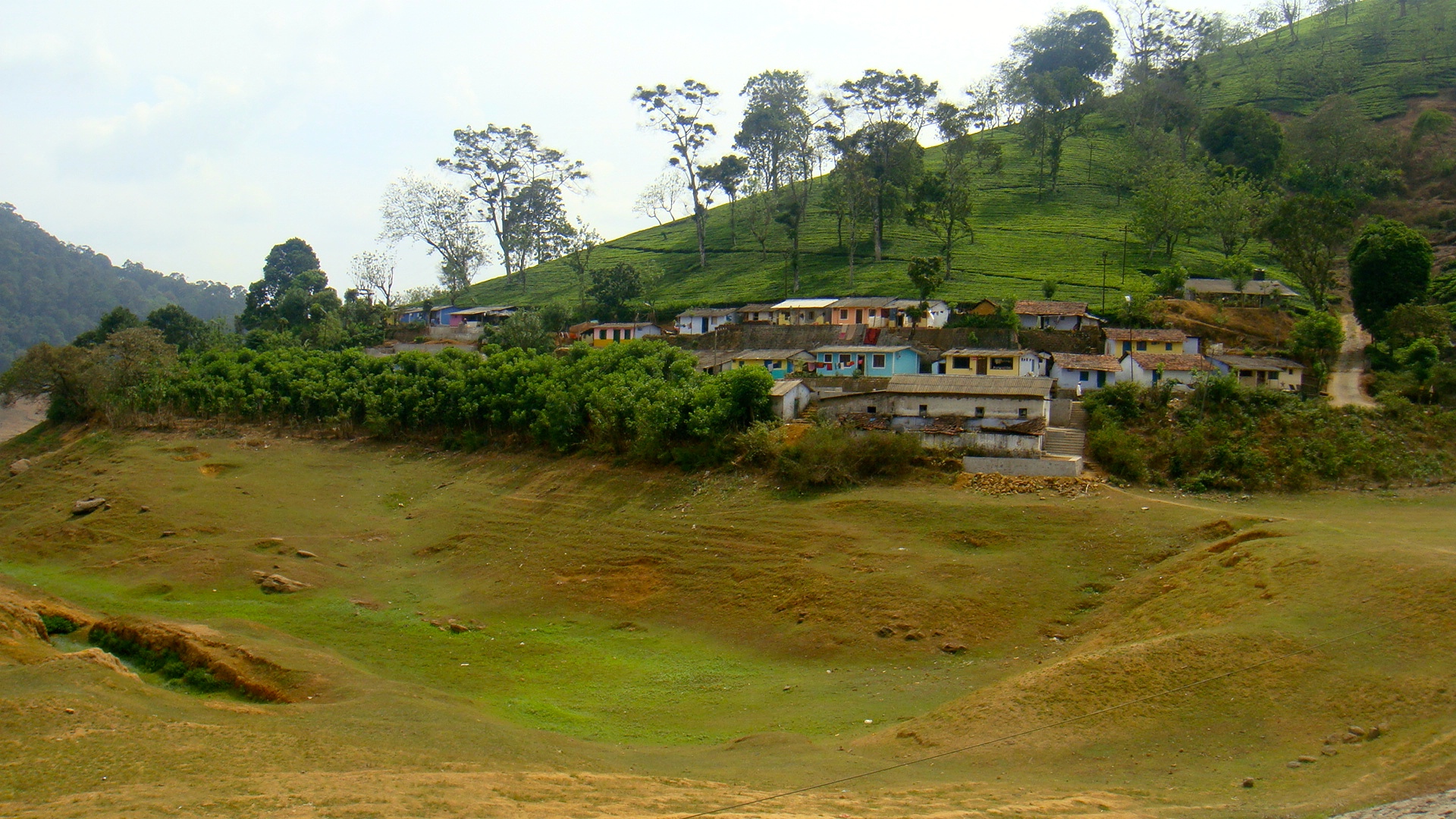
before reaching the drop down into the plains. After the seventeen hairpins on the way up we had twenty three more on the way down, here’s the midway point, bend twenty:

The descent was stupendous, it reminded us of the Stelvio pass in Italy:

When we took the shot above we could see animals on the road lower down, they were still there when we arrived:
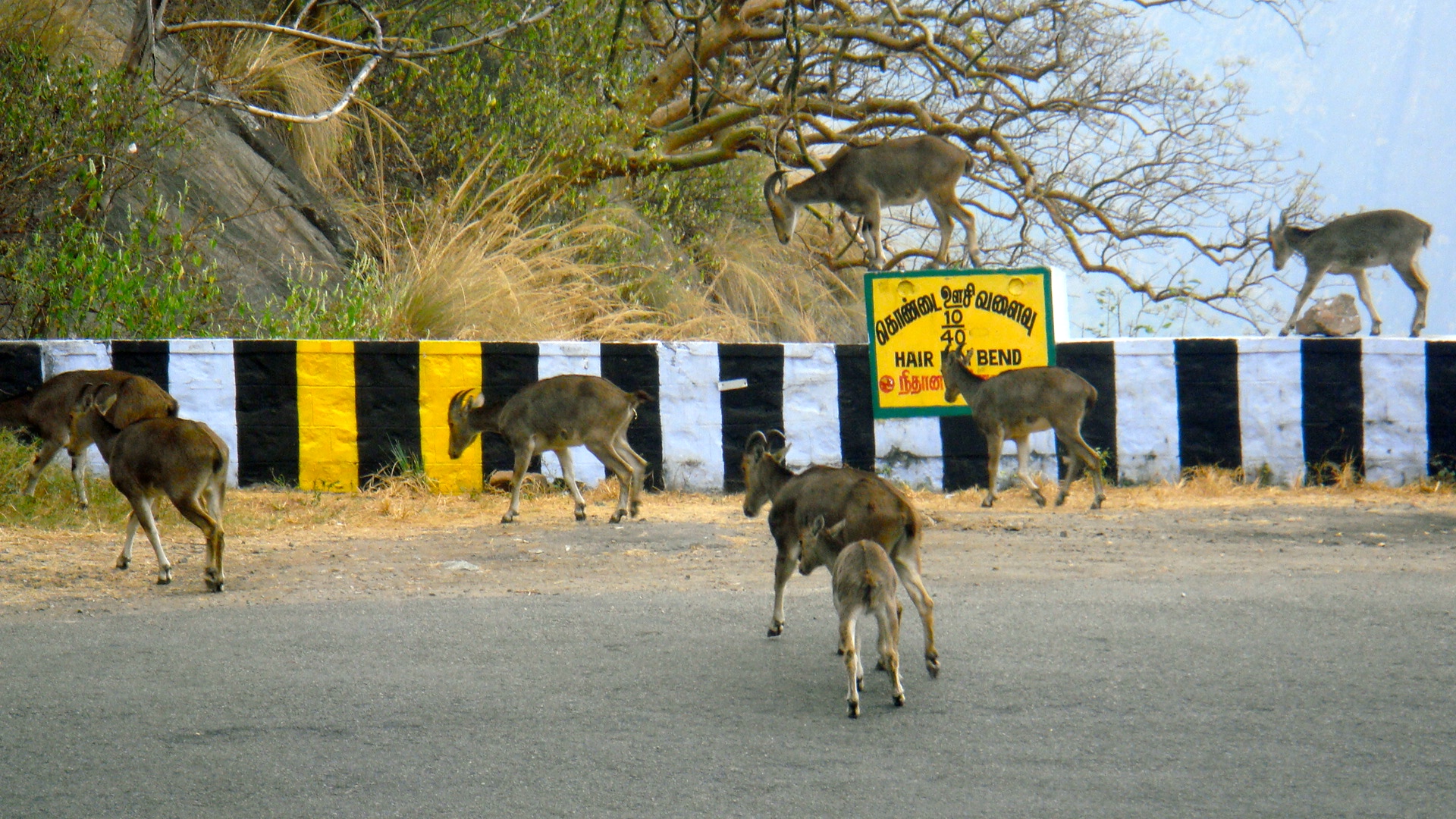
(The bends in our direction were numbered from forty down to one).
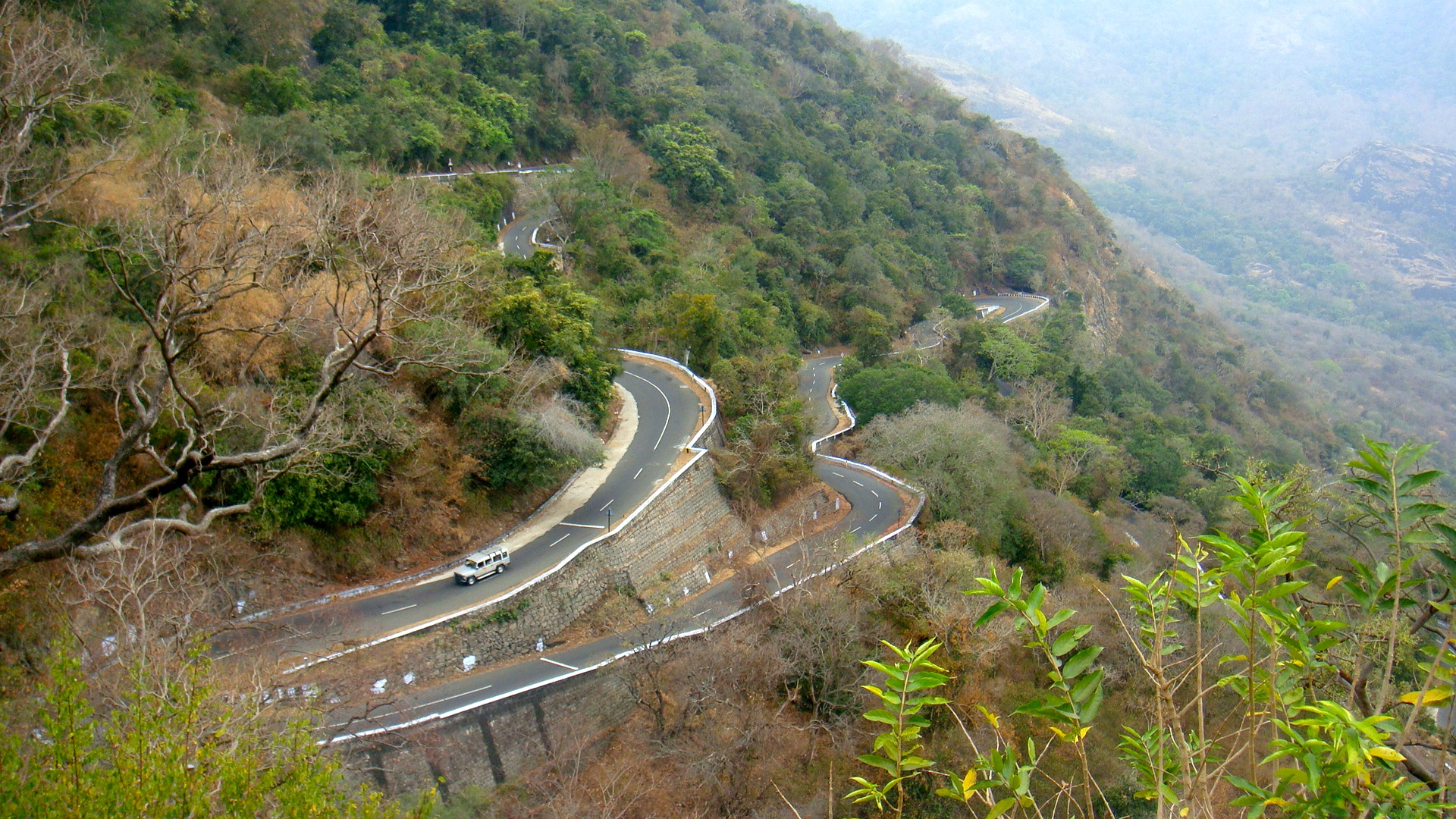 Another shot of the endless descent!
We had started the day early but our route was slow and by the time we had crossed the plains and reached the bottom of the climb to Coonoor and on to Ooty it was already dark. We decided to do the climb in the dark which was more than exciting, it was 52km long and climbed from 325m (1,070 ft) to 2,240m (7,350ft). With all the cows, cars, trucks, buses and bends I’m not sure if reaching Ooty was a relief or a surprise!
Next morning we were on the road again heading north but not before we visited the beautiful St Stephens church in Ooty:
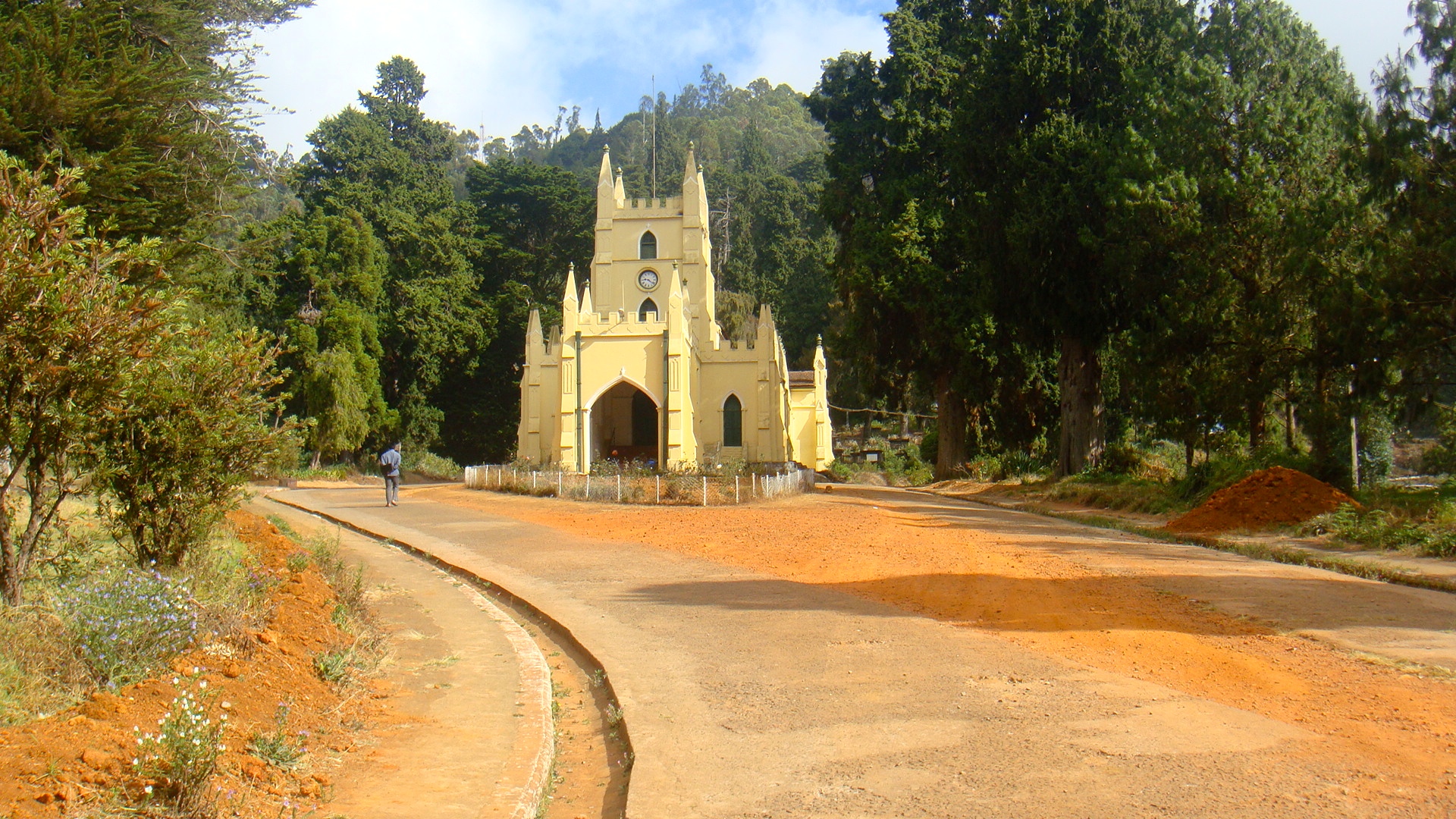
The church was built in 1830 and opened on Easter Sunday in 1831.

Several of the plaques told interesting tales:
 Georgiana, died at 30 leaving 7 children.
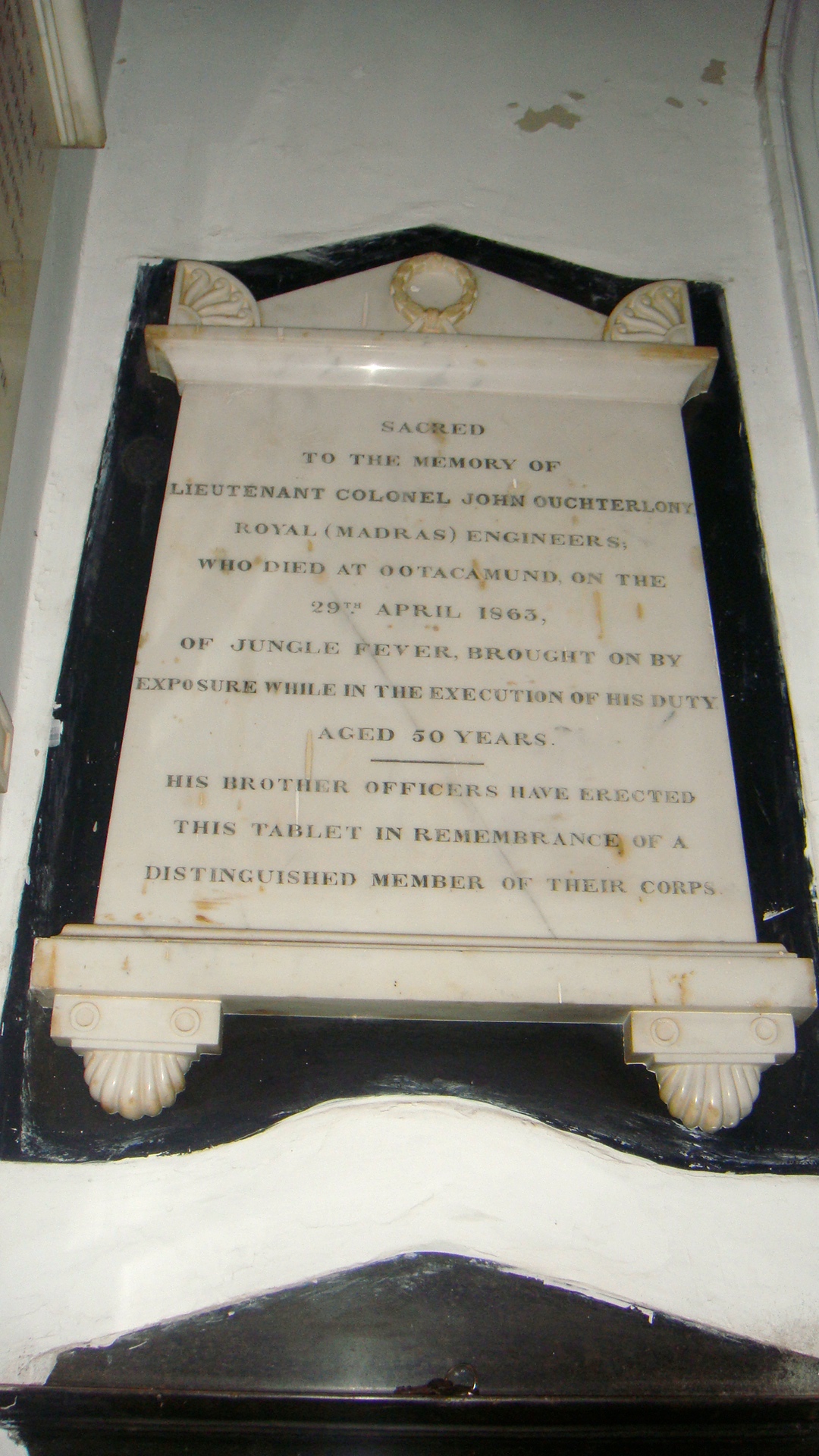 Died at Ootacamund of “Jungle fever” (Malaria).
We drove on in the hills from Ooty passing through villages:
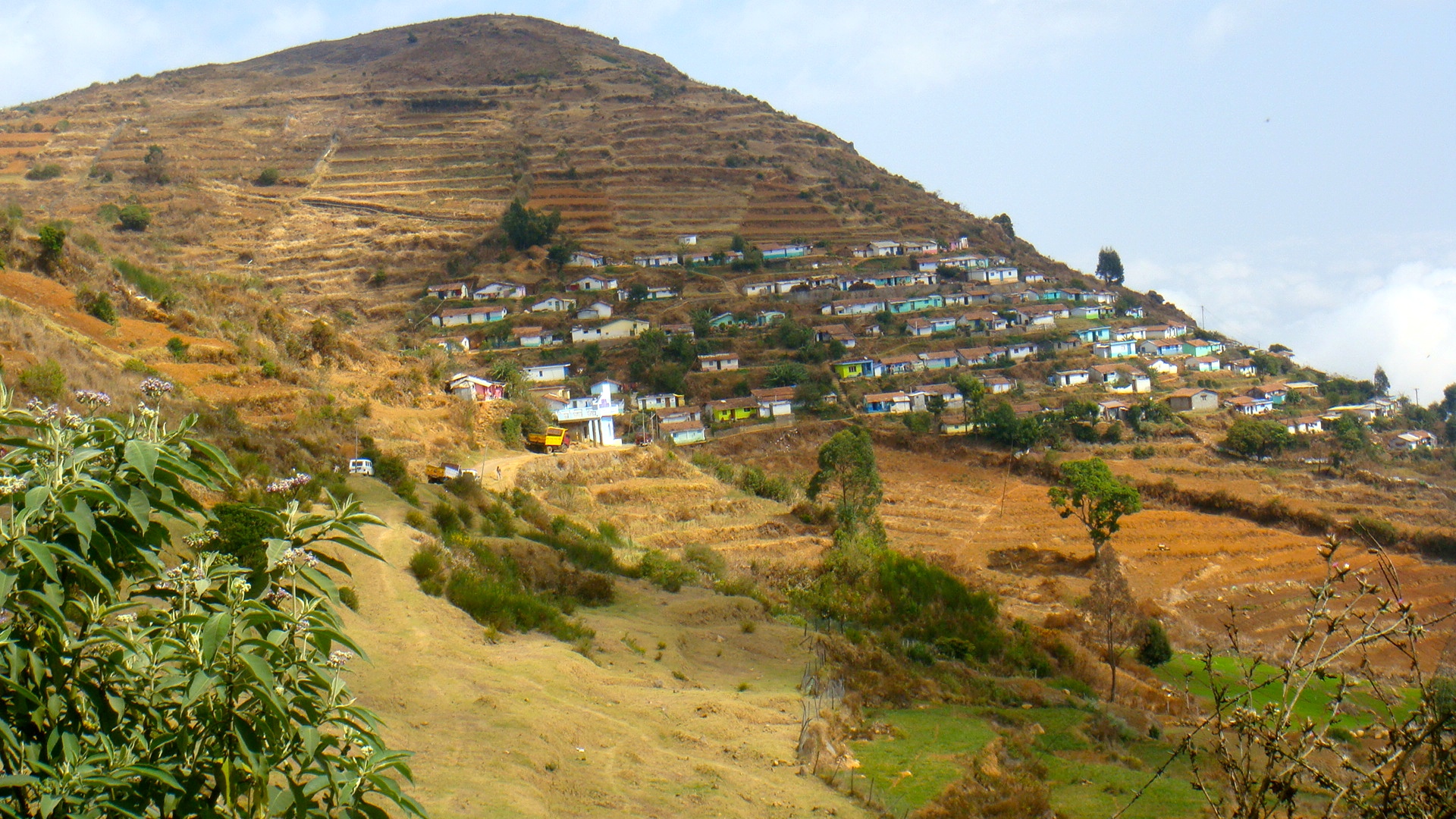
valleys:

and tiger reserves:
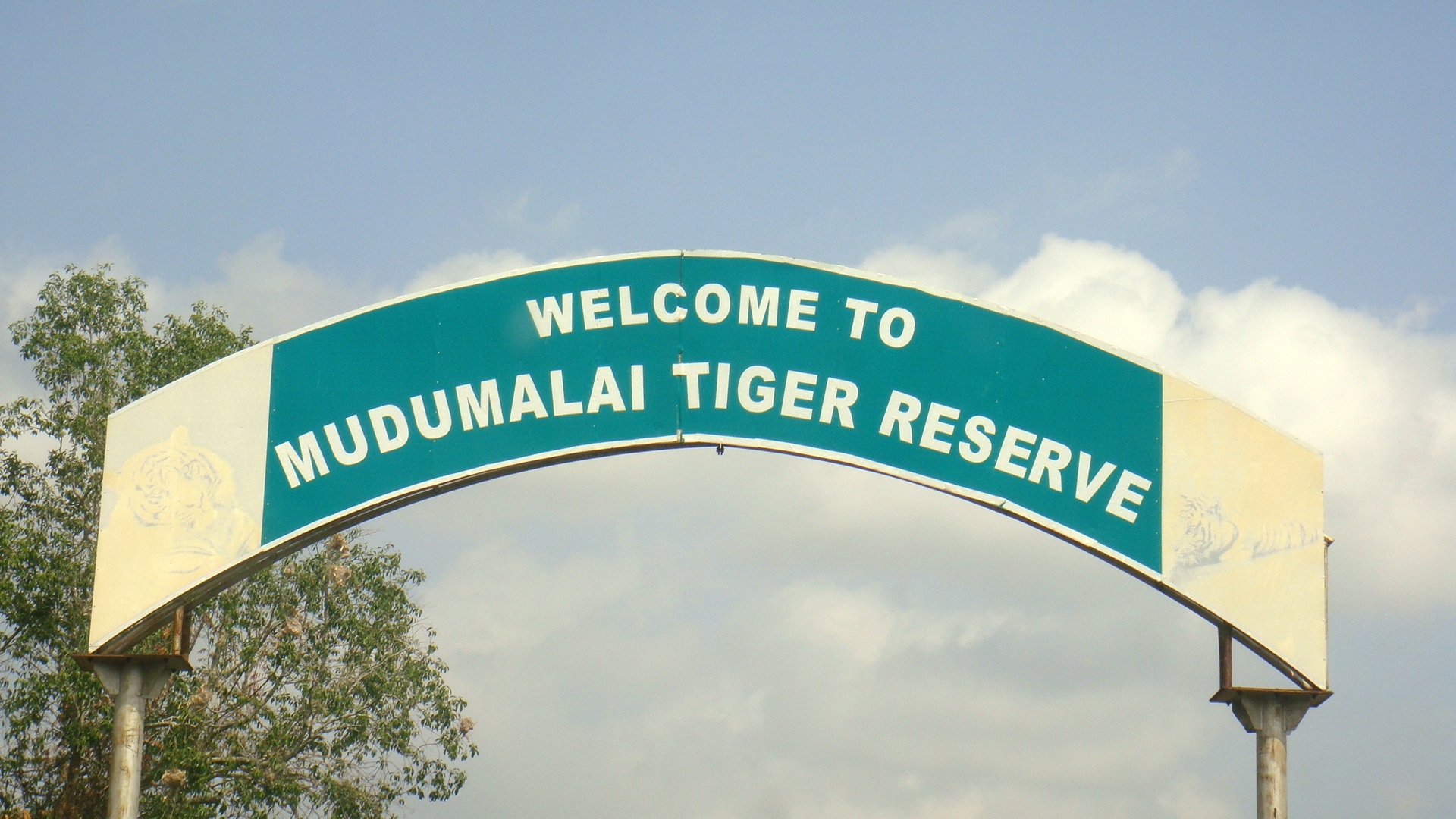 Mudumalai in Tamil Nadu
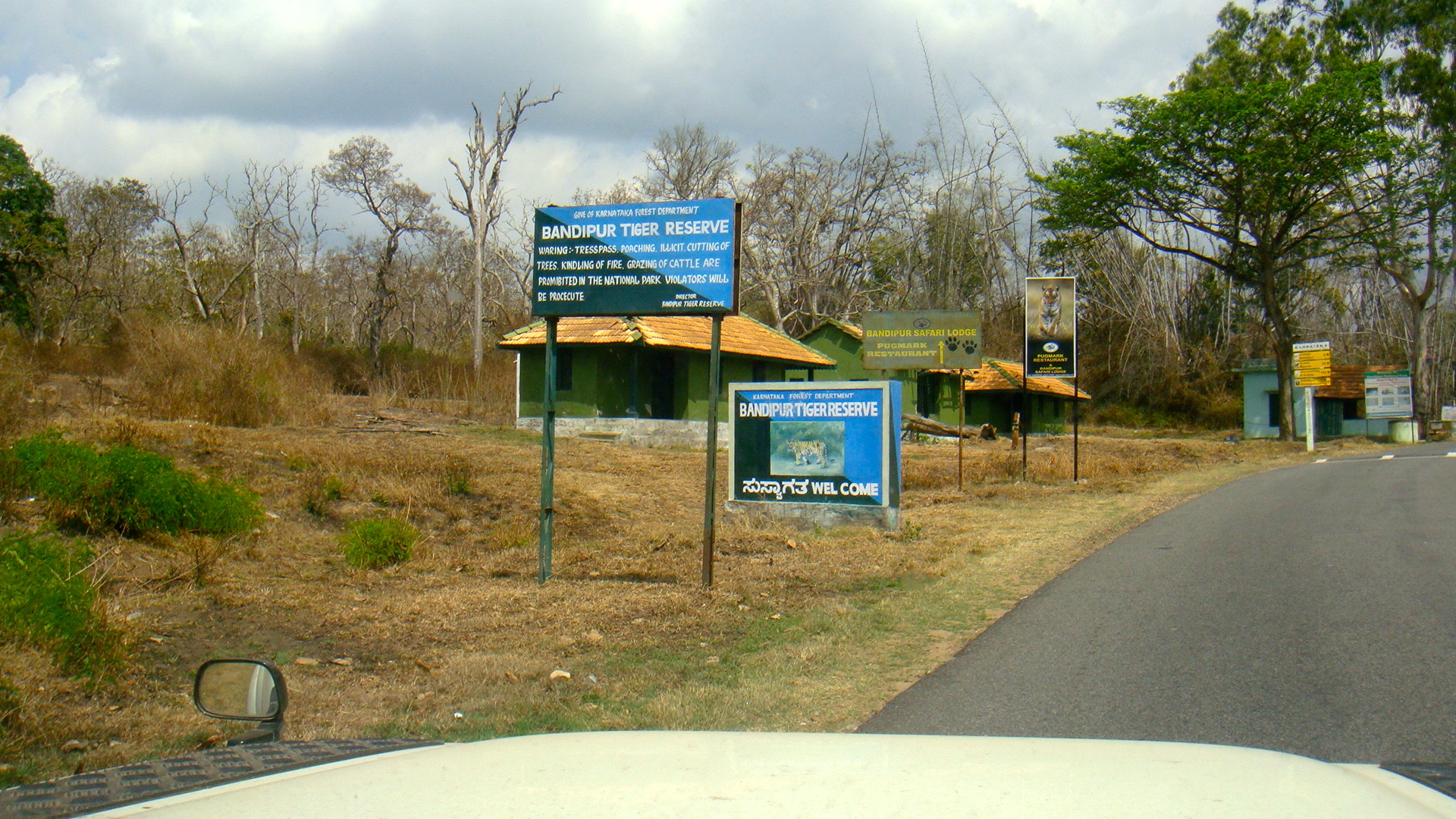 Bandipur in Karnataka
Sadly no tiger sightings 😦
By now we were leaving the Nilgiris (the range of hills we had been passing through) and the countryside became flatter but no less interesting:
 Bamboo ladders.
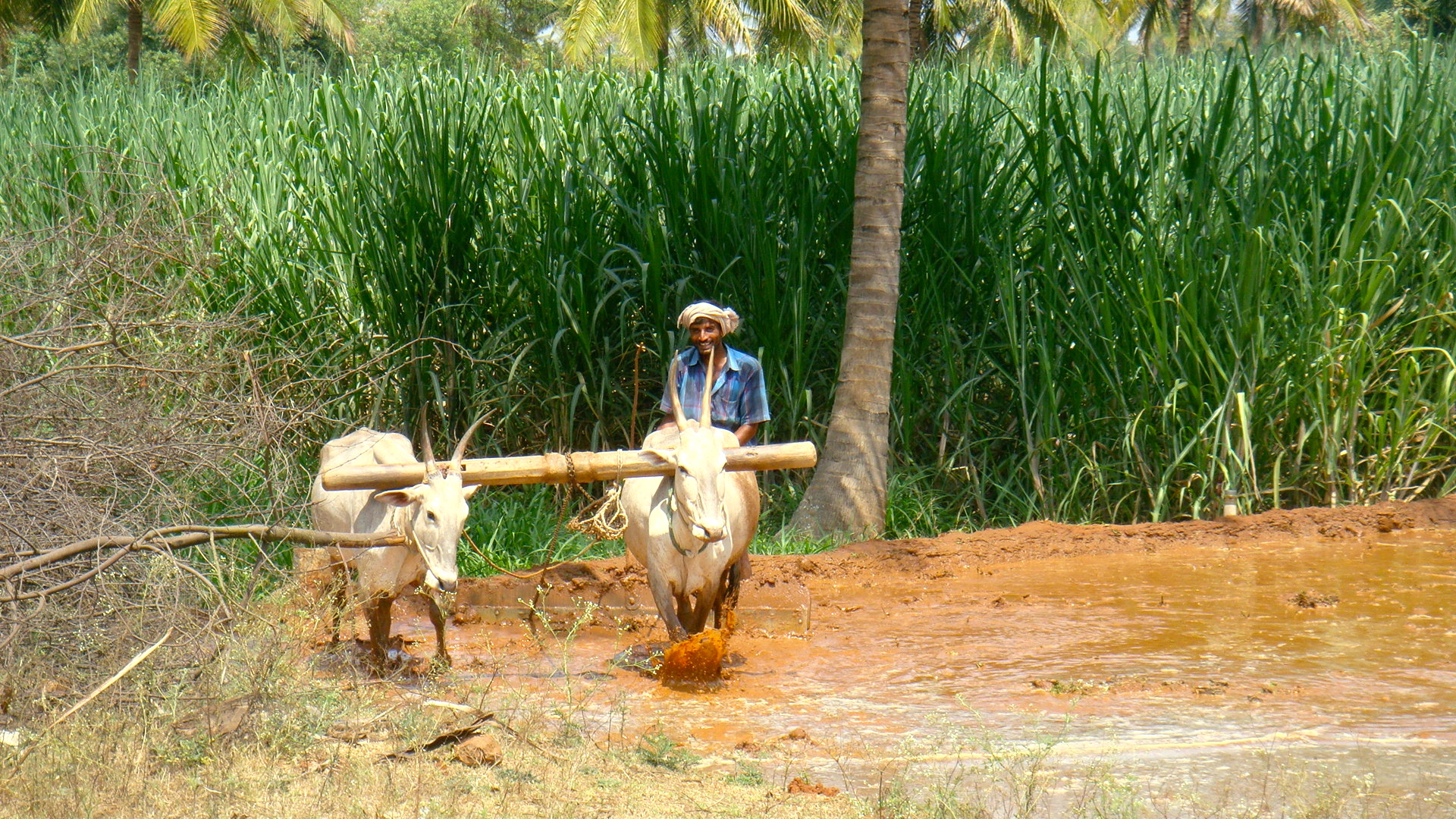 Happy in his work.
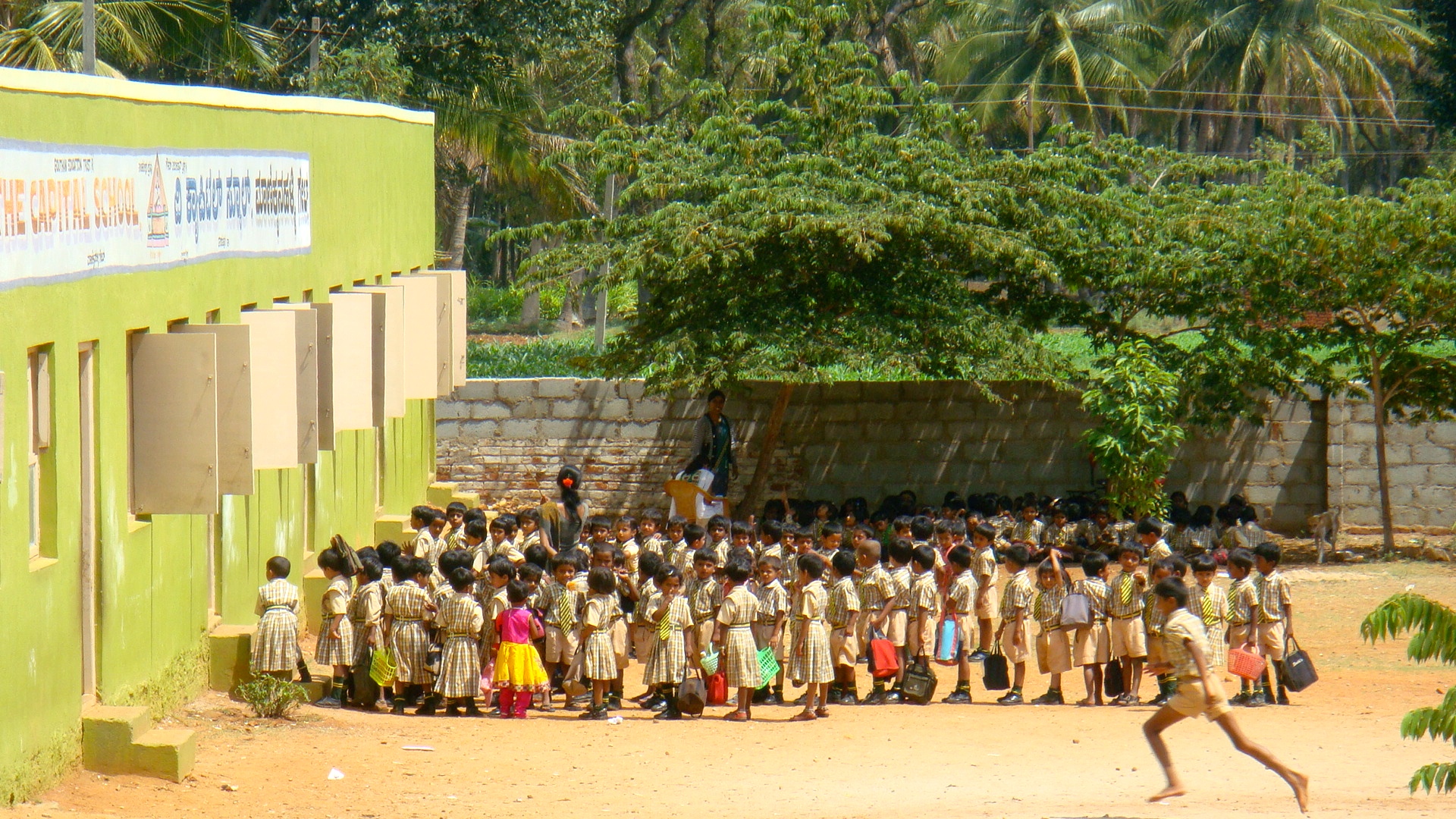 I remember lining up like this in school!
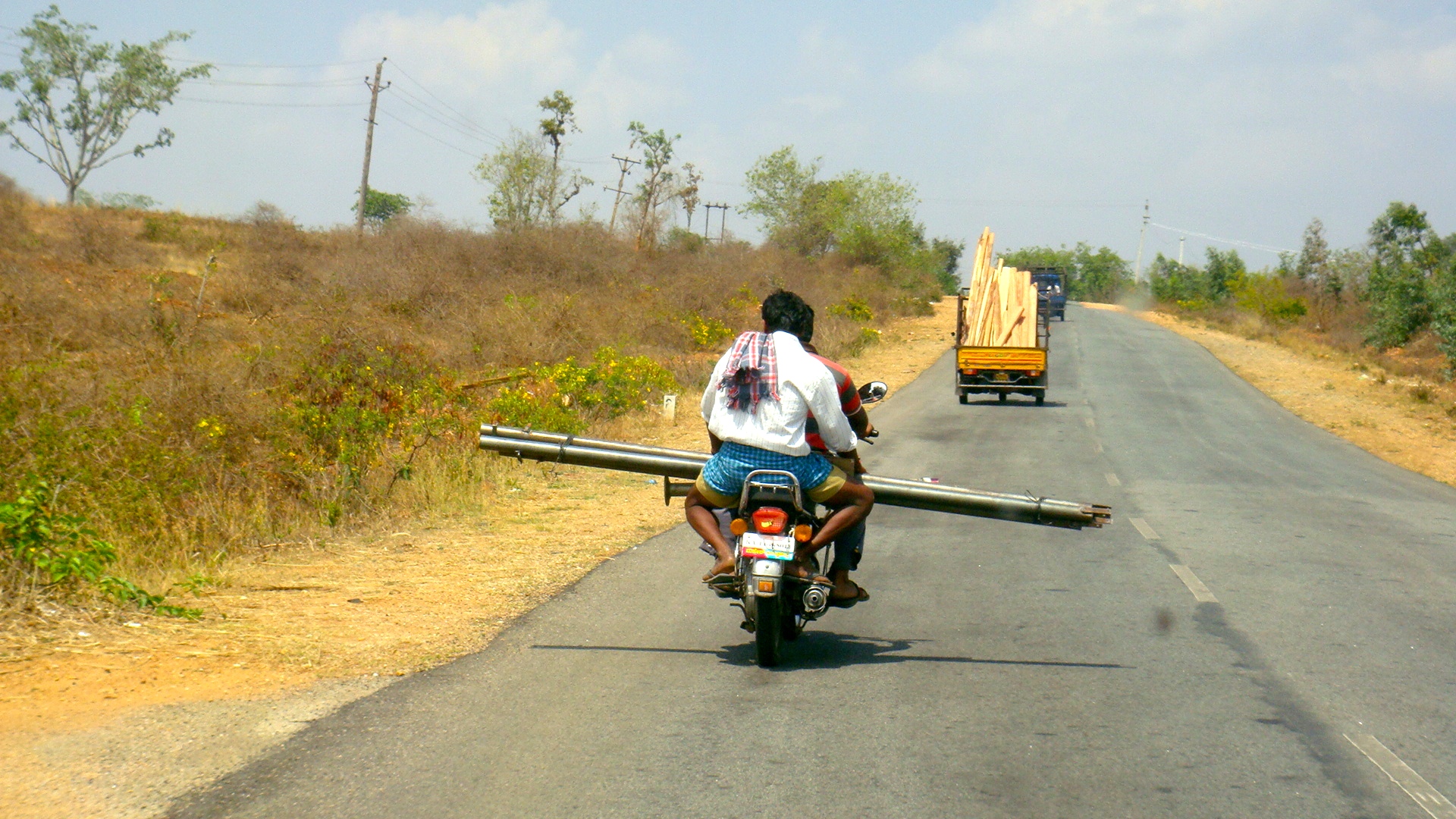 Wide load?
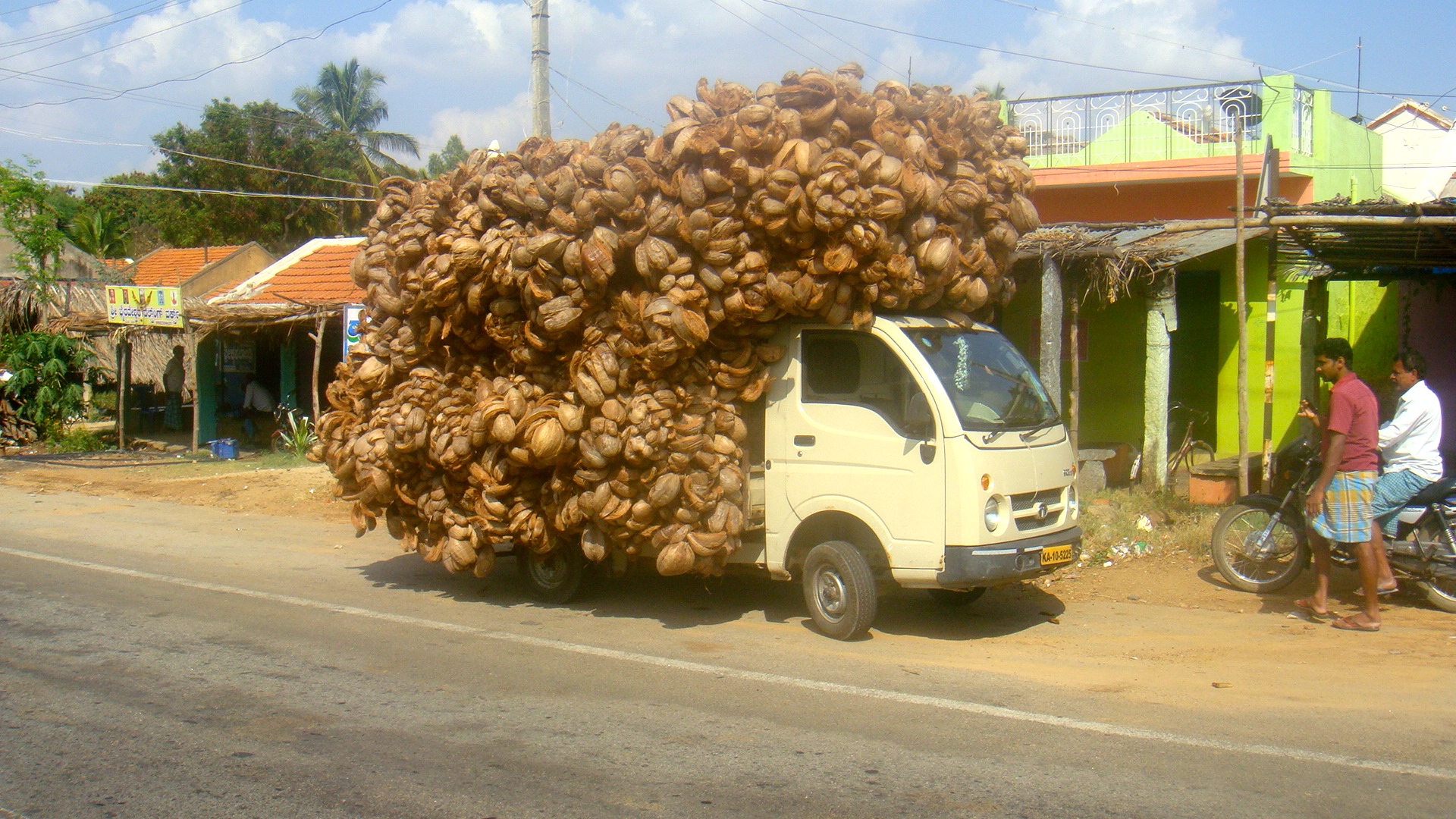 A lovely bunch …
Around noon we arrived at a typical Indian one-street roadside village called Adichunchanagiri, a village with a difference. This village is home to an absolutely massive temple complex which sits on a rocky hillside with commanding views over the plains we had just crossed. We visited the temple, here’s the climb up to it:
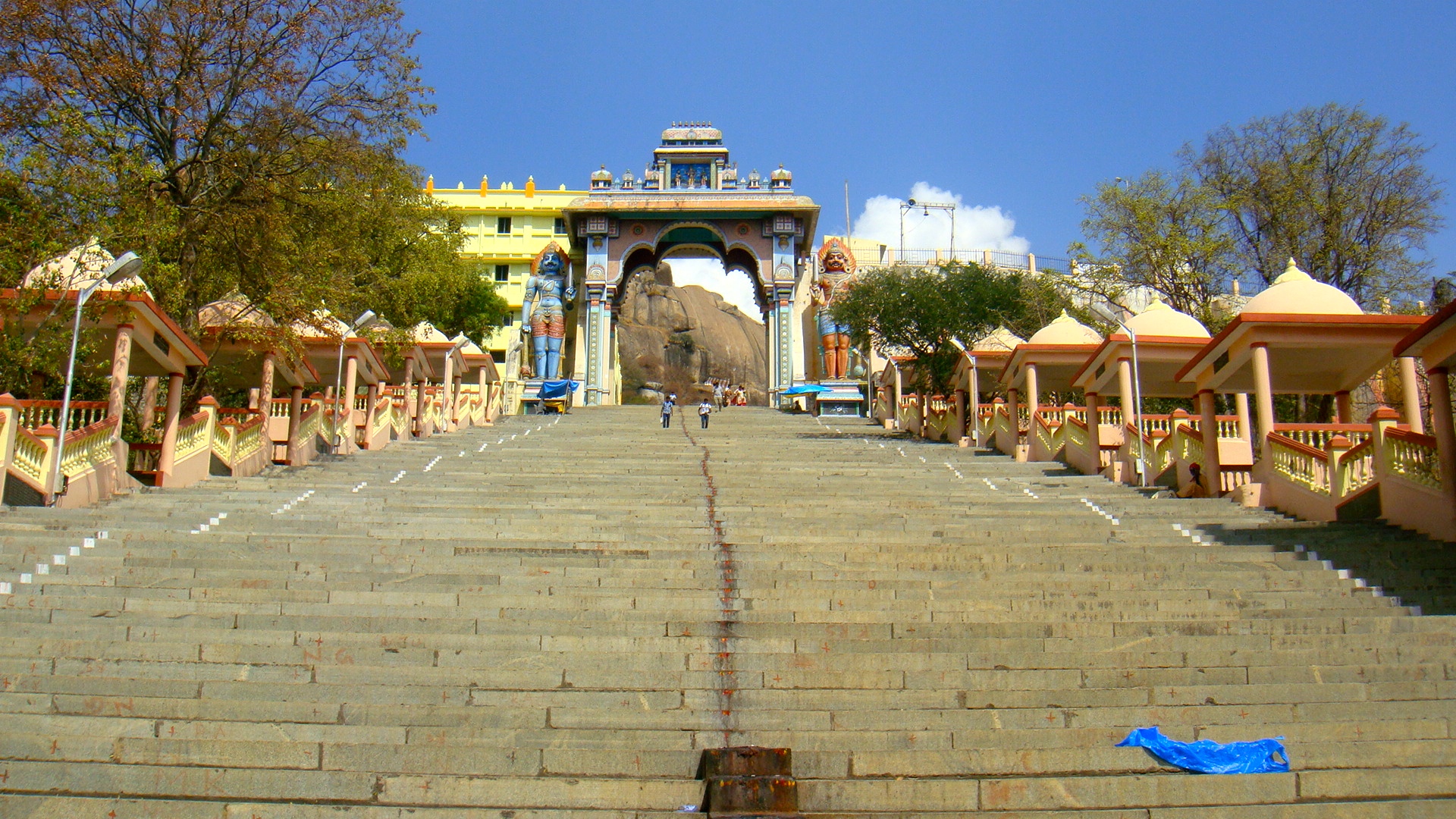
Every step was numbered and plaques at each flight listed a sentence against each number; this was the last flight:
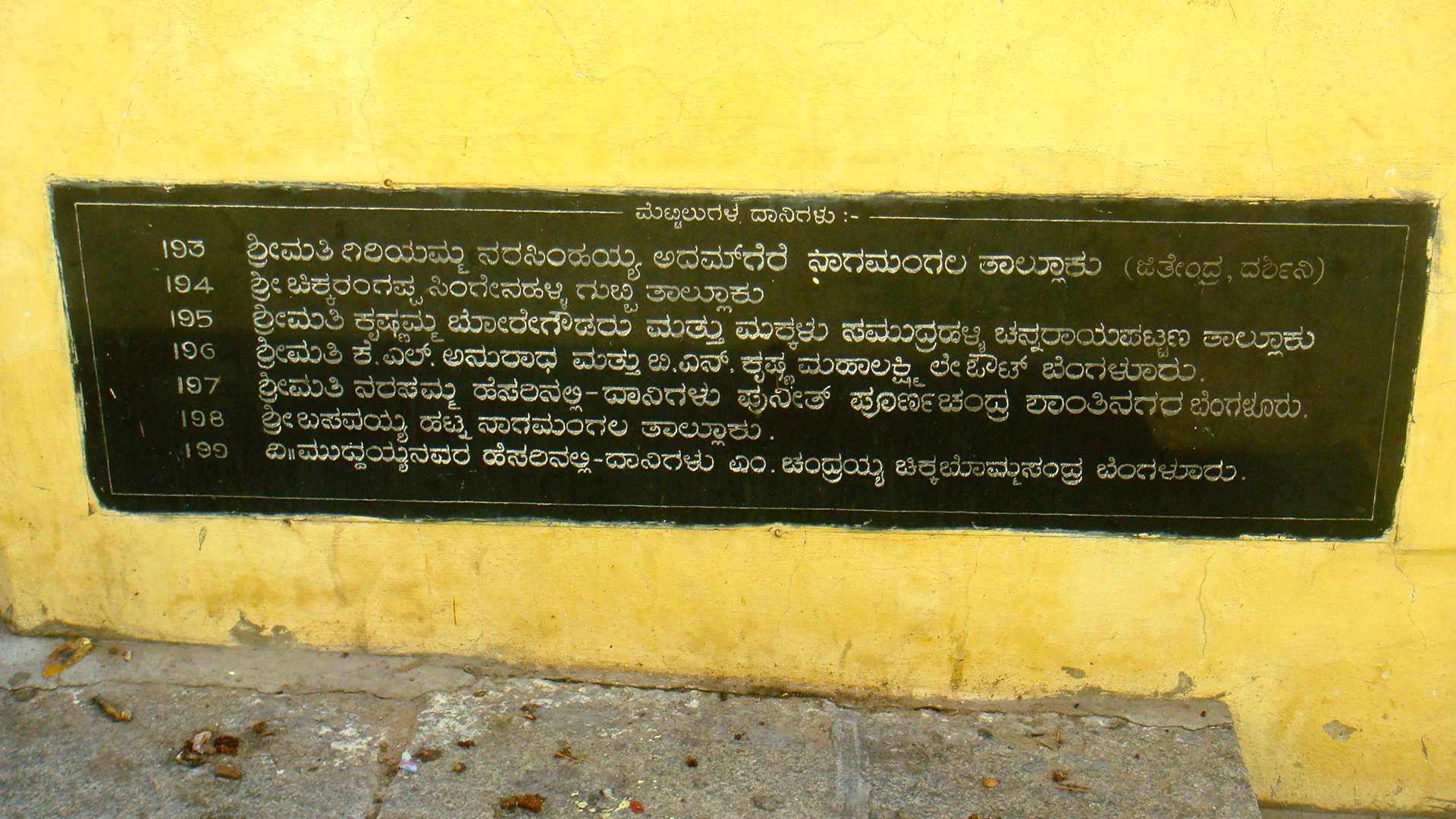
No idea what they say, hopefully one of my Hindu speaking friends will enlighten us all.
Inside the main temple:
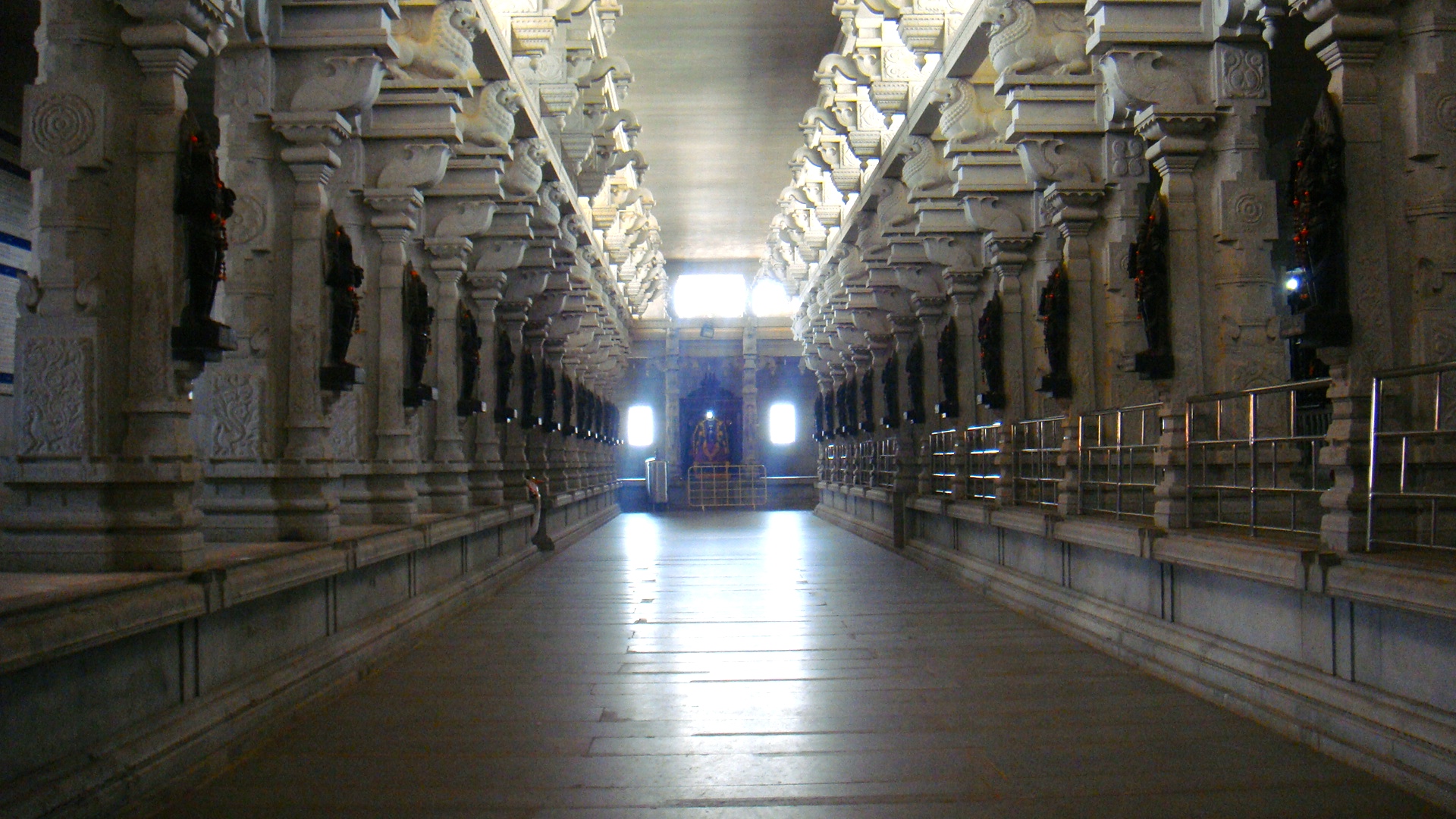
Like the Golden temple this temple offered food to all visitors so rice and vegetables it was!
Further on along the road we came across an entrepreneurial troupe of ladies who were waving down cars and then doing a folk dance. This was the view through the windscreen, they were very talented, very friendly – and very happy with the tip we gave them!
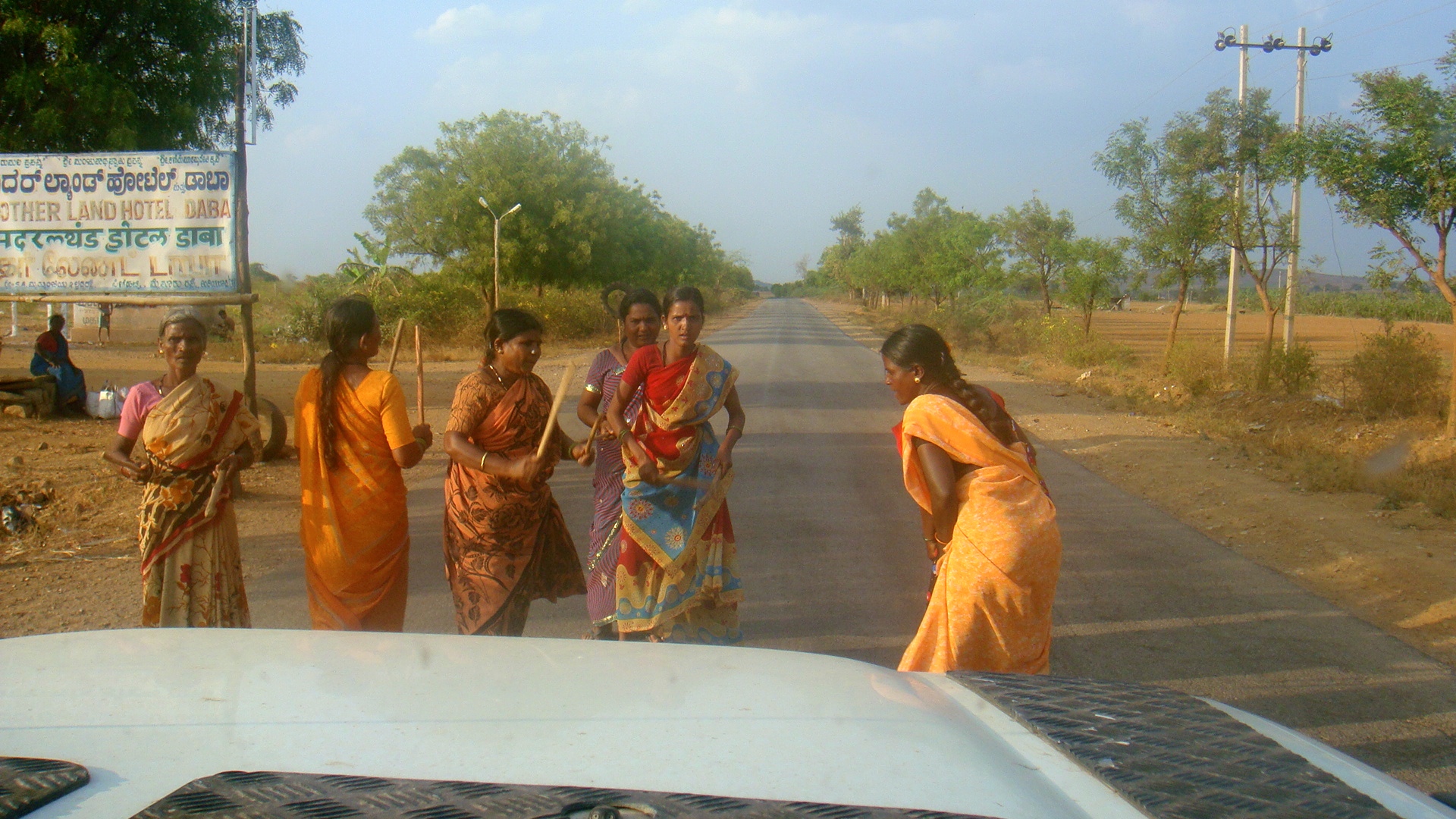
Soon the sun was setting, time to stop. We were very close to a town called Chitradurga so we decided to stop there but not before we took take one last picture:

We left Allepey and took the short drive to Kochin, once again great sights along the way:

 Chinese fishing net
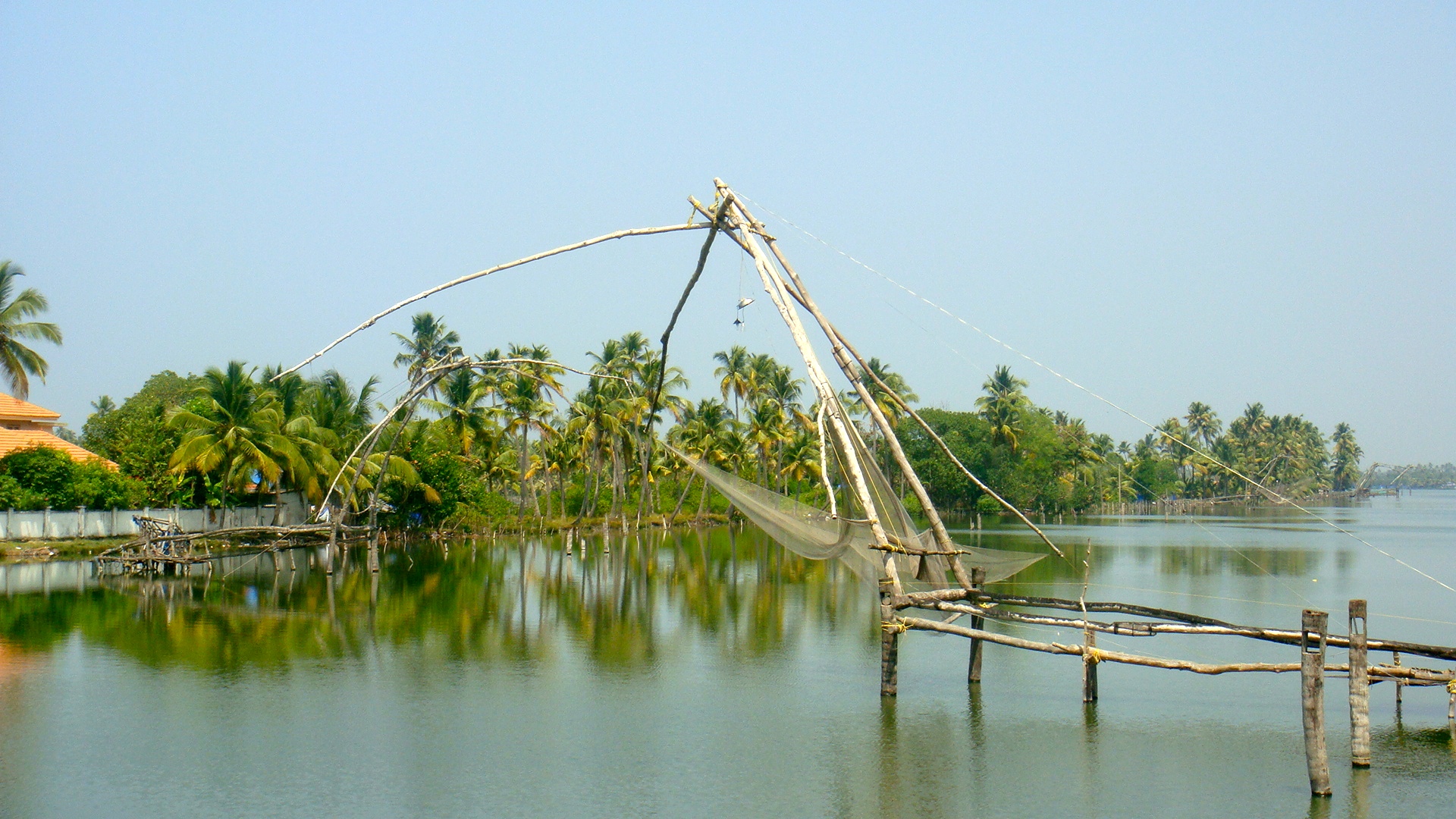 and another, very common here.
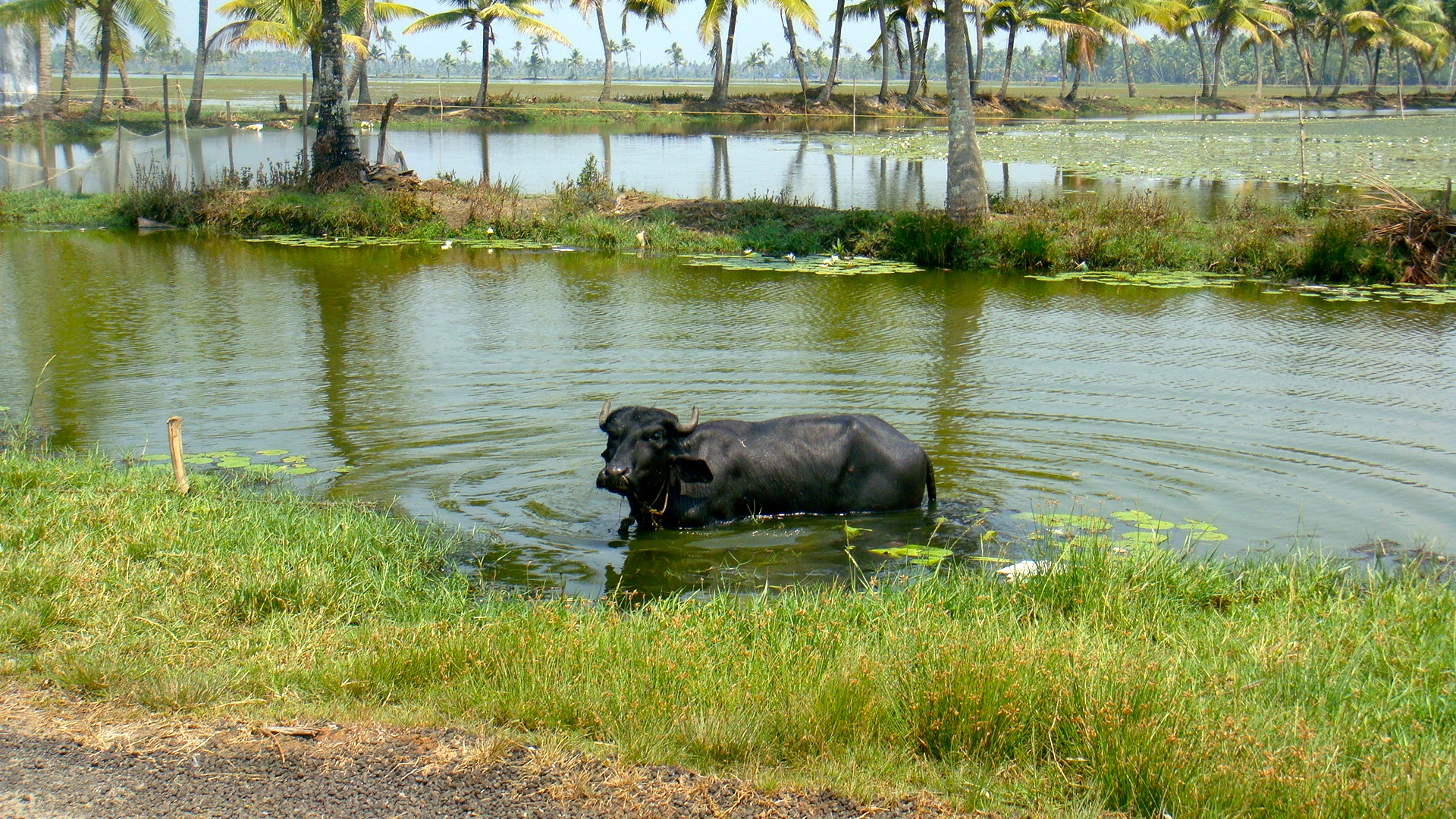 It was warm!
We arrived in Kochin and went out to explore the area. The first thing we noticed was that this is a wealthy area, several of the houses near the Fort are really impressive:
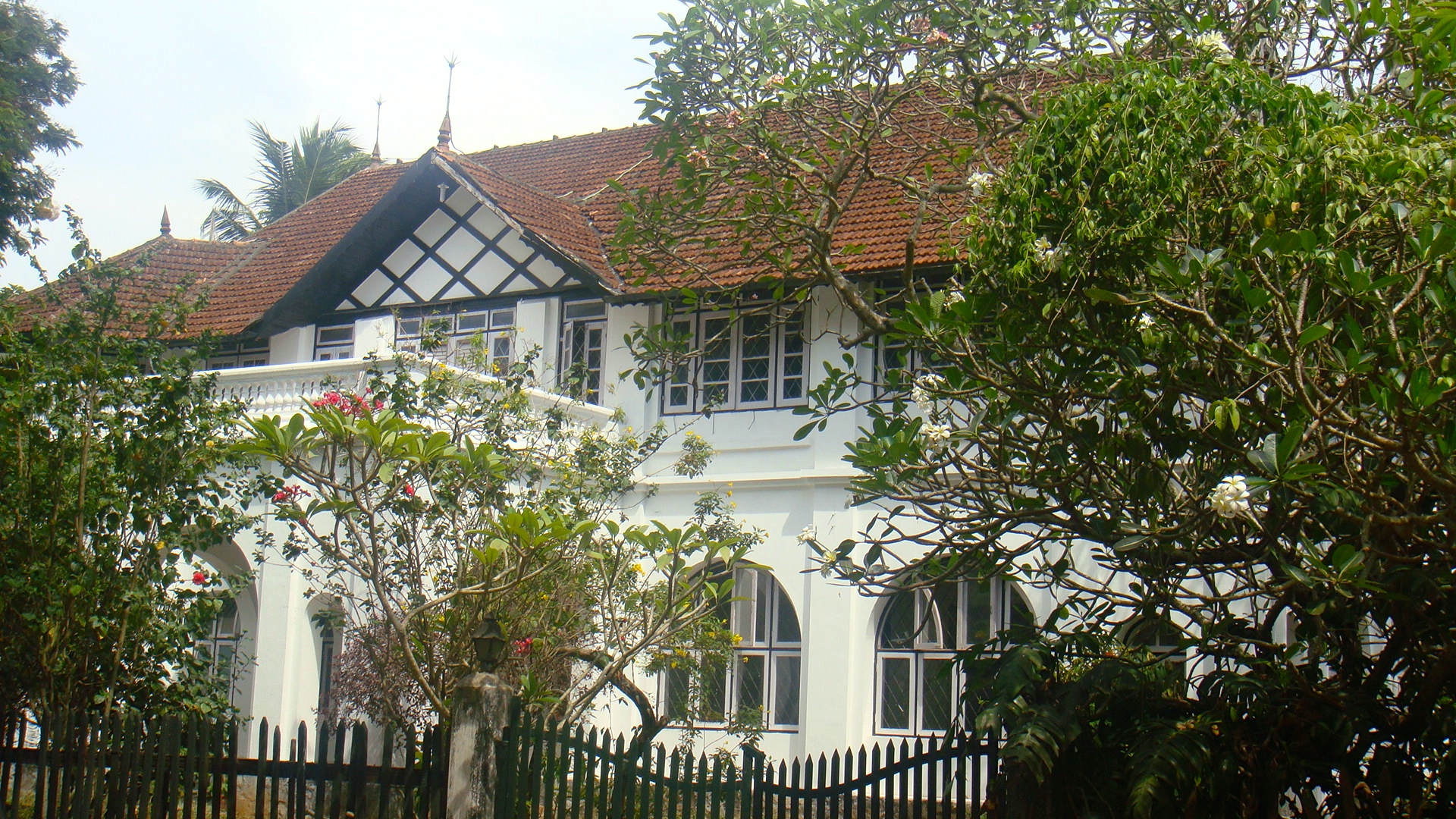
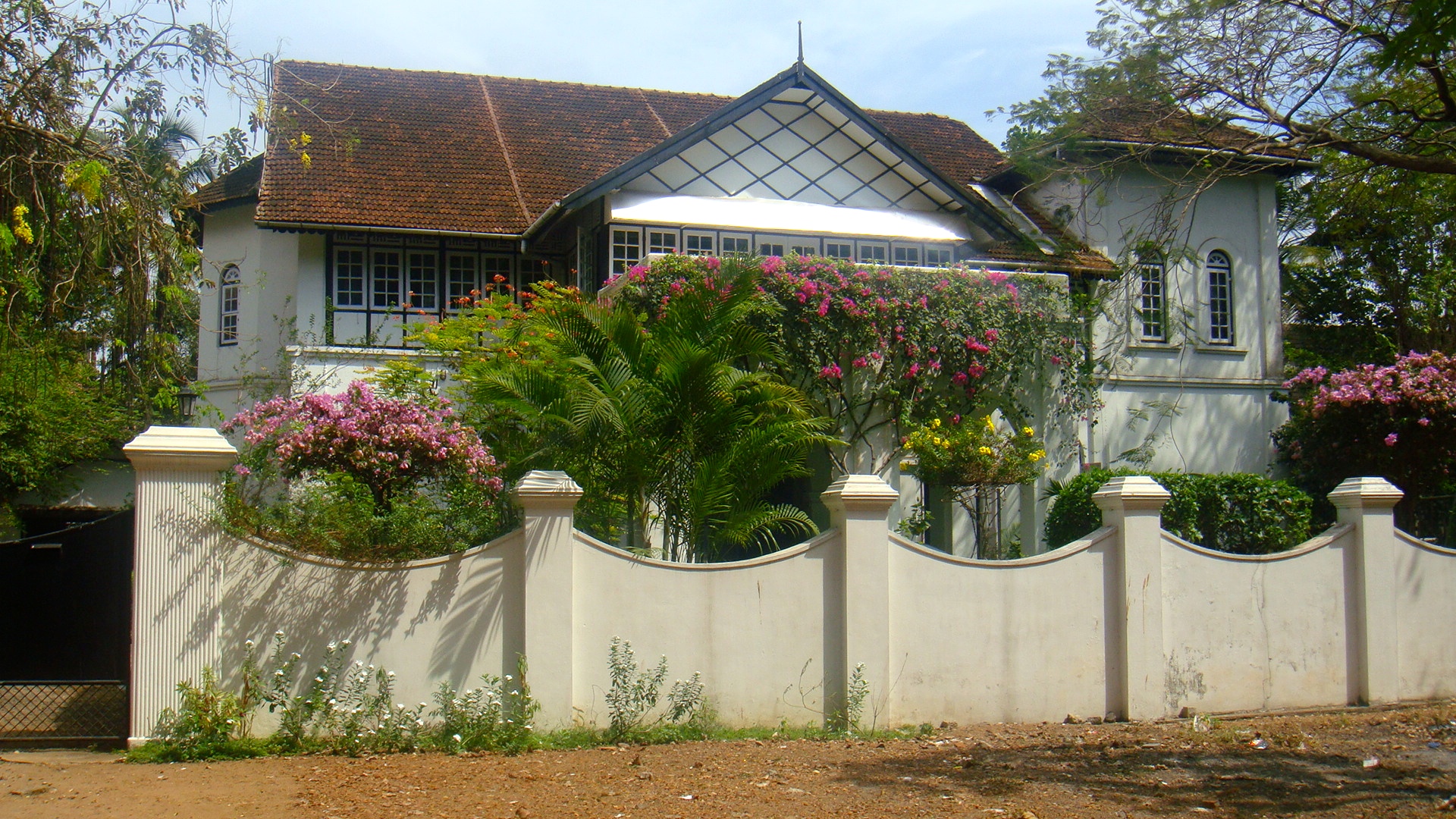
Off course just like everywhere in India the rich and the poor live side by side.
Our first sight seeing stop was the Indo-Portuguese museum, lots of religious artefacts, most interesting for us was this traditional Keralan “Mani-chitra-thal” door lock:

The lock used to be displayed on the front door of Keralan houses and signified tolerance of all religions. The pattern symbolises the Hindu trident, the Jewish menorah, the Muslim crescent, the Christian cross and (between the spears of the trident) the Chinese symbols “Shou” and “Fu” meaning “Good Fate”.
We liked the lock so much we bought an old one which we plan to restore and display.
Next morning we recruited an auto-rickshaw driver and took a mini tour. We love this way of getting around the towns in India, you see a lot, there’s automatic air-con and you just get to relax and watch the world go by.
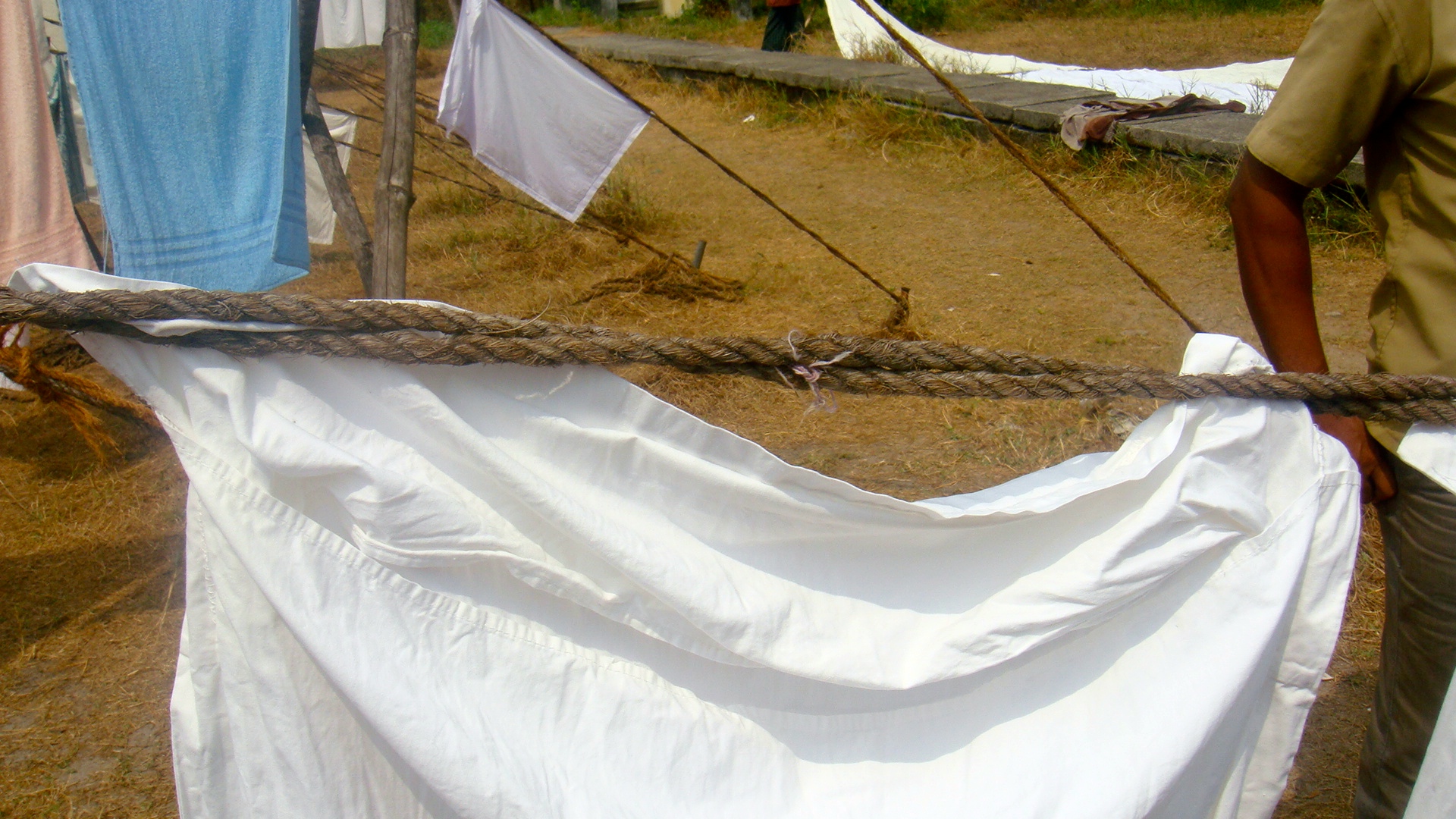
First stop was the local laundry, the drying area was huge:
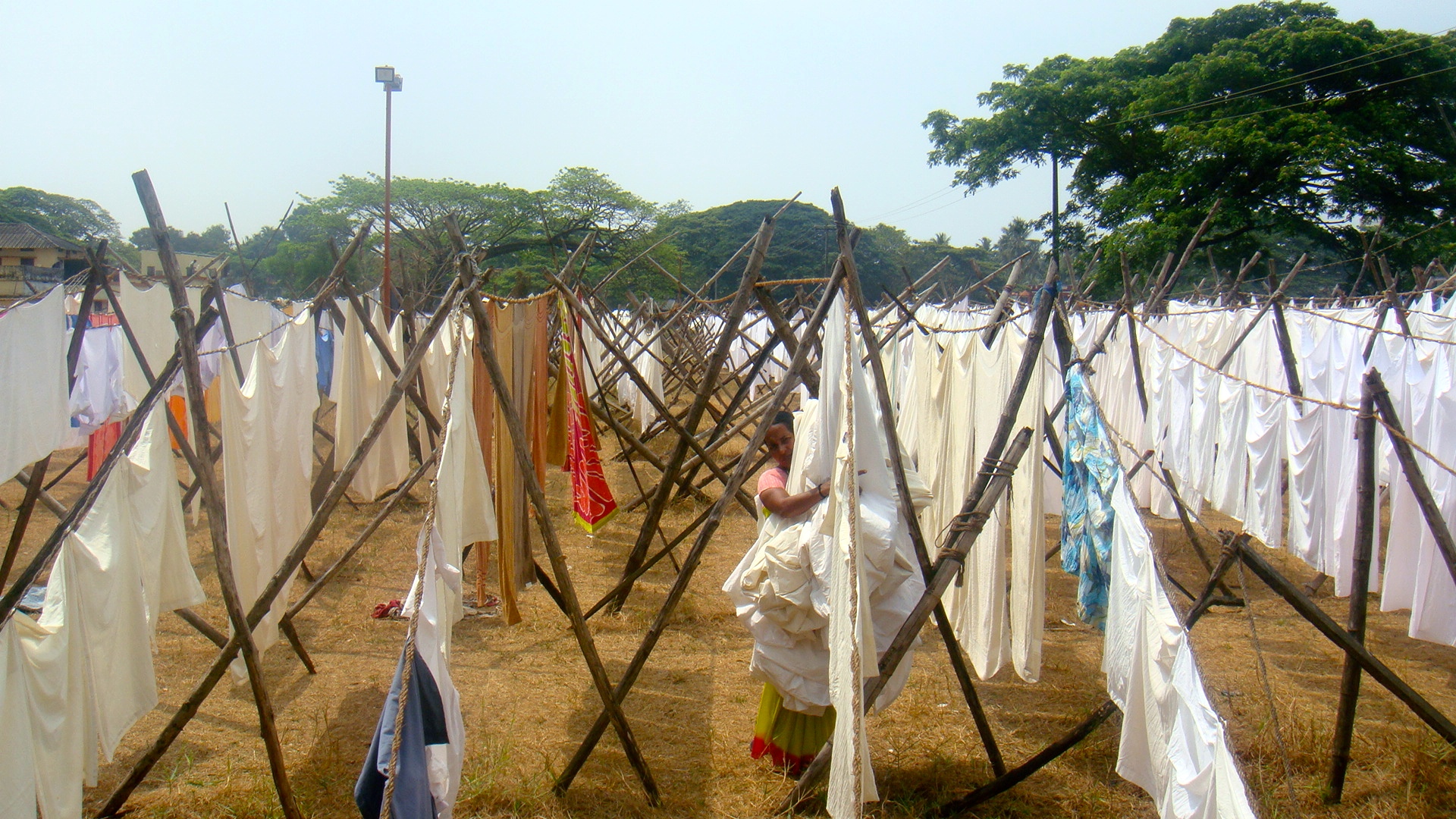
They twist two ropes to form the line and then push the clothes between the ropes:
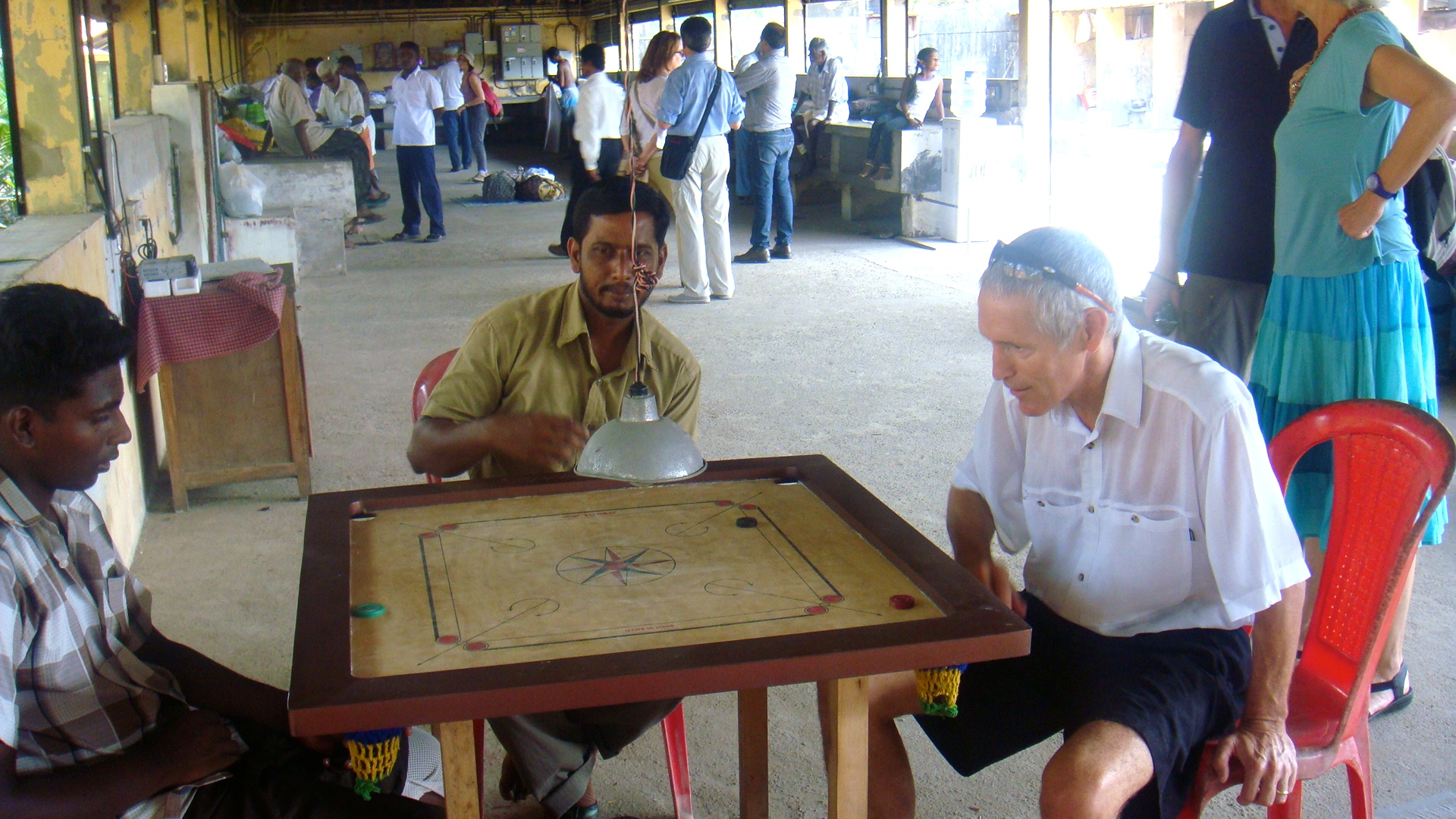
I managed to play a game of Karrom with a couple of locals:
Next stop was the market, this one was really clean – especially compared to the Crawford market in Mumbai:
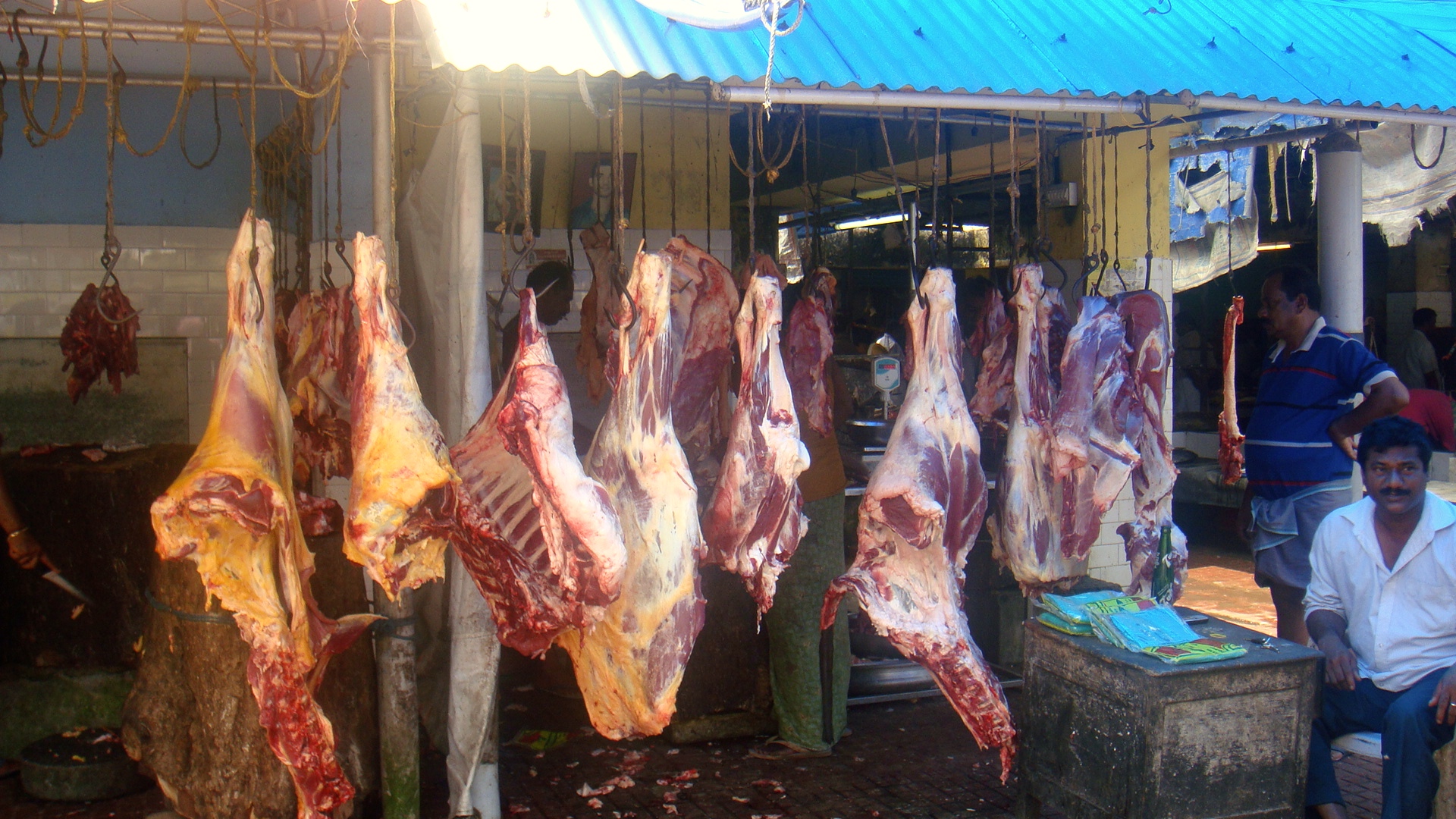
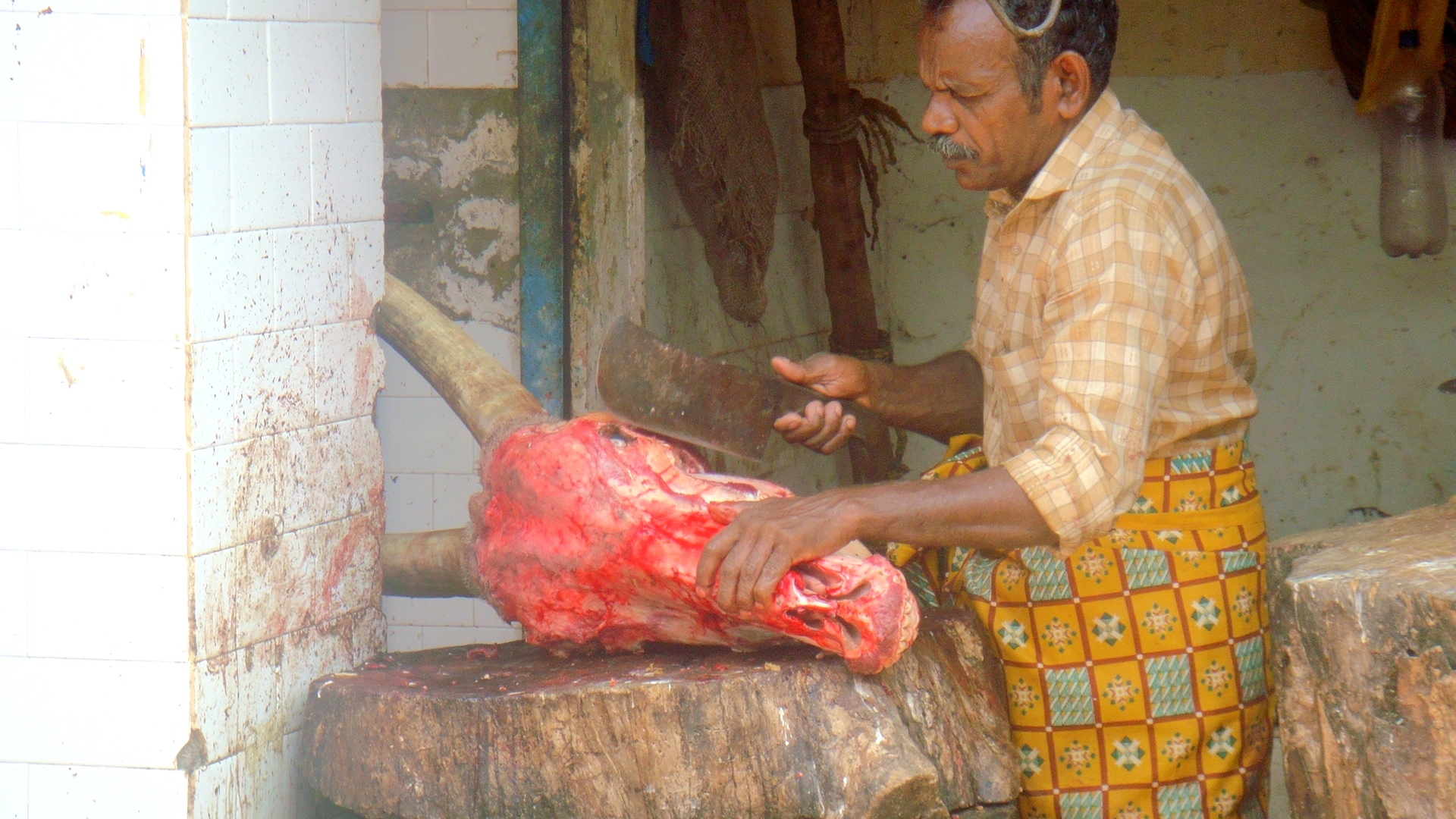
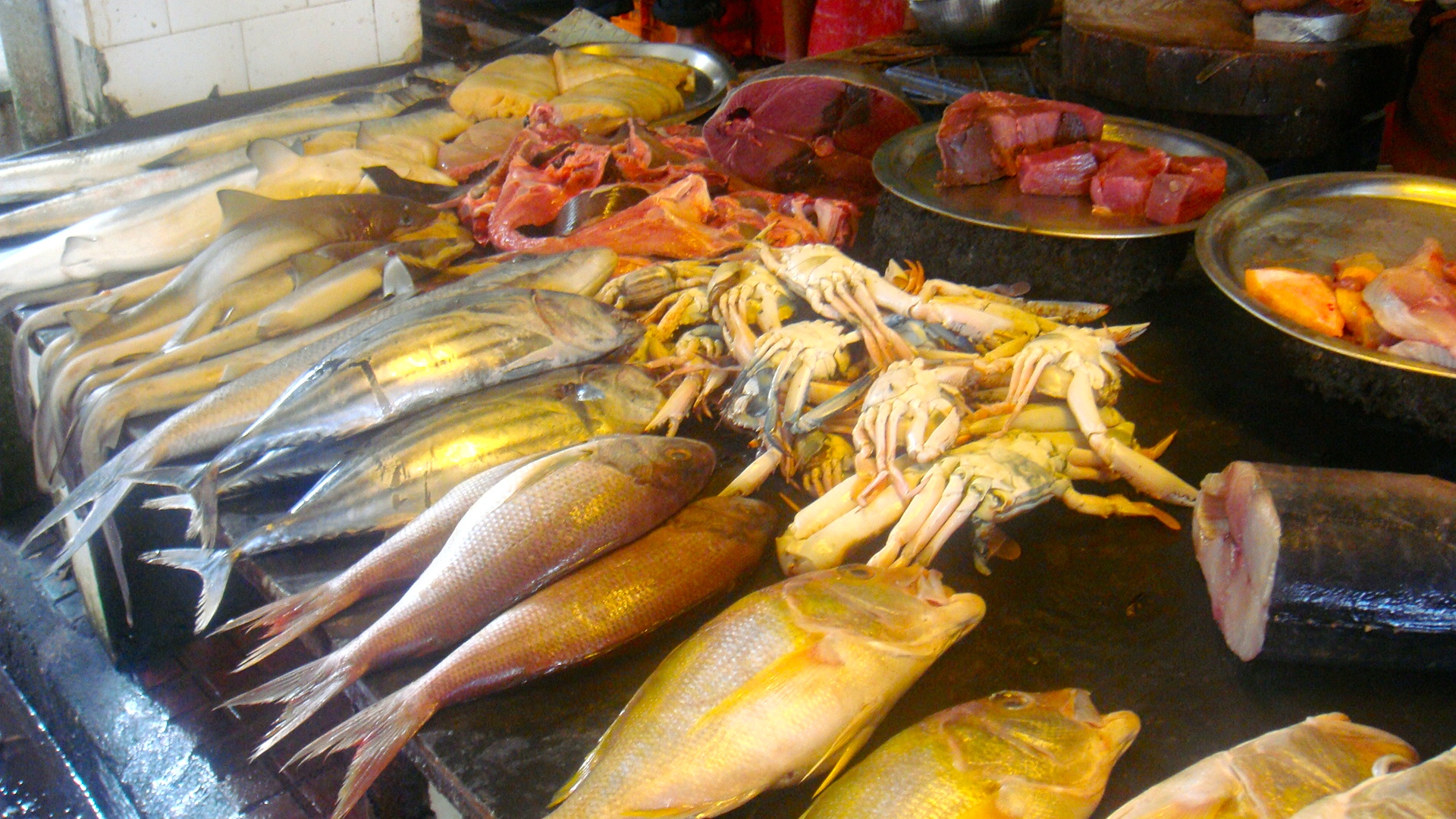
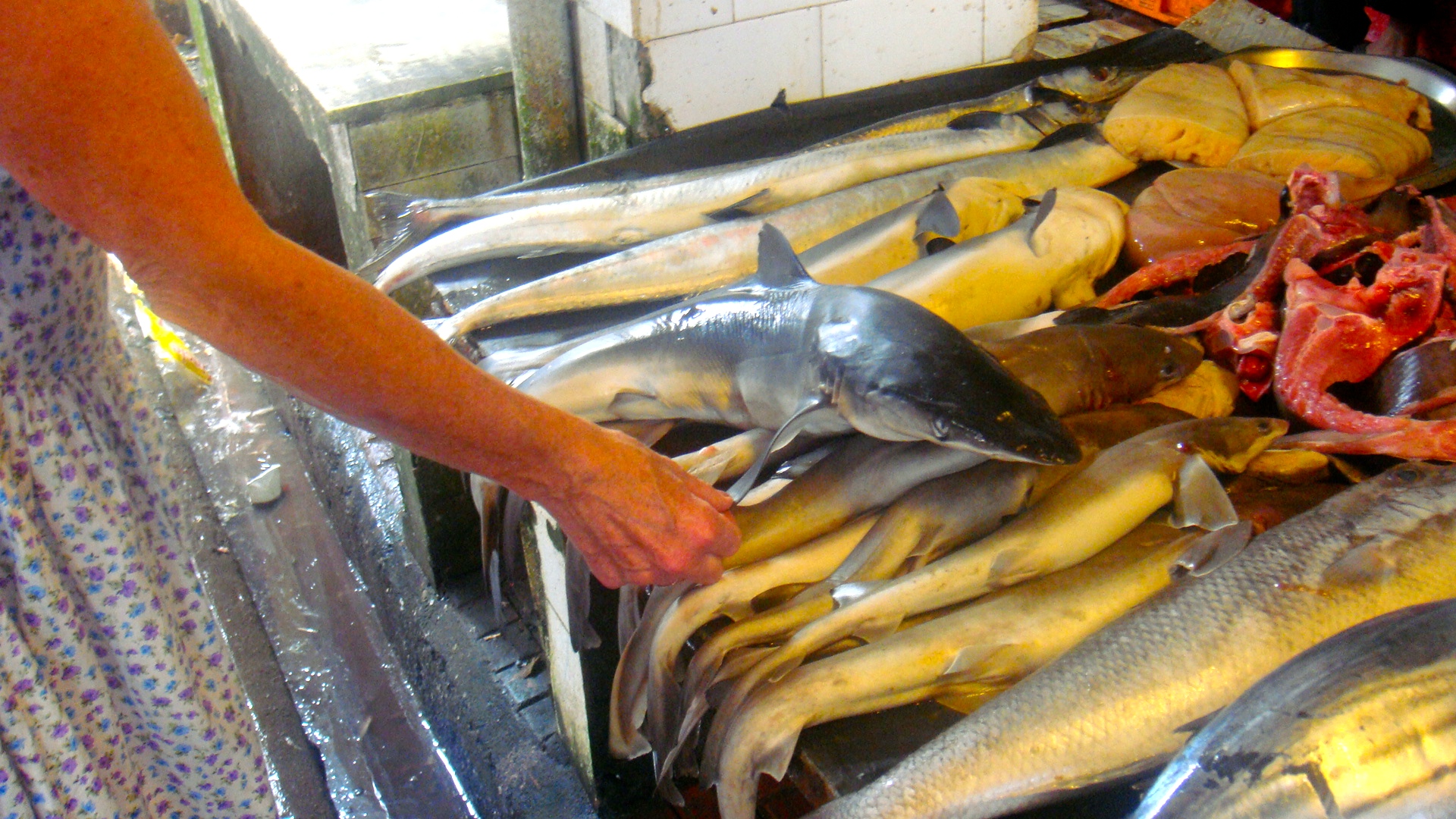
Having just read about a campaign against a butcher in Suffolk by people who objected to his window displays we couldn’t help wondering what they would make of this:

The fish was great too, and really fresh:
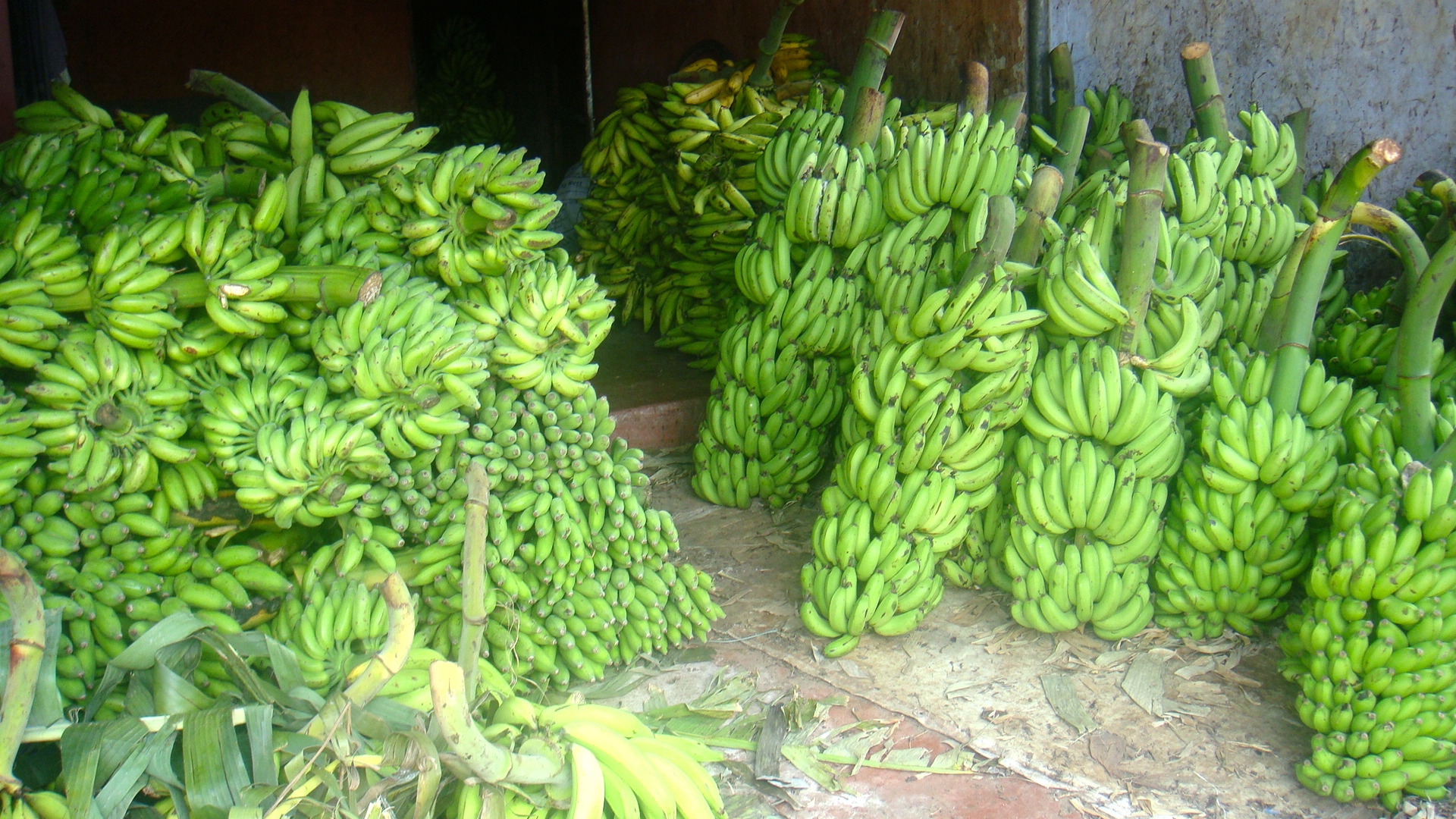
Just a few bananas:
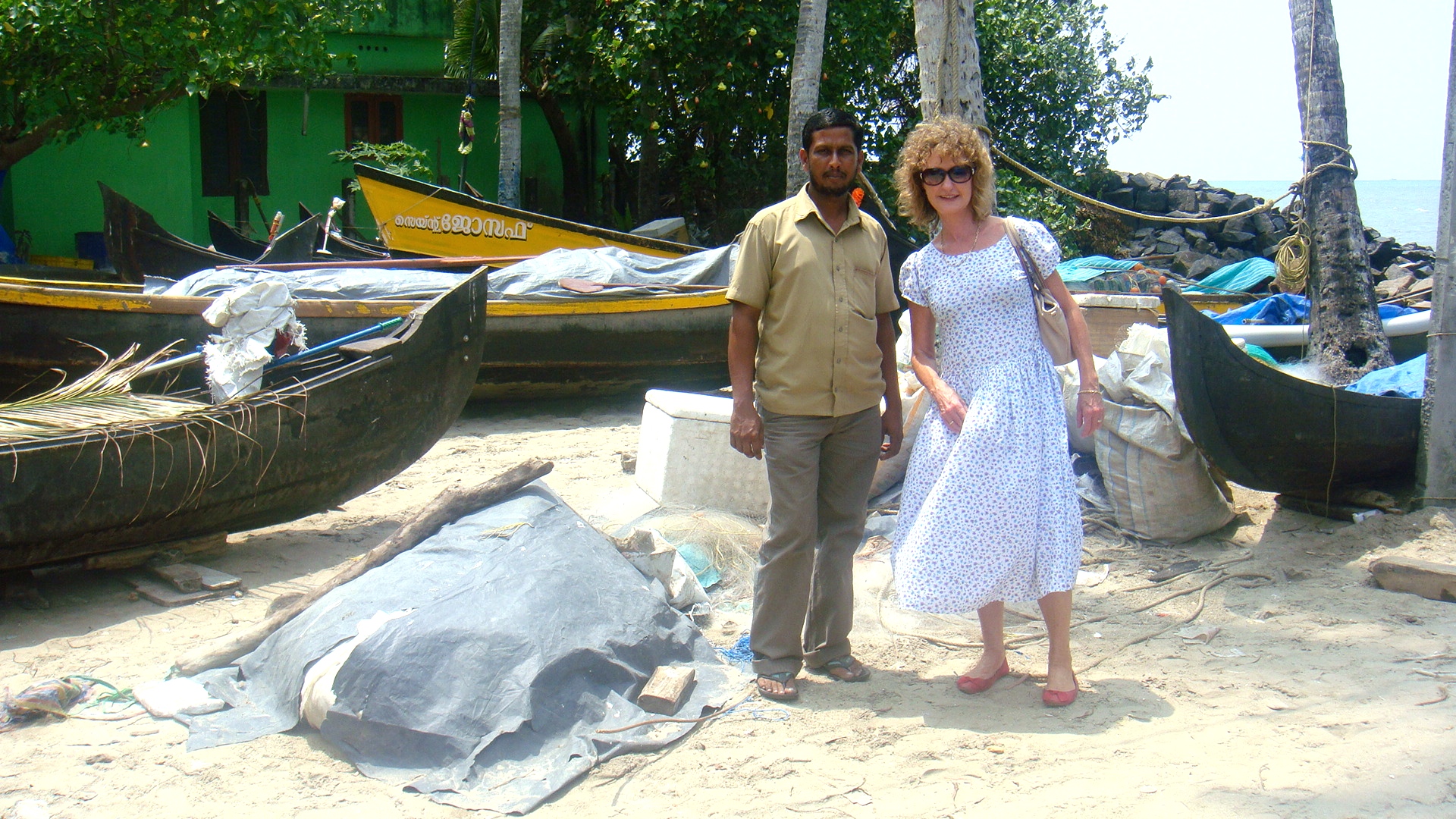
After the market Saleem (our driver), took us to Tsunami beach, so called because it was devastated by the 2004 tsunami which, although centred on Aceh, Indonesia, also hit this part of India. The houses on the beach are no more, just fishing boats left now. Here is Saleem with Leishia on the beach:
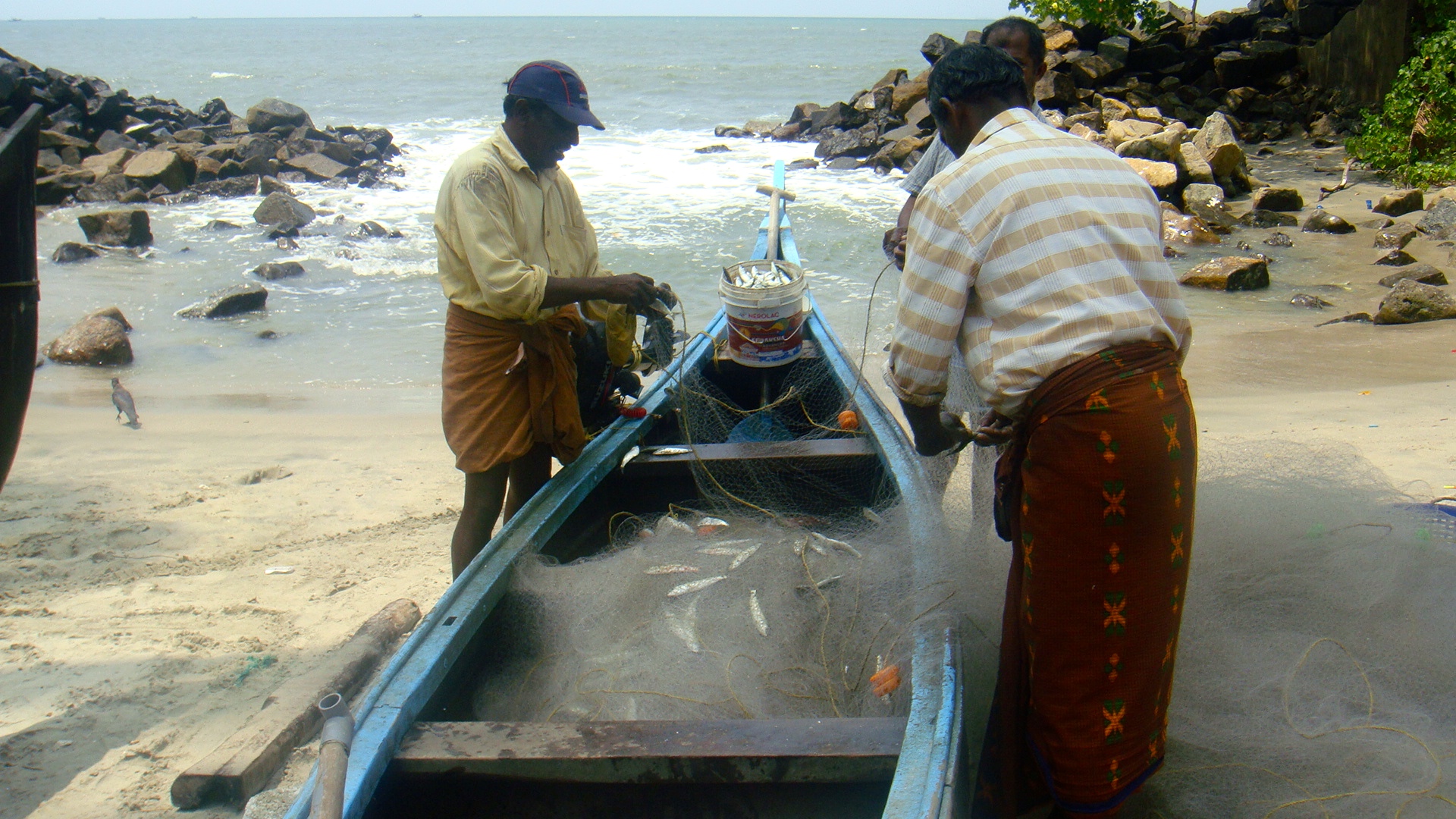 Clearing the nets
Saleem invited us to his house for coffee and to meet his family, this is his daughter Naziya drawing a Henna flower for Leishia:
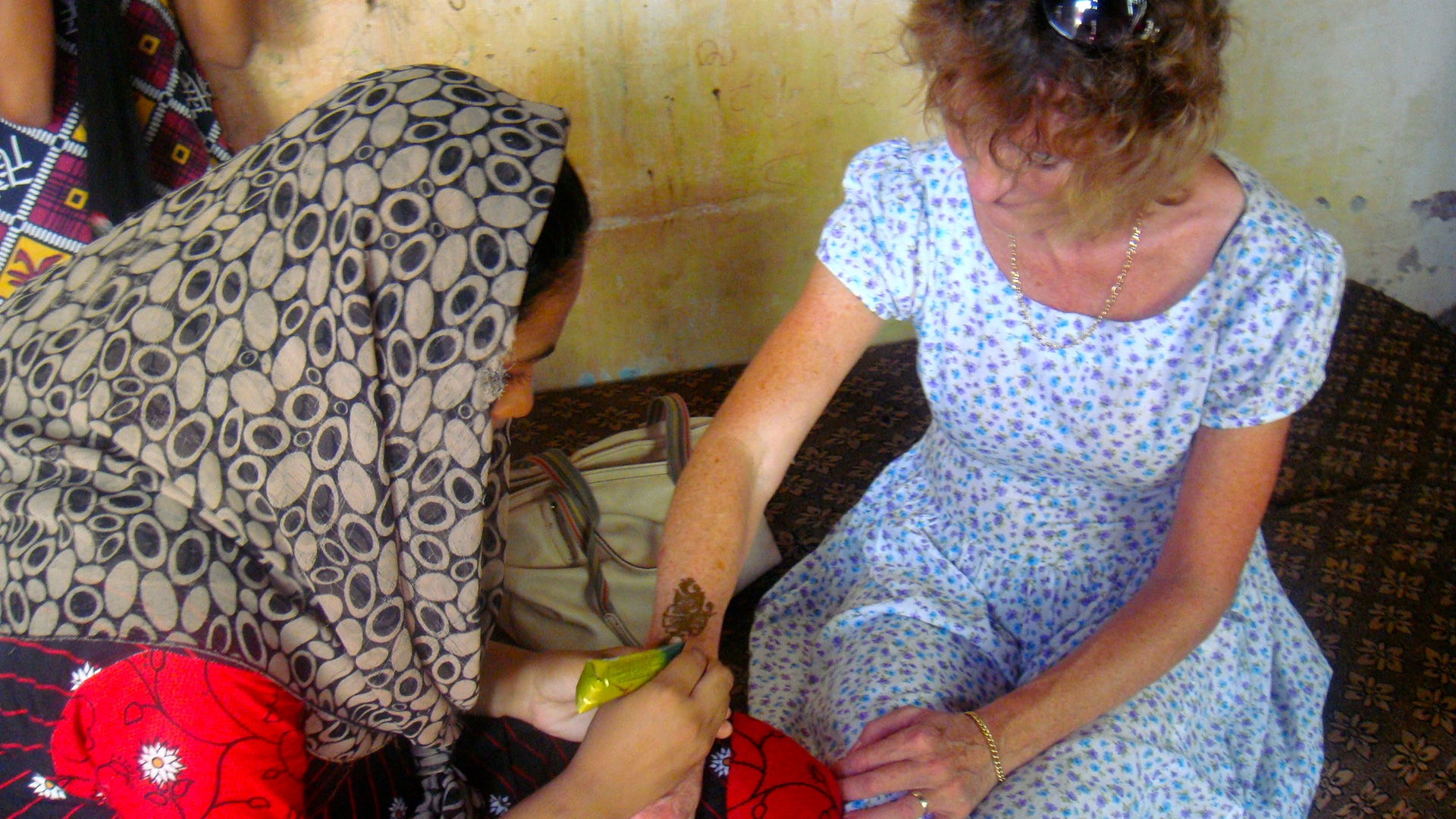
After coffee we went off for more sight-seeing passing this open Muslim funeral hall. Muslims here burn the bodies in full view, very different from the way cremations are conducted in the west:
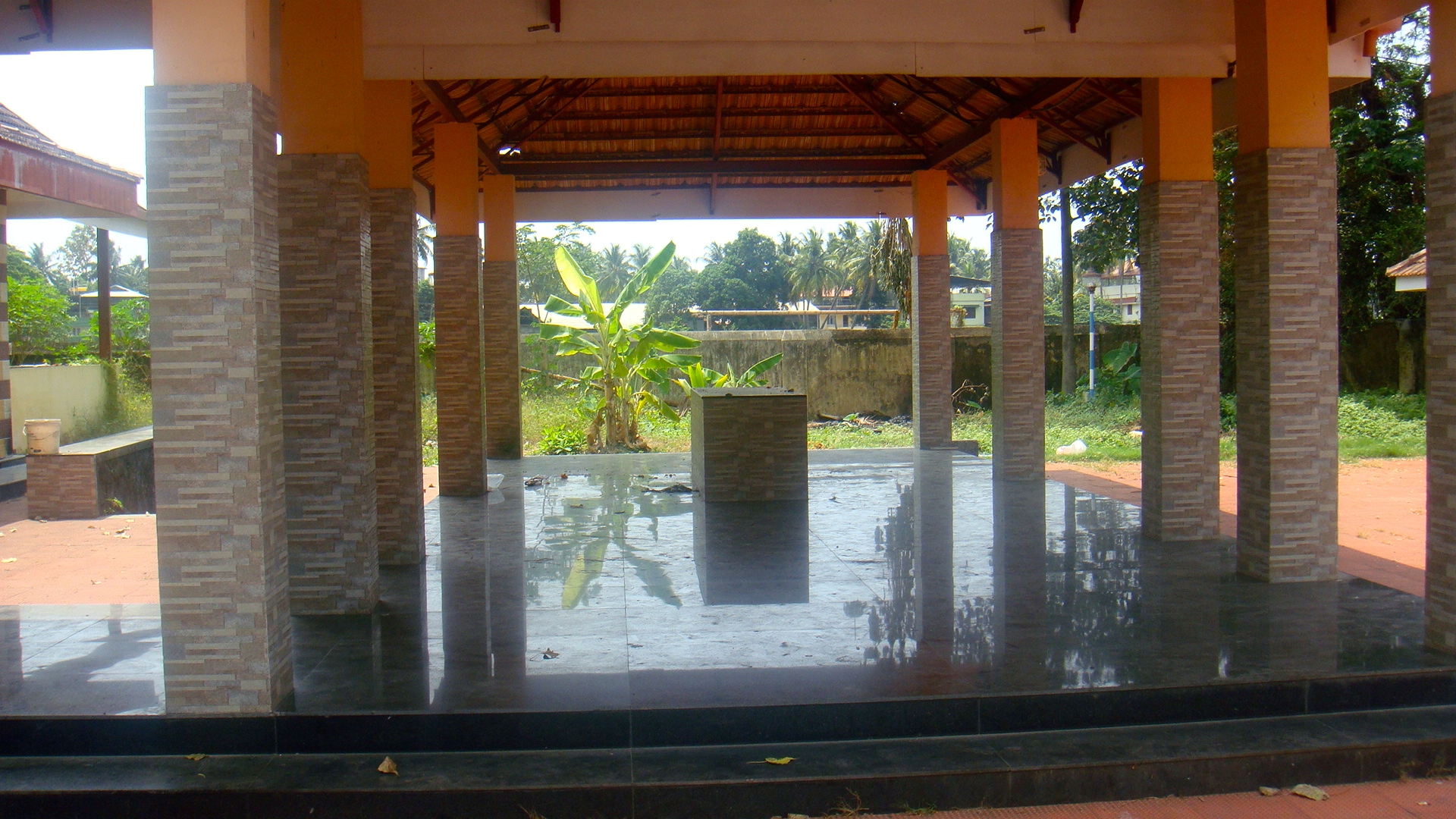
Last stop of the day was to watch people fishing in the river from traditional coracles:
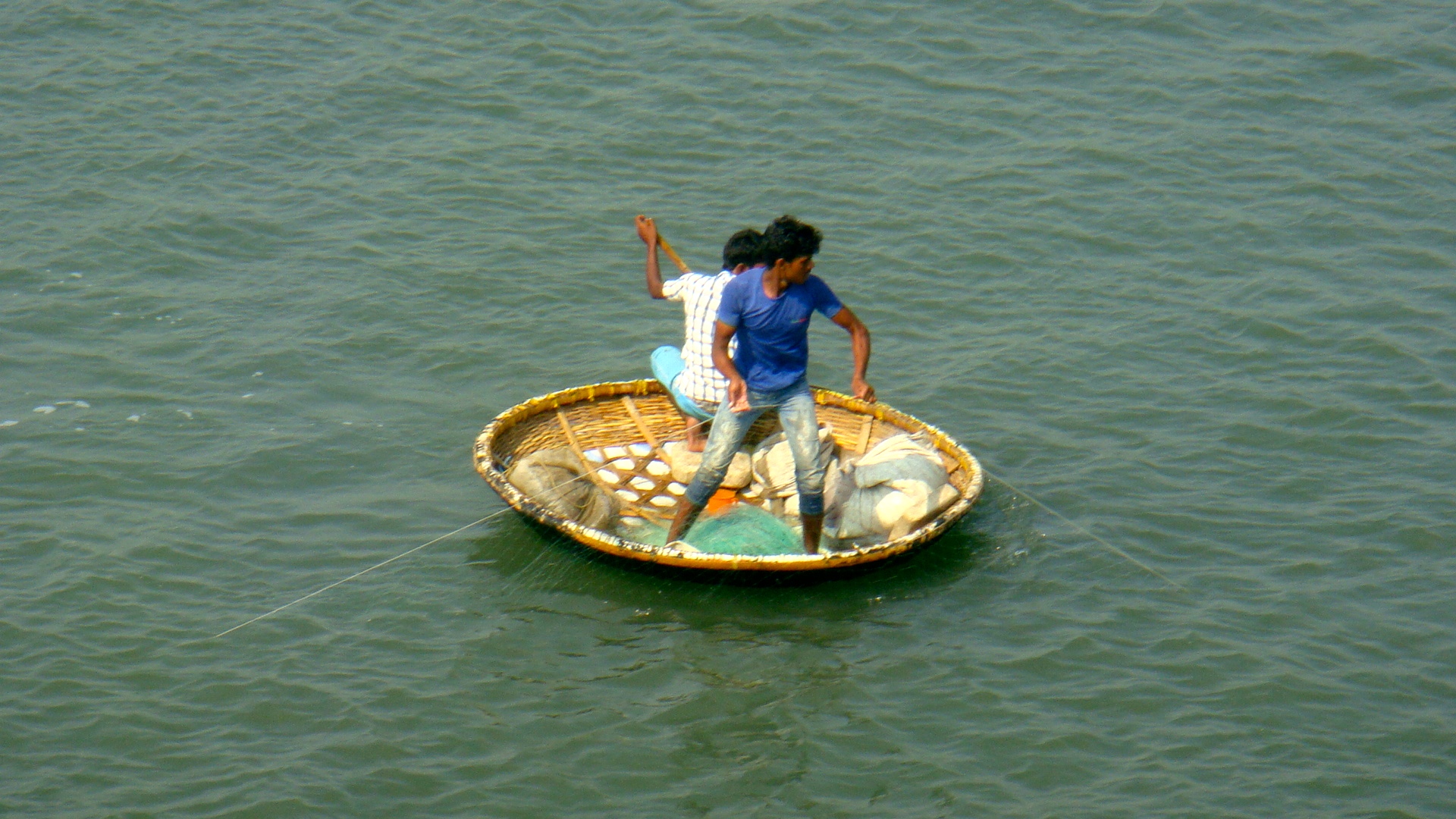
On the way back we went to a couple of craft shops. We weren’t interested in buying anything but every time the driver takes a tourist to one of the more expensive shops he gets something for his efforts. It may be a tee-shirt, a rice voucher, a petrol voucher or a hundred rupees. We’ve even had drivers approach us and ask if they can take us to two or three shops free of charge, sometimes we accept, we go window shopping and they get some fuel!
Here’s Leishia at one of the shops sitting on a bench we both really liked:
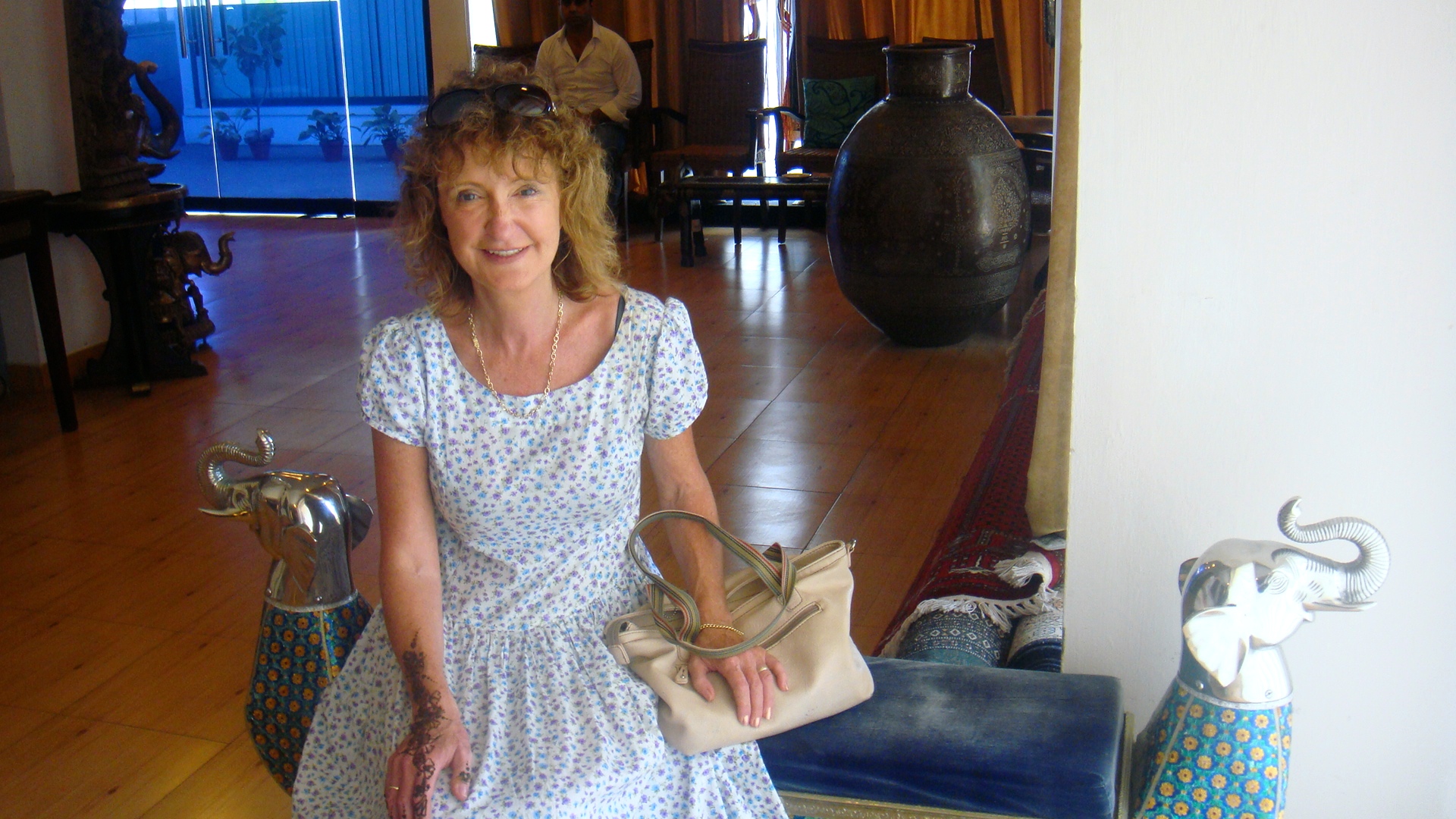
She looks pretty happy there but shortly afterwards a carpet salesman started giving her a load of BS about a carpet. She soaked it up for a while but finally she responded with “Don’t give me that bollocks Sonny!”. I think it was at that point he realised he might not get a sale!
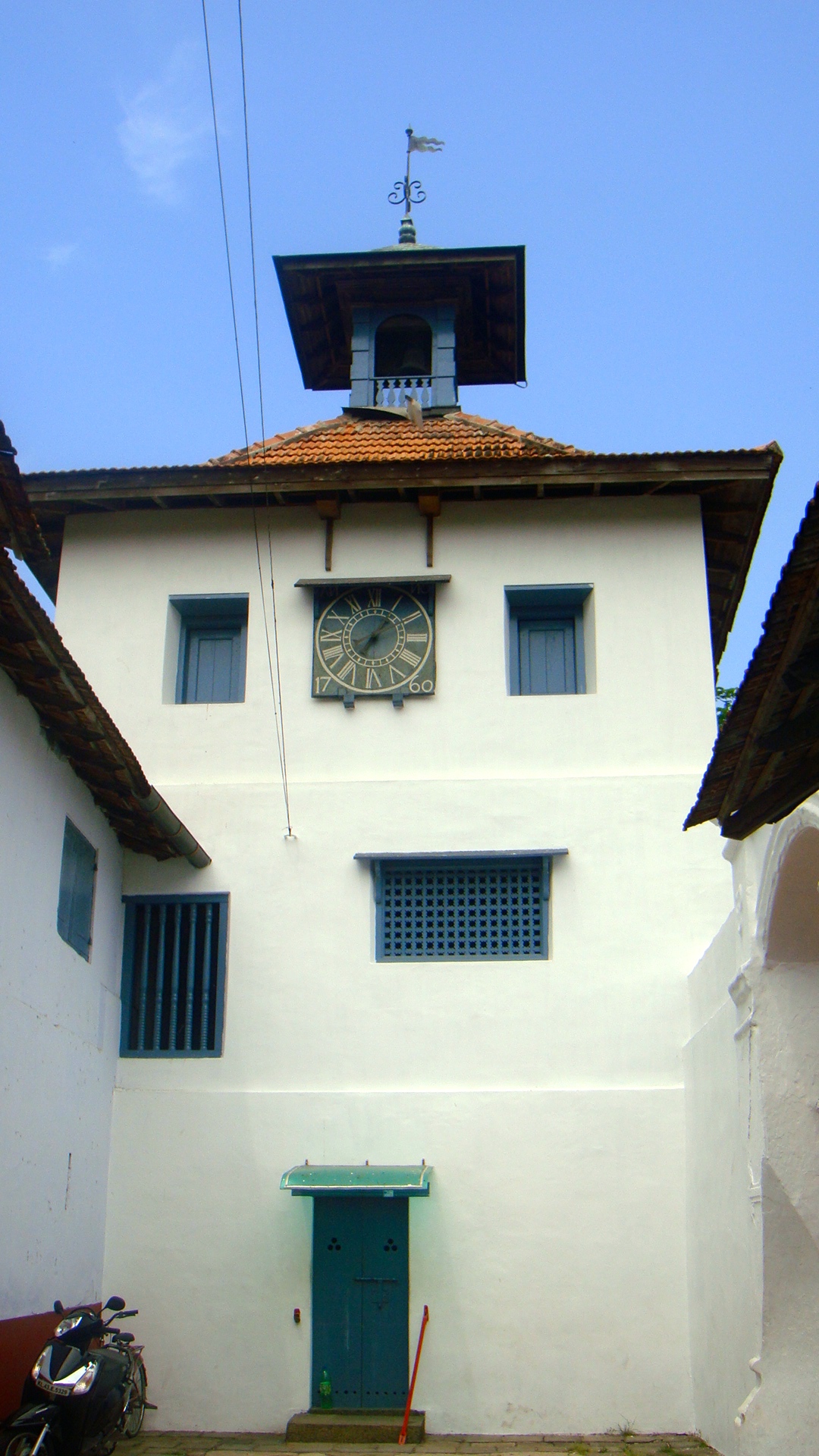
Next morning we went to the Jewish quarter to see the Paradesi synagogue. This synagogue was built in 1568 and is at the heart of one of the oldest Jewish communities in the diaspora with the first settlers possibly arriving as early as the 1st century AD. Unfortunately the synagogue was another place which banned photography so all we managed to get a shot of was the clock tower (added later in 1760):
Then we went to see the Church of St Francis. This church, built between 1500 and 1516 is the first European church ever built in India and is interesting for several reasons. It has been used successively by different religions and orders (originally Franciscan friars). It has changed name from St. Anthony to St. Francis. It has been under Portuguese, Dutch, British and now Indian control. And, in 1524, Vasco da Gama was buried here until his remains were removed to Portugal in 1538. Here’s the empty tomb:

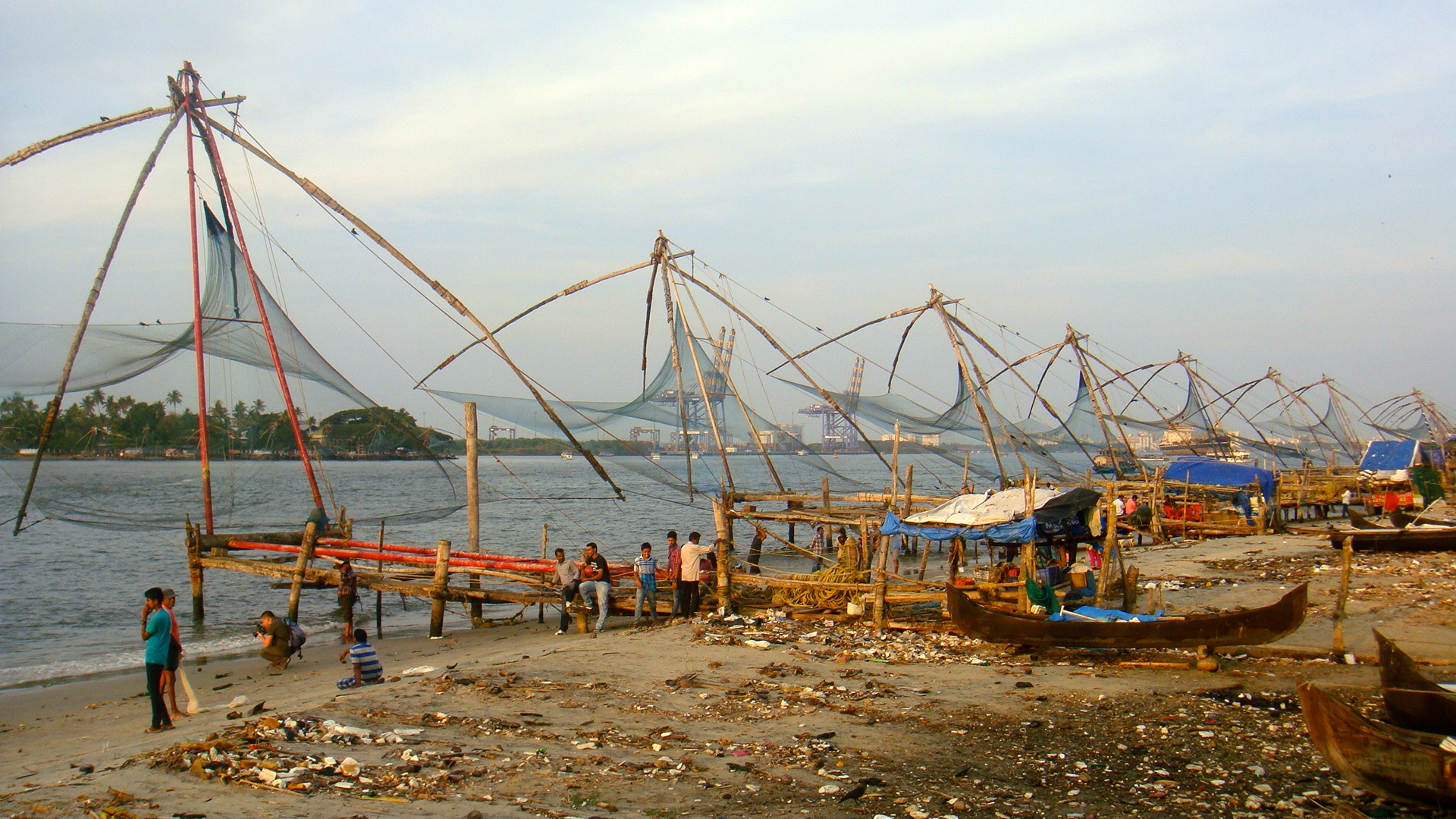
In the evening we went to meet Sue who nursed Samuel (new Grandson) in the weeks after he and Roman were born. She was in India on a cycling holiday and by a stroke of good fortune we were both in Kochin on the same day! We went for a walk along the waterfront to see the fishing nets:
and then had dinner, here are the Ladies:
 Dodgy shot, flash was off, sorry 🙂
And that was Kochin. We thought of Rajahstan as India-lite – Kerala, and Kochin in particular, is India-ultra-lite!
Next stop Ooty back in the wonderful Western Ghats.
Kerala is famous for backwater cruises and Allepey is the town where most of them start from. So we went to Allepey!
Most of the boats have one or two bedrooms, ours had two but we had the boat to ourselves:
 Not our boat but they all look the same!
There are day trips or overnight trips, we decided on an overnight trip with just one night on the water, that was enough to see lots of sights:
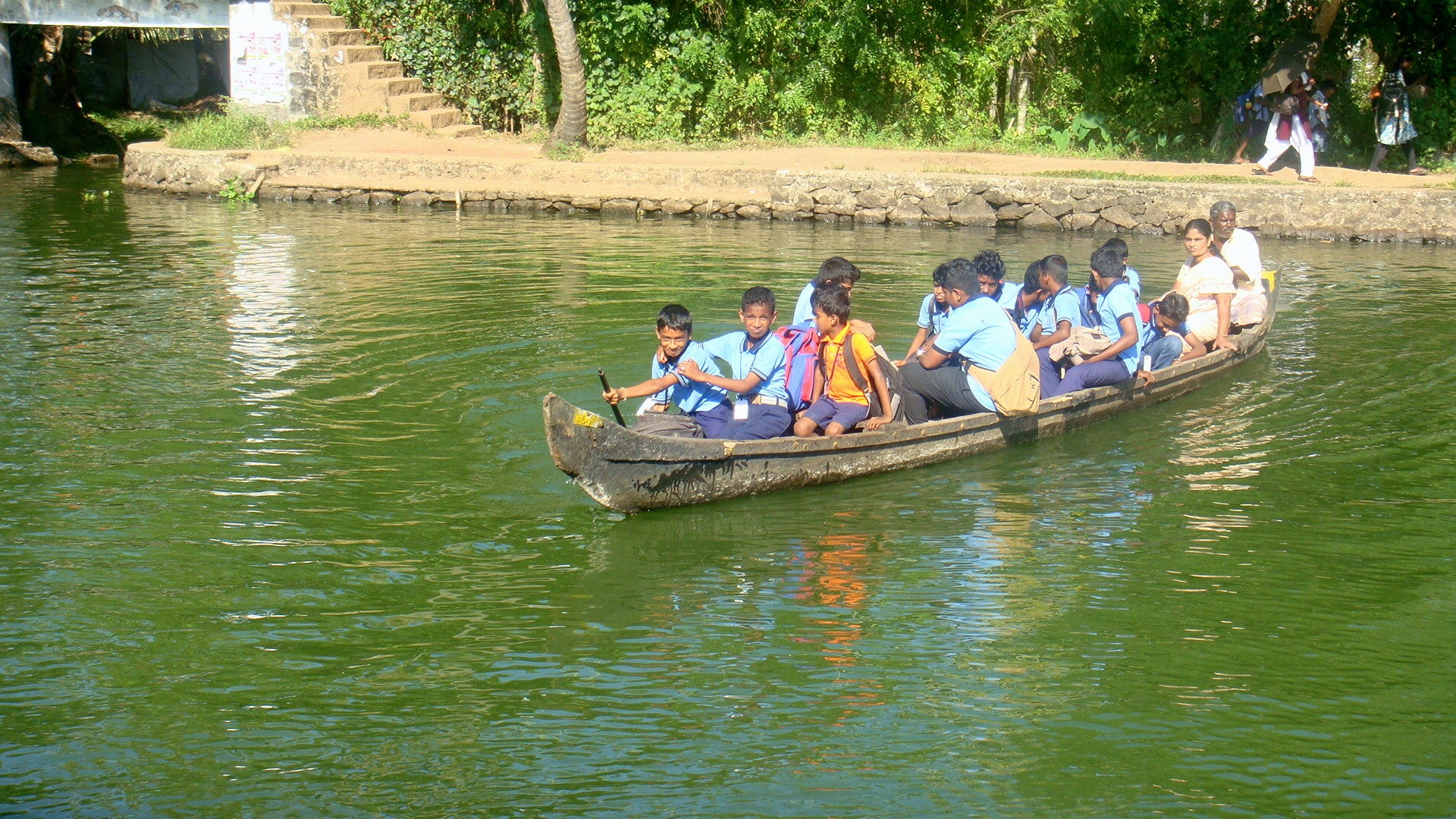 A school boat
 Travelling in comfort
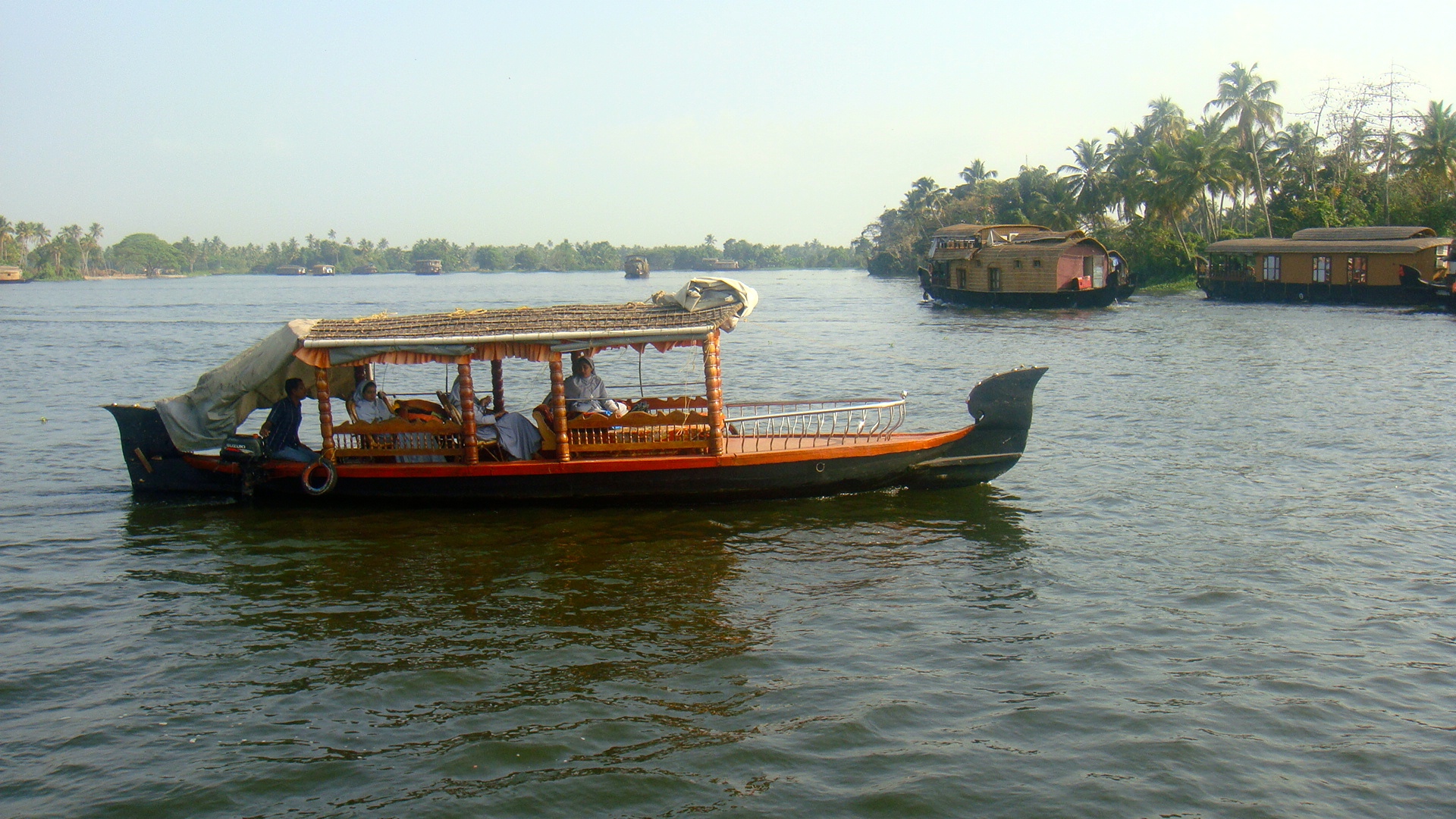
Sometimes the river can be a very scary place:
I was comforted by the sight of a boat full of nuns, with them on the water nothing could possibly go wrong!
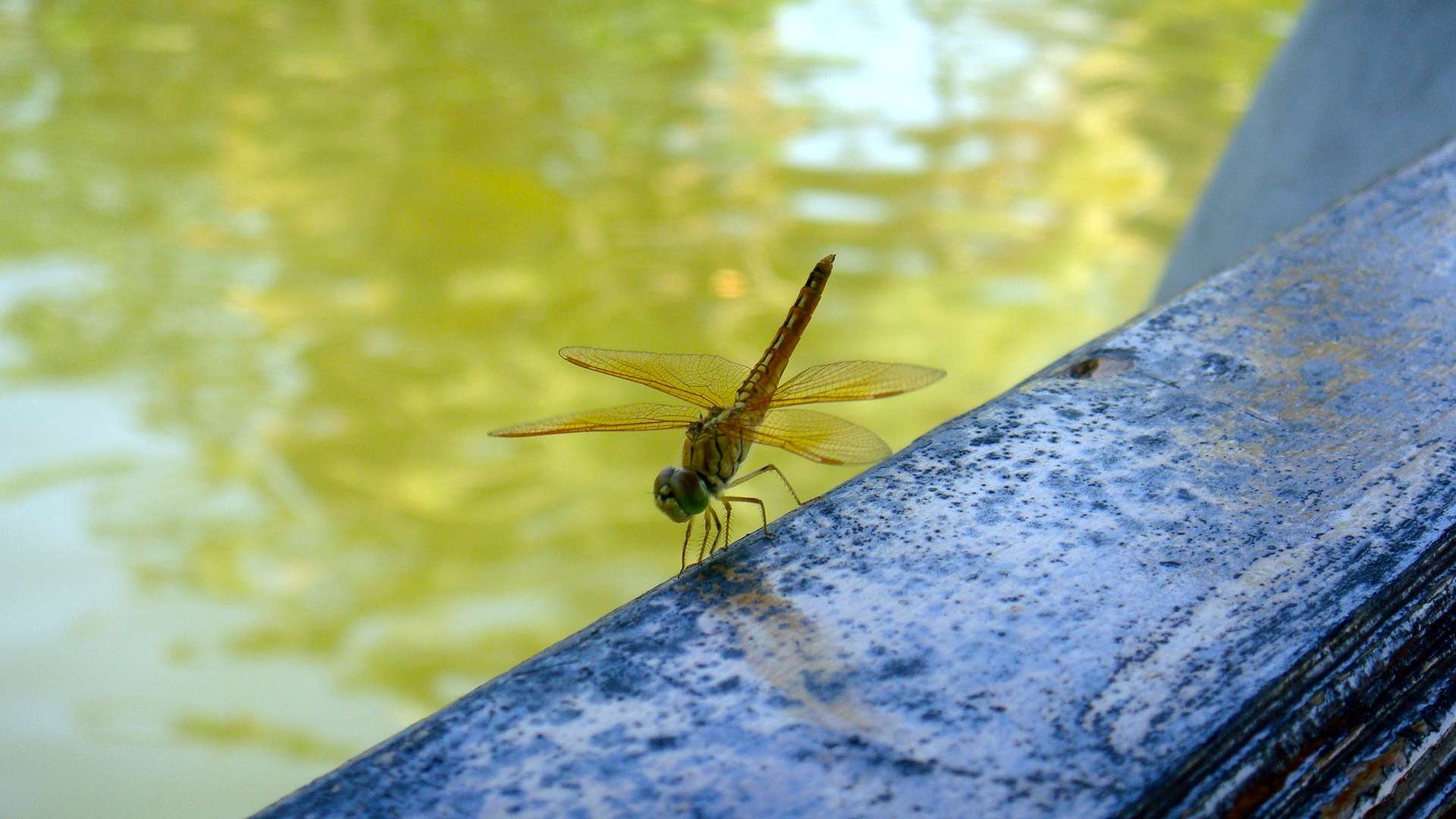
Our house guest for a large part of the trip:
We stopped cruising at 5:30 in the afternoon, our cook went for a swim:

and we went for a walk. This was a very interesting bridge supported on two boats:

We found a little shop and bought a few things, this was the shop, the shopkeeper and her son:
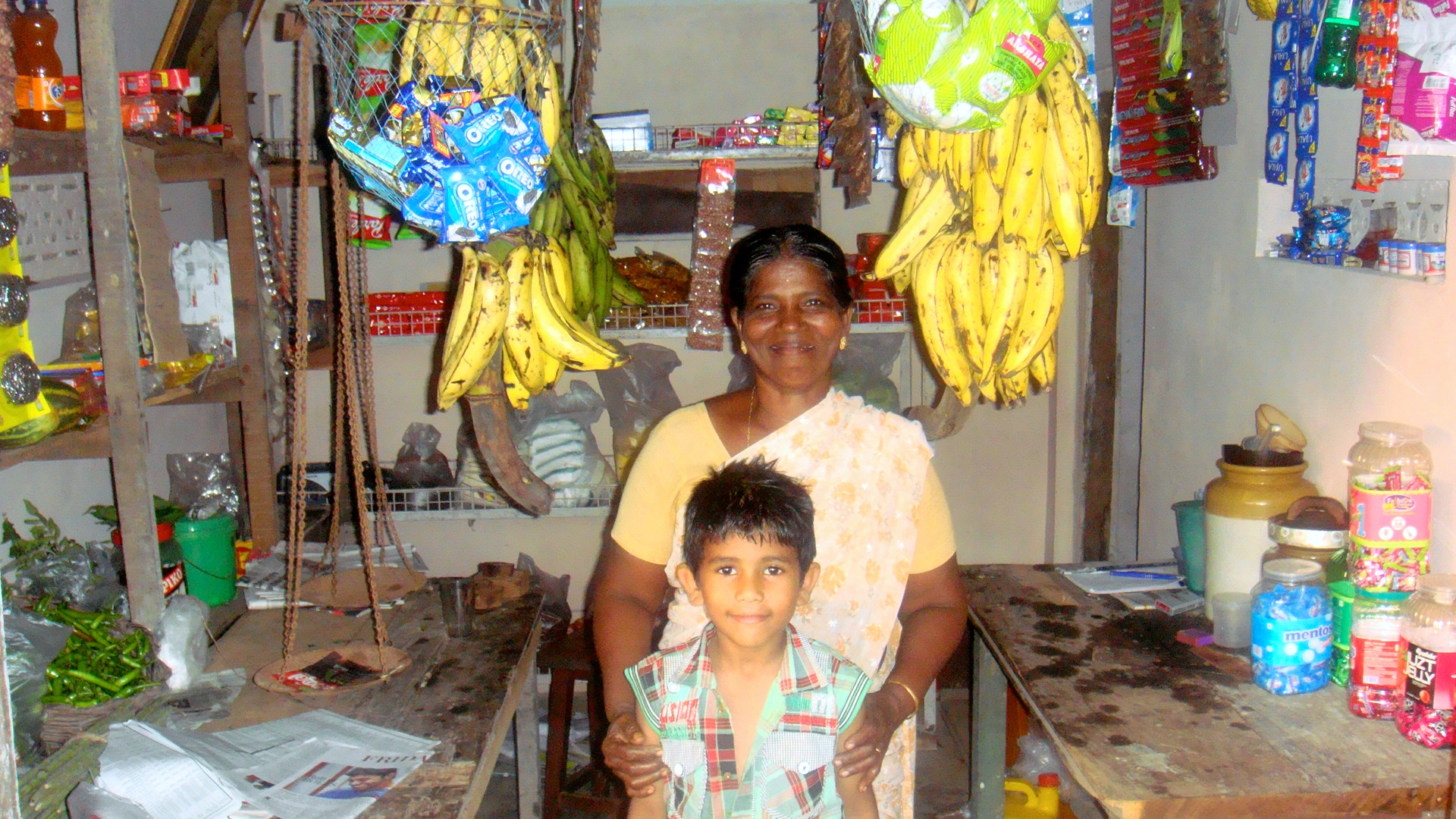
Not much chance of selling her any inventory control software!
We walked on until we reached a local temple where they were holding a twelve day festival, here is Ganesh, the elephant God, dressed for the festivities:

In the morning all the boats converge on Allepey at more or less the same time (9am), the river gets pretty congested:

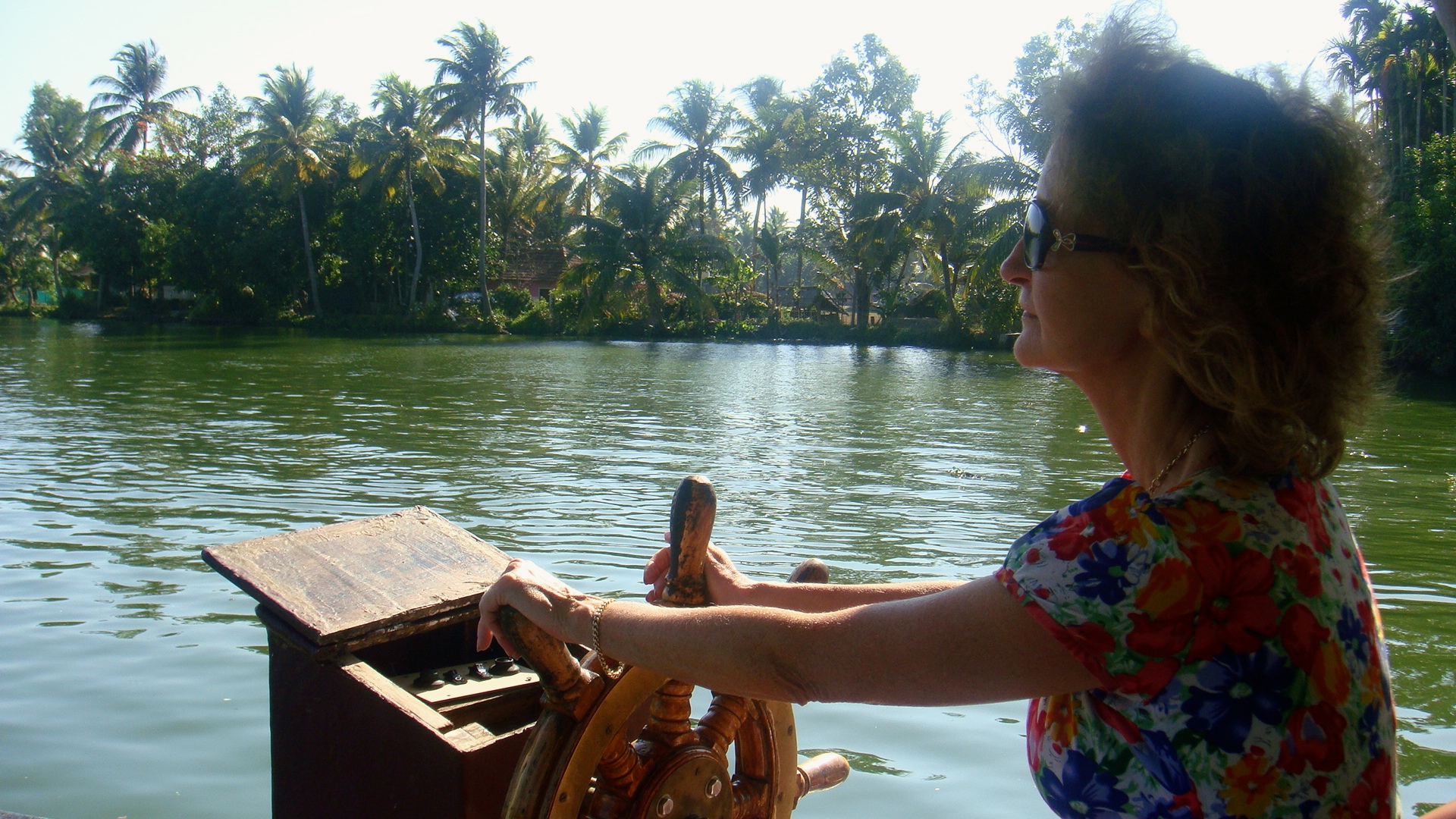
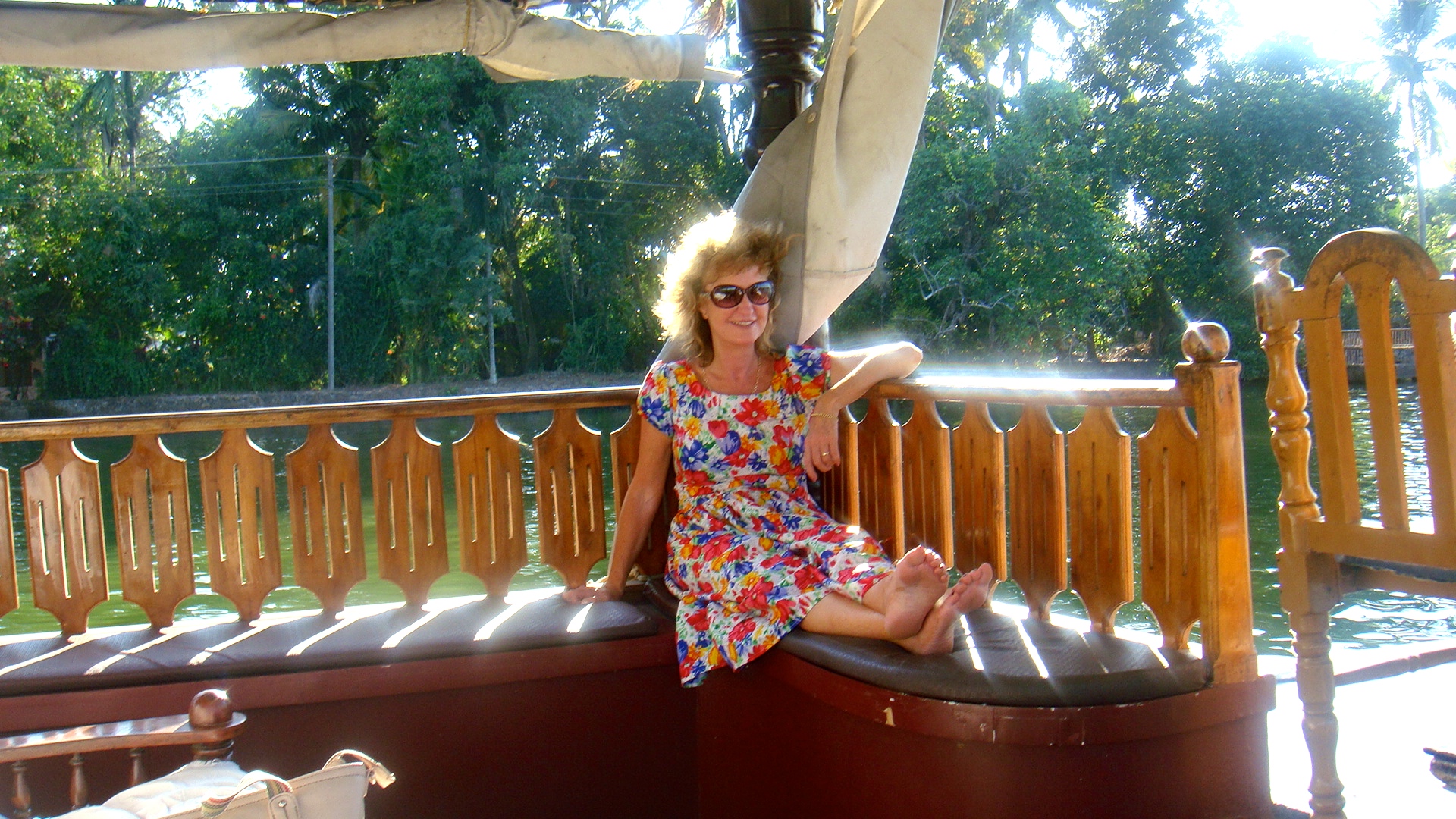
So did Leishia enjoy the trip? You decide:
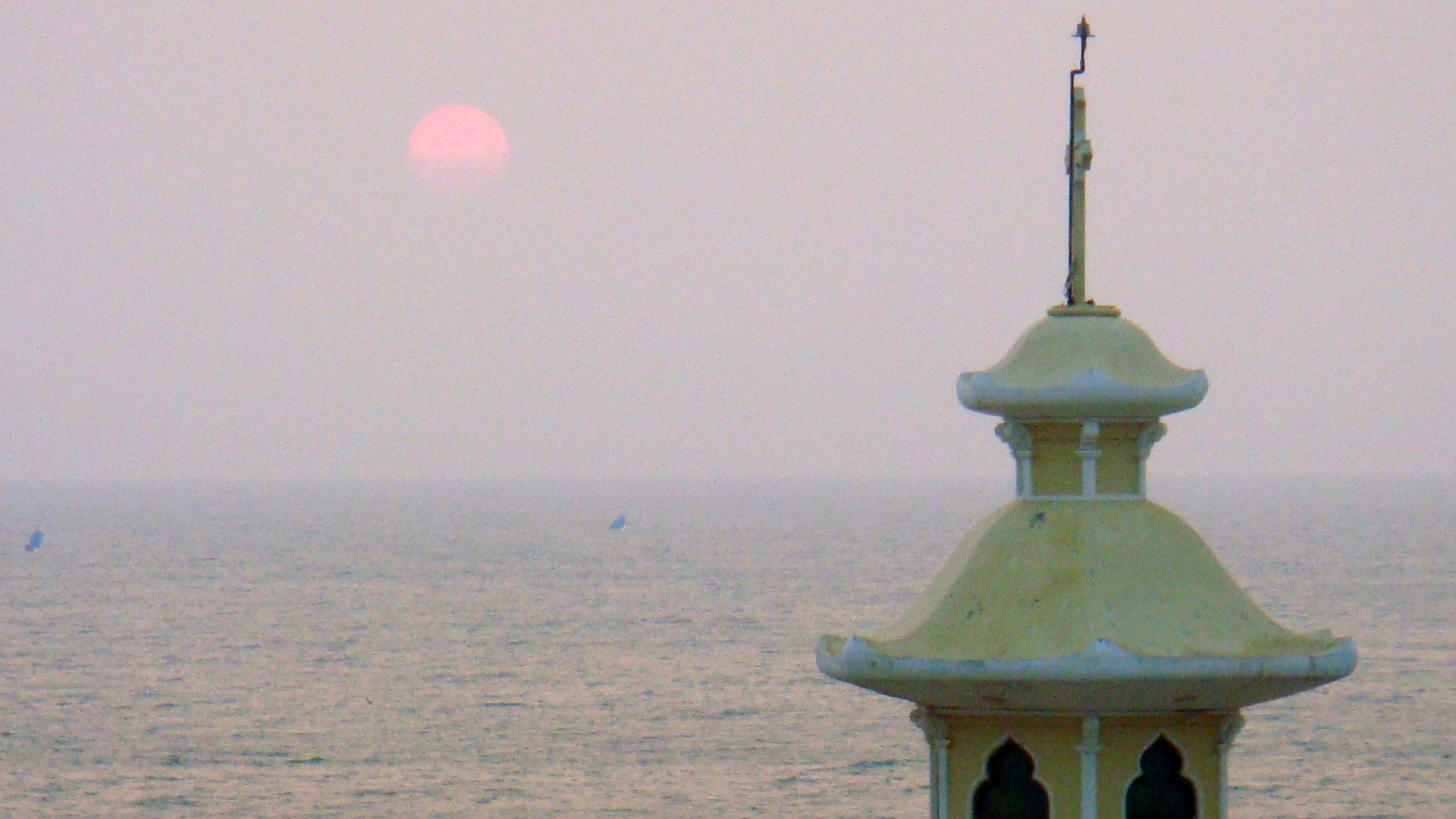
Kanyakumari, the most southerly point of the Indian mainland. We arrived late so we didn’t see much of the town until the morning sunrise. We took this shot from our room:
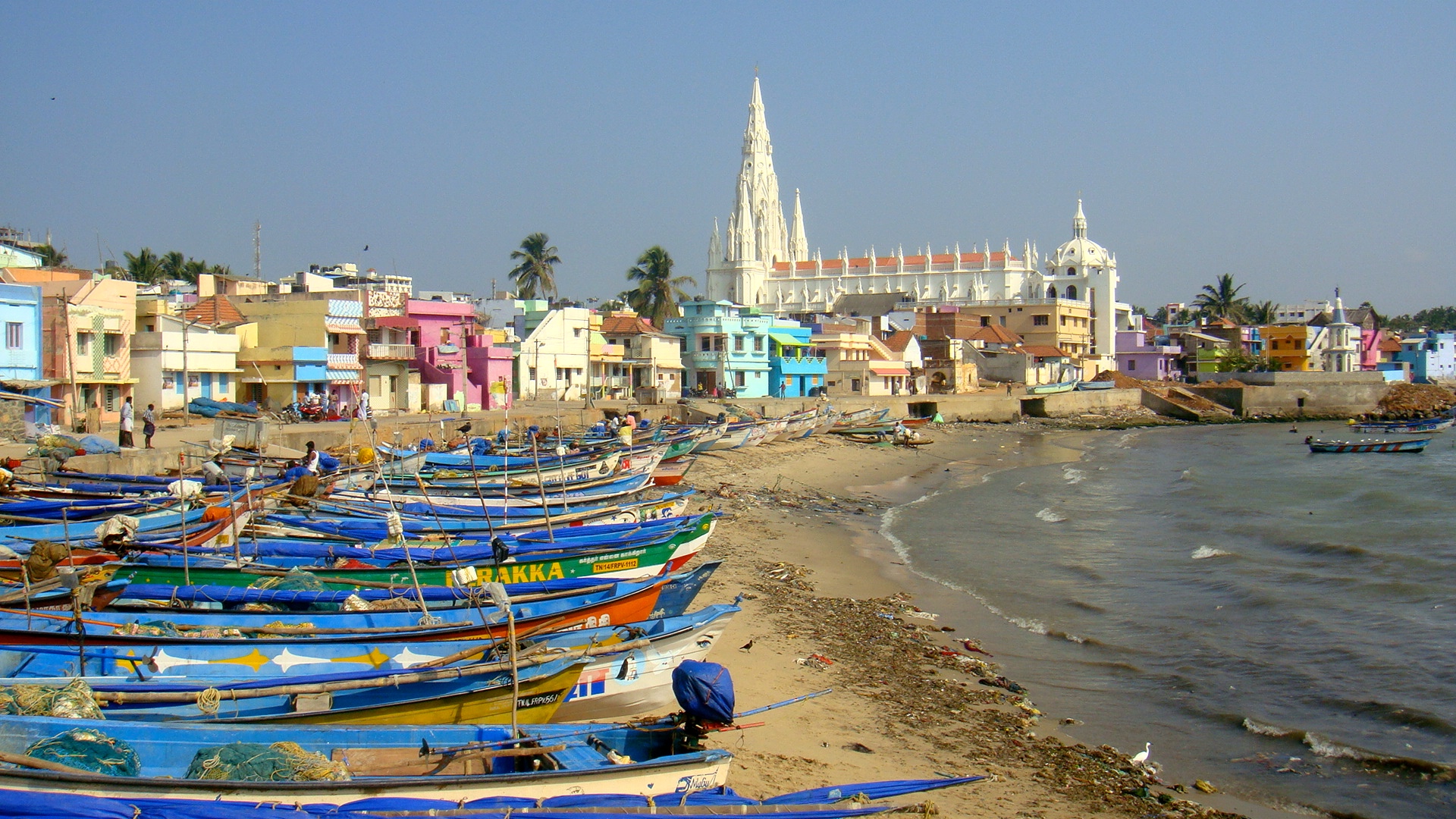
We went out to explore the town and were pleasantly surprised by how pretty it was:
These two islands sit just off the shoreline, the one on the right sports a statue of the poet Thiruvalluvar who was apparently born in Kanyakumari. Surprisingly no-one has any real idea when he was born, dates range from the 1st century BC to the 8th century AD. The statue looks old but was actually opened to the public on January 1st, 2000:

The town is still a working fishing port:

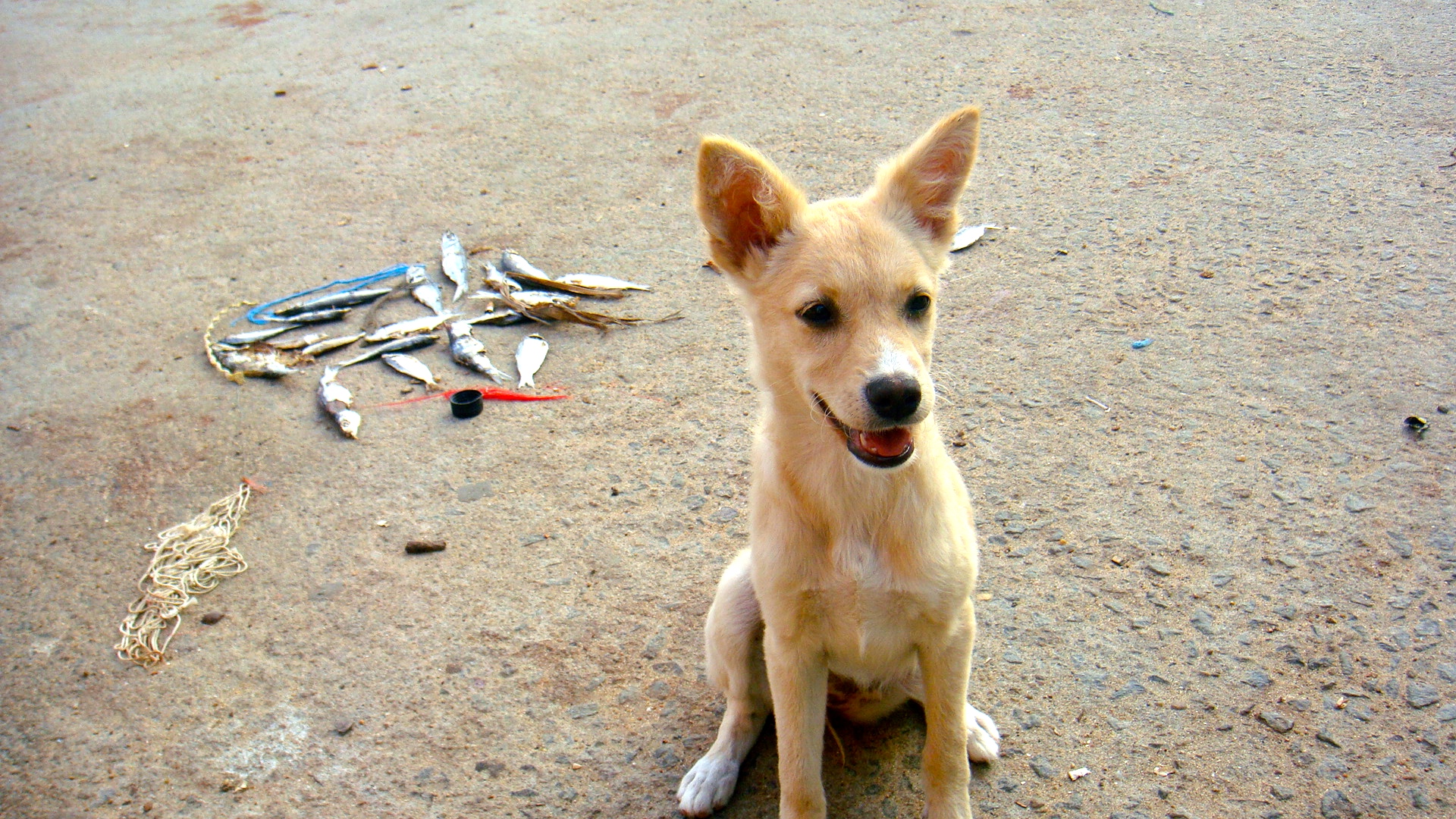
This little dog came running up to us as we were walking along the front, he was a cute little thing desperate for attention:
Several of the houses were really pretty:

as were the local games:
 Sumeet – recognise it?
Except for the game we could easily have been in Cornwall but as we left the coast we were bluntly reminded that we were in India:

The Kanyakumari highlight for us was the temple on the seafront. From the outside it’s a long low building painted with red and white vertical stripes. From the inside it’s a three thousand year old work of art. Beautiful carved stone pillars, fabulous shrines, hundreds of people following their various religious rituals. It was a very calming place. Unfortunately photos were not allowed 😦
Having reached the end of the world we turned north again for Varkala. Along the way (just 13km from Kanyakumari) we stopped at a small town with another splendid temple, the Suchindram temple. This temple had a 40m high entrance way known as a “Gopuram”:

The feel of the temple was just like the one in Kanyakumari, these are living temples full of believers. The last time we saw such constant activity was at the Golden temple in Amritsar. It makes quite a contrast to a visit to an Anglican church!
Next to the temple was a large pool with separate bathing steps for men and women:

The temple attracted lots of people and the people attracted lots of stalls, if you wanted chillies you were in the right place:

After the Suchindram temple we drove on to the Padmanabhapuram Palace near the town of Thuckalay. This palace was built in 1600 and rebuilt in 1750. It is apparently a superb example of traditional Keralan architecture. We just thought it was very welcoming:
 A cluster of rooftops
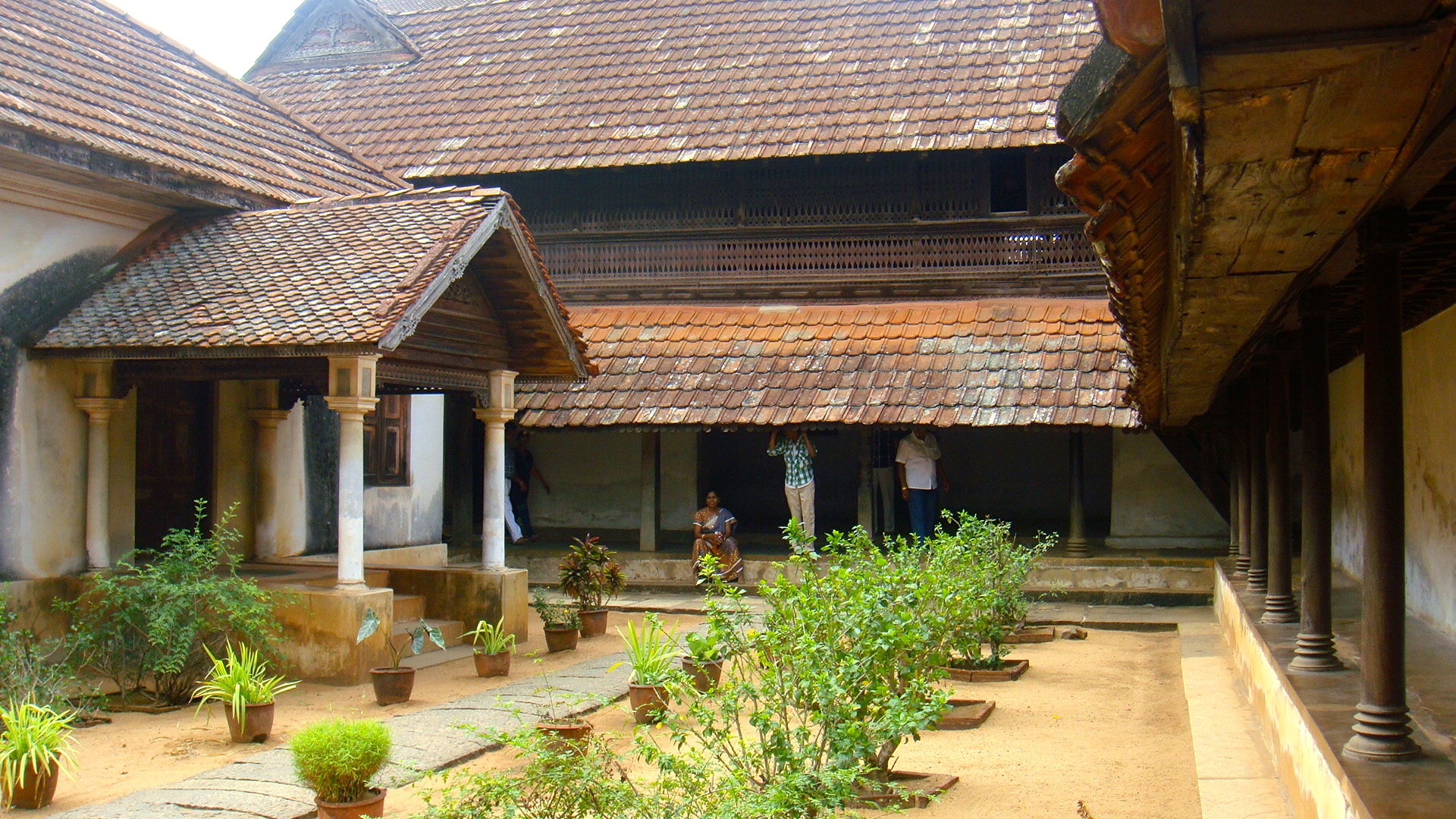 An internal courtyard
 Elephant steps
 The King’s privy
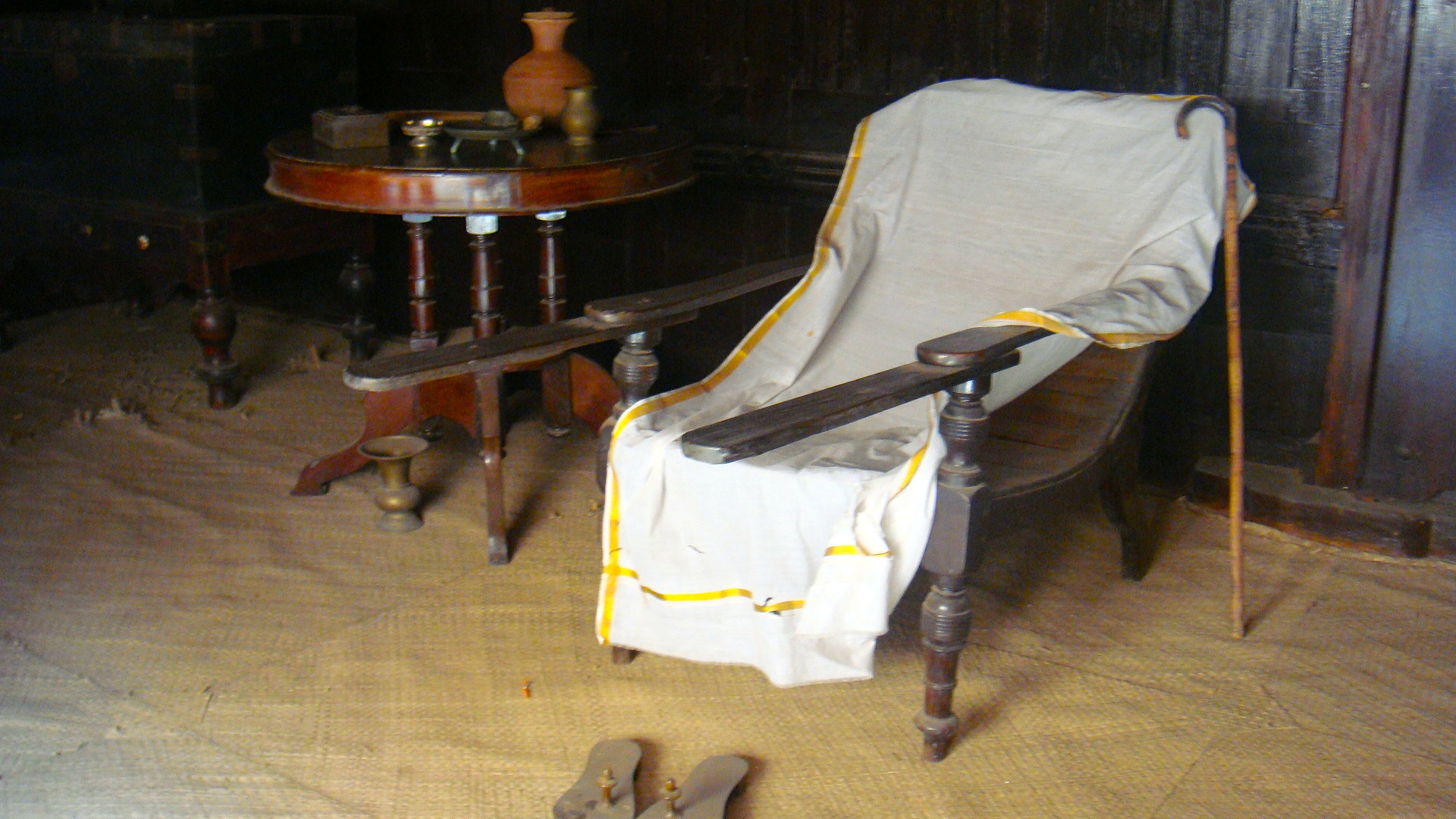 and his reading chair
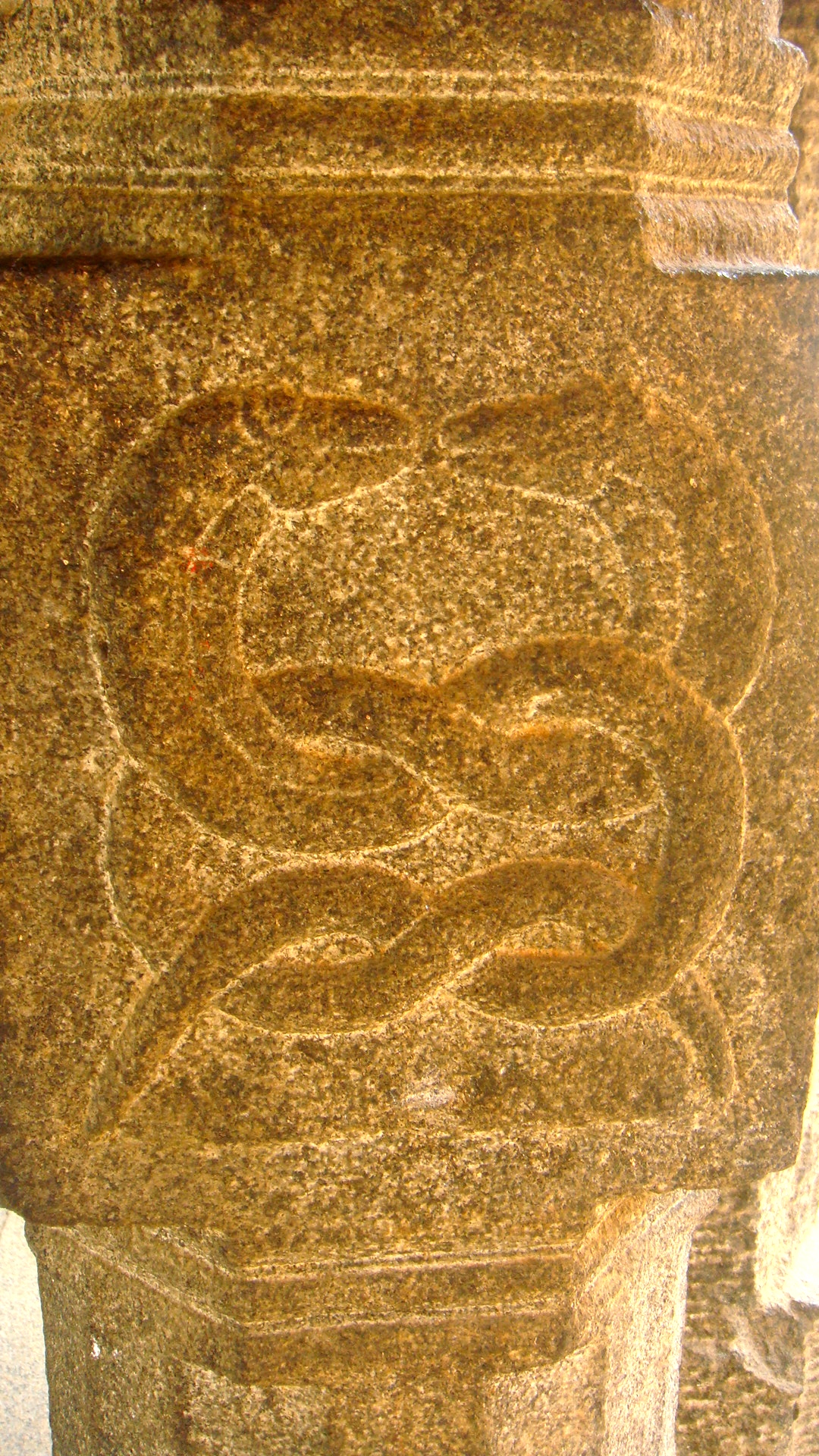 Cobras carved into a stone pillar
 Curved granite slabs
 The kitchen
 The King (found in the garden)
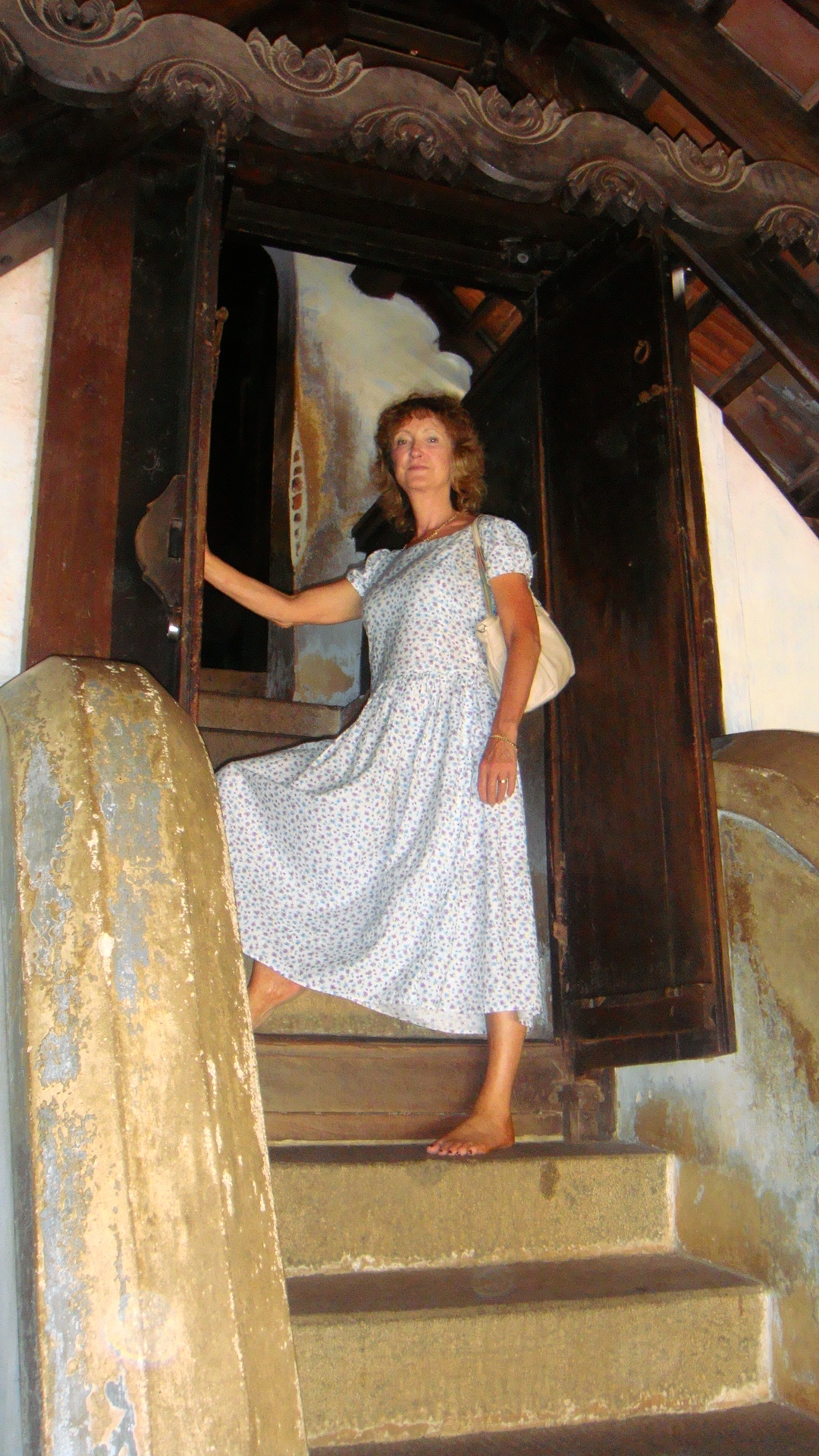 and the Queen!
The palace also housed a museum, there were some really interesting artefacts, this was a suit worn by people who were to receive capital punishment:
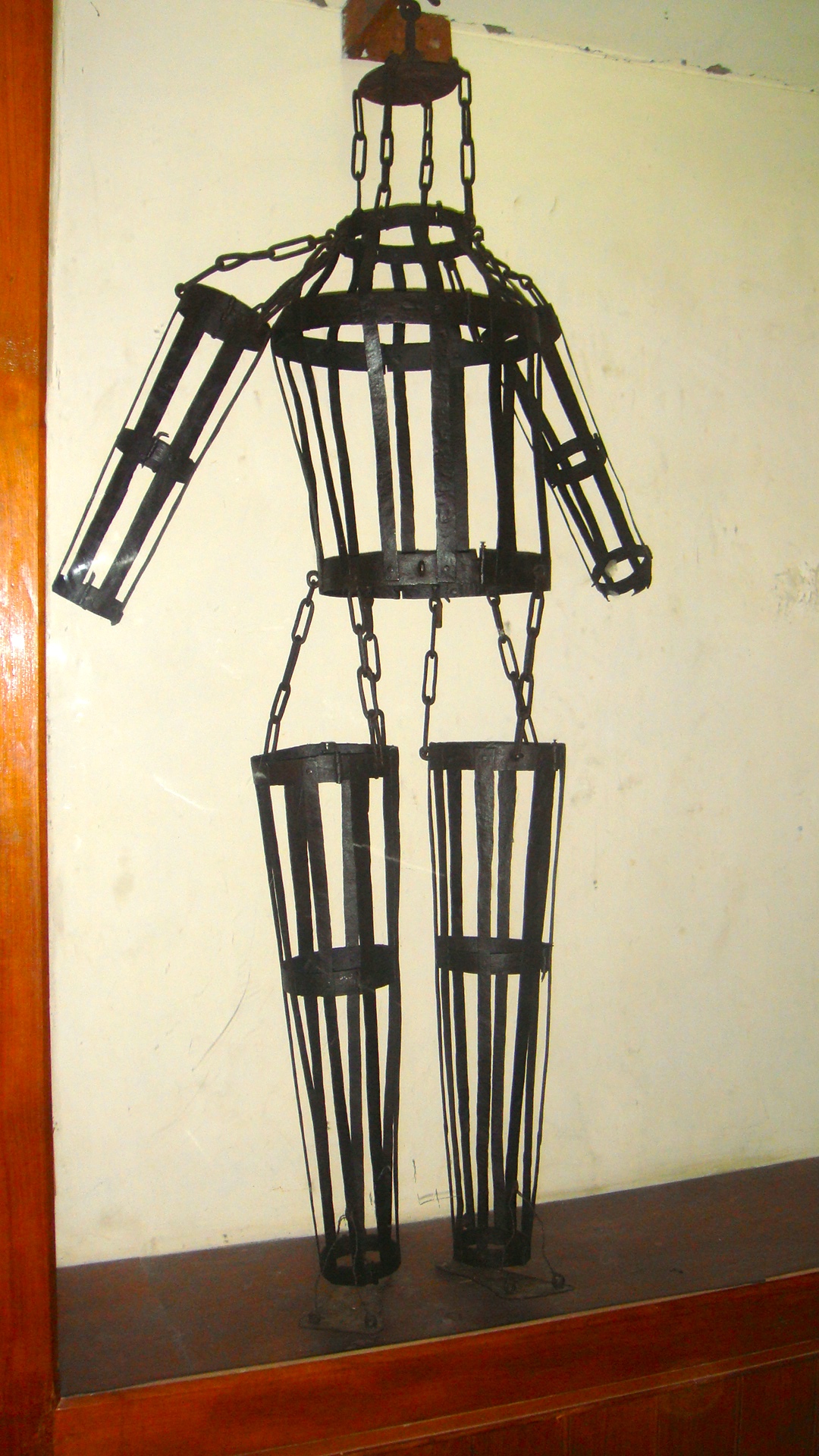
The notes didn’t explain why they had to wear the suit, presumably it was to stop them moving around and spoiling the spectacle.
There were also lots of carved stones each of which proclaimed something, the one below for example recorded the erection of a stone tub for giving drinking water to cows!


Eventually after a solid day of history we reached Varkala, here is the beach by day:

Varkala is big on sun, sea, sand, massages, restaurants, bars, stalls, yoga, and all things ayurvedic. We avoided the yoga and the ayurvedic bits, did the rest, stayed for three very pleasant nights and then left for Allepey – and the houseboats!
 India 2013/14